An integration of Eulers pentagonal partition
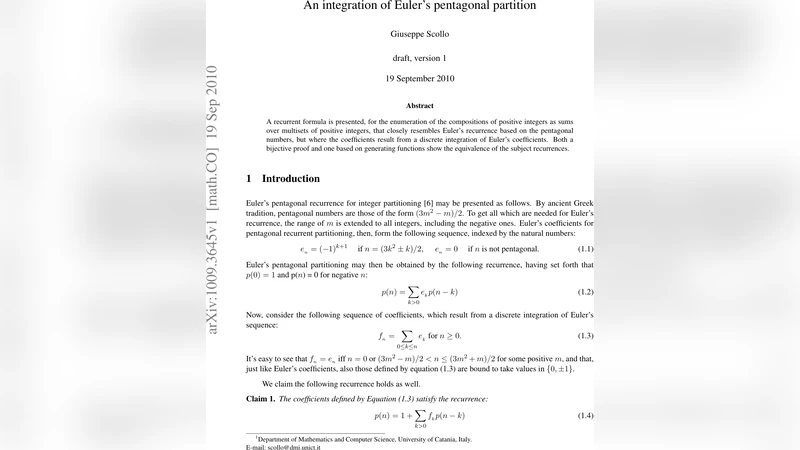
A recurrent formula is presented, for the enumeration of the compositions of positive integers as sums over multisets of positive integers, that closely resembles Euler’s recurrence based on the pentagonal numbers, but where the coefficients result from a discrete integration of Euler’s coefficients. Both a bijective proof and one based on generating functions show the equivalence of the subject recurrences.
💡 Research Summary
The paper revisits Euler’s celebrated pentagonal‑number recurrence for the partition function p(n) and introduces a parallel recurrence that counts the number of ways to write a positive integer n as a sum of a multiset of positive integers, i.e., as an unordered composition with repetitions allowed. The new quantity, denoted a(n), is defined by a(0)=1, a(n<0)=0 and for n≥1 by
a(n)=∑_{m=1}^{n}σ(m)·a(n−m),
where σ(m) is the discrete integral of Euler’s alternating coefficients ε(k)=(-1)^{k‑1}. Explicitly, σ(m)=∑_{k=1}^{m}ε(k) takes only the values 0 or 1 and flips whenever m passes a generalized pentagonal number. In this sense the recurrence looks formally identical to Euler’s, but the coefficients have been “integrated” rather than taken directly.
The authors give two independent proofs of the equivalence between this new recurrence and the classical one. The bijective proof constructs an explicit one‑to‑one correspondence between ordinary partitions of i (counted by p(i)) and multiset‑sum representations of n. By interpreting each part λ_i of a partition as a weight placed at a specific “height” and using the flip points of σ(m) to encode the pentagonal skips, they obtain a bijection that shows a(n)=∑_{i=0}^{n}p(i).
The generating‑function proof starts from the standard partition generating function
P(q)=∑{n≥0}p(n)q^n=∏{k≥1}(1−q^k)^{-1}
and defines A(q)=∑_{n≥0}a(n)q^n. Using the definition of σ(m) one derives the functional equation
(1−q)A(q)=∑_{m≥1}σ(m)q^m A(q).
Because ∑_{m≥1}σ(m)q^m = q/(1−q) – the series that records the cumulative Euler signs – the equation simplifies to
A(q)=P(q)/(1−q).
Expanding this identity yields the closed form a(n)=∑_{i=0}^{n}p(i), confirming that a(n) is precisely the cumulative sum of partition numbers. Consequently the new recurrence is not a novel counting sequence but a reformulation of the cumulative partition function, and the “integrated” coefficients σ(m) encode exactly the same combinatorial information as Euler’s original alternating signs.
The paper’s contributions are threefold. First, it demonstrates that integrating Euler’s coefficients yields a natural recurrence for a different, yet closely related, combinatorial object. Second, it provides two rigorous, conceptually distinct proofs—one bijective, one analytic—of the equivalence between the integrated recurrence and the classical pentagonal recurrence. Third, it uncovers the simple relationship a(n)=∑_{i=0}^{n}p(i), giving a clear combinatorial interpretation: counting unordered multisets of summands is equivalent to counting all partitions of all integers up to n.
Beyond the immediate result, the authors suggest that the discrete‑integration technique could be applied to other partition‑type recurrences, such as restricted partitions, colored partitions, or multipartite generalizations, potentially leading to new identities and combinatorial insights. In summary, the work bridges Euler’s pentagonal framework with multiset‑sum compositions, enriching the toolbox of integer‑partition theory and offering a fresh perspective on how classic generating‑function identities can be transformed through elementary discrete calculus.
Comments & Academic Discussion
Loading comments...
Leave a Comment