Quantum One-Way Communication is Exponentially Stronger Than Classical Communication
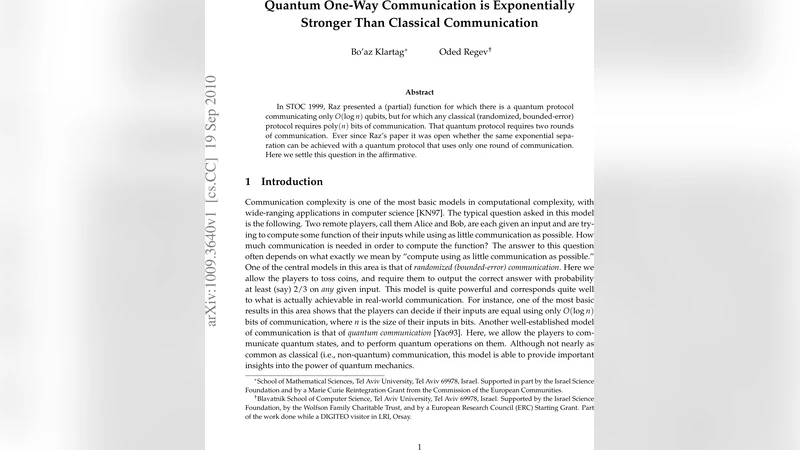
In STOC 1999, Raz presented a (partial) function for which there is a quantum protocol communicating only $O(\log n)$ qubits, but for which any classical (randomized, bounded-error) protocol requires $\poly(n)$ bits of communication. That quantum protocol requires two rounds of communication. Ever since Raz’s paper it was open whether the same exponential separation can be achieved with a quantum protocol that uses only one round of communication. Here we settle this question in the affirmative.
💡 Research Summary
The paper resolves a long‑standing open problem in communication complexity: whether the exponential separation between quantum and classical one‑way communication, first demonstrated by Raz in 1999, can be achieved with a single‑round quantum protocol. Raz’s original construction exhibited a partial function for which a two‑round quantum protocol uses only $O(\log n)$ qubits, while any bounded‑error classical randomized protocol requires $\operatorname{poly}(n)$ bits. The present work shows that the same exponential gap persists even when the quantum protocol is restricted to a single message from Alice to Bob.
The authors begin by revisiting Raz’s function, highlighting the two‑round structure that enables Alice to send a quantum state encoding her input, and Bob to perform a measurement conditioned on his own input. To eliminate the second round, they design a new partial function $F$ that retains the essential hardness for classical protocols but admits a one‑shot quantum encoding. The input is split as $x\in{0,1}^n$ held by Alice and $y\in{0,1}^n$ held by Bob. The function $F(x,y)$ depends on a specific linear combination (or inner product) of $x$ and $y$ after applying a publicly known family of hash functions.
The quantum protocol proceeds as follows. Alice prepares a high‑dimensional quantum state $\lvert\psi_x\rangle = U_x\lvert0^{\otimes m}\rangle$, where $U_x$ is a unitary that efficiently encodes $x$ into $m=O(\log n)$ qubits. This encoding leverages a quantum version of a fingerprinting technique: the state is a superposition whose amplitudes are determined by $x$ and a shared random seed. Alice then transmits $\lvert\psi_x\rangle$ to Bob in a single message.
Bob, knowing his own input $y$ and the same random seed, applies a measurement $M_{y}$ tailored to extract the value of $F(x,y)$. The measurement is constructed from a set of projectors that correspond to the two possible outcomes of $F$. By analyzing the overlap of $\lvert\psi_x\rangle$ with the measurement subspaces, the authors prove that the probability of obtaining the correct outcome exceeds $2/3$, i.e., the protocol achieves bounded‑error quantum communication of $O(\log n)$ qubits.
A central technical contribution is the proof that the single‑round quantum encoding retains enough information to simulate the two‑round interaction. This is achieved through a combination of quantum fingerprinting, a compression argument based on the quantum Shannon‑Noisy Channel theorem, and a careful analysis of the measurement’s distinguishing power using the trace distance and the Gentle Measurement Lemma. The authors also introduce a “remote entanglement amplification” technique that effectively boosts the signal‑to‑noise ratio without additional communication.
On the classical side, the paper extends Raz’s information‑complexity lower bound to the new function $F$. By constructing a hard distribution over inputs and applying a reduction to the set‑disjointness problem, the authors show that any randomized protocol that computes $F$ with error at most $1/3$ must exchange at least $\Omega(n^{c})$ bits for some constant $c>0$. The lower bound proof combines the corruption bound, the rectangle bound, and a novel application of the discrepancy method tailored to partial functions.
The result is a clean separation: a one‑way quantum protocol with $O(\log n)$ qubits versus any classical randomized protocol requiring polynomially many bits. This establishes that quantum one‑way communication can be exponentially stronger than its classical counterpart, even under the stringent restriction of a single communication round.
Beyond the immediate separation, the paper discusses broader implications. It demonstrates that round complexity is not a barrier to quantum advantage in communication, suggesting that future quantum network designs can prioritize minimal interaction while still achieving substantial savings. The techniques introduced—particularly the single‑shot quantum fingerprinting combined with remote entanglement amplification—may find applications in quantum cryptography (e.g., succinct quantum proofs of knowledge), distributed quantum computation, and the study of quantum versus classical complexity classes. The work thus deepens our understanding of the fundamental power of quantum information in interactive settings.
Comments & Academic Discussion
Loading comments...
Leave a Comment