The 2-category of weak entwining structures
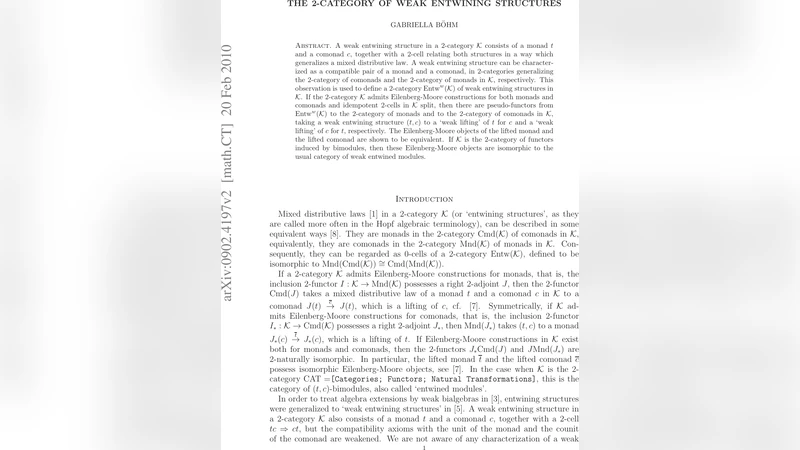
A weak entwining structure in a 2-category K consists of a monad t and a comonad c, together with a 2-cell relating both structures in a way that generalizes a mixed distributive law.A weak entwining structure can be characterized as a compatible pair of a monad and a comonad, in 2-categories generalizing the 2-category of comonads and the 2-category of monads in K, respectively. This observation is used to define a 2-category Entw^w(K) of weak entwining structures in K. If the 2-category K admits Eilenberg-Moore constructions for both monads and comonads and idempotent 2-cells in K split, then there are pseudo-functors from Entw^w(K) to the 2-category of monads and to the 2-category of comonads in K, taking a weak entwining structure (t,c) to a weak lifting' of t for c and a weak lifting’ of c for t, respectively. The Eilenberg-Moore objects of the lifted monad and the lifted comonad are shown to be equivalent. If K is the 2-category of functors induced by bimodules, then these Eilenberg-Moore objects are isomorphic to the usual category of weak entwined modules.
💡 Research Summary
The paper introduces a novel notion called a weak entwining structure within an arbitrary 2‑category K. A weak entwining structure consists of a monad t, a comonad c, and a 2‑cell ψ : c t ⇒ t c that satisfies four relaxed axioms. These axioms are weaker than those required for a mixed distributive law: they demand only compatibility with units and multiplications, compatibility with counits and comultiplications, a weakened interchange law, and an idempotency condition. Consequently, ψ need not give a full distributive law, but merely a “weak” interaction between the monad and comonad.
The authors reinterpret such a triple (t, c, ψ) as a compatible pair of objects in the 2‑categories Mnd(K) (monads in K) and Comnd(K) (comonads in K). This viewpoint leads to the definition of a new 2‑category Entw⁽ʷ⁾(K). Its objects are weak entwining structures; its 1‑cells are pairs of morphisms (φ, θ) that respect both the monad and comonad structures, and its 2‑cells are natural transformations that make the obvious squares commute. When ψ satisfies the stronger distributive law, Entw⁽ʷ⁾(K) contains the classical 2‑category of entwining structures as a full sub‑2‑category.
A central technical achievement is the construction of two pseudo‑functors L : Entw⁽ʷ⁾(K) → Mnd(K) and R : Entw⁽ʷ⁾(K) → Comnd(K), provided that K admits Eilenberg‑Moore constructions for both monads and comonads and that idempotent 2‑cells split. The functor L sends a weak entwining structure (t, c, ψ) to a “weak lifting” of the monad t along the comonad c, producing a new monad t̂ on the Eilenberg‑Moore category of c. Dually, R produces a “weak lifting” of the comonad c along the monad t, yielding a comonad ĉ on the Eilenberg‑Moore category of t. The constructions of t̂ and ĉ use ψ to intertwine the original actions, and the pseudo‑functoriality follows from the coherence conditions encoded in the weak axioms.
The authors then prove that the Eilenberg‑Moore objects of t̂ and ĉ are equivalent. By explicitly constructing a pair of inverse 1‑cells between the two Eilenberg‑Moore categories and checking that the required 2‑cell equations hold, they show that the two liftings encode the same algebraic information. Hence a weak entwining structure gives rise to two “dual” lifted structures that are, up to equivalence, indistinguishable.
Finally, the paper specializes to the concrete 2‑category of bimodules (objects are rings, 1‑cells are bimodules, 2‑cells are bimodule homomorphisms). In this setting, the lifted monad and comonad correspond precisely to the usual constructions of weak entwined modules. Consequently, the Eilenberg‑Moore categories obtained from L and R are not merely equivalent but actually isomorphic to the classical category of weak entwined modules. This demonstrates that the abstract 2‑categorical framework faithfully recovers known module‑theoretic results while simultaneously providing a more general and conceptual perspective.
Overall, the work bridges monad theory, comonad theory, and entwining structures at the level of 2‑categories, introduces a flexible weakening of distributive laws, and shows how this weakening still yields robust constructions such as lifted monads/comonads and their Eilenberg‑Moore categories. The results open avenues for applying weak entwining structures in higher‑dimensional algebra, categorical quantum mechanics, and other areas where monads and comonads interact in a non‑strict fashion.
Comments & Academic Discussion
Loading comments...
Leave a Comment