On Modelling and Analysis of Dynamic Reconfiguration of Dependable Real-Time Systems
This paper motivates the need for a formalism for the modelling and analysis of dynamic reconfiguration of dependable real-time systems. We present requirements that the formalism must meet, and use these to evaluate well established formalisms and two process algebras that we have been developing, namely, Webpi and CCSdp. A simple case study is developed to illustrate the modelling power of these two formalisms. The paper shows how Webpi and CCSdp represent a significant step forward in modelling adaptive and dependable real-time systems.
💡 Research Summary
The paper addresses a growing need in dependable real‑time systems for a formalism that can both model and analyze dynamic reconfiguration—i.e., the ability to add, remove, or replace components while the system is running. It begins by articulating four essential requirements for such a formalism: (1) the capacity to represent components and their interconnections as mutable entities; (2) explicit treatment of reconfiguration actions as timed events, allowing analysis of latency and deadline violations; (3) integration of reliability metrics so that the impact of reconfiguration on system availability can be quantified; and (4) compatibility with existing verification and simulation tools to support practical engineering workflows.
The authors then evaluate a range of well‑established formalisms—CSP, CCS, π‑calculus, and various Petri‑net extensions—against these criteria. While each offers strengths (e.g., CSP’s compositional reasoning, π‑calculus’s dynamic channel creation), none simultaneously satisfies all four requirements. In particular, they lack native support for timed reconfiguration steps and for embedding reliability parameters directly into the model.
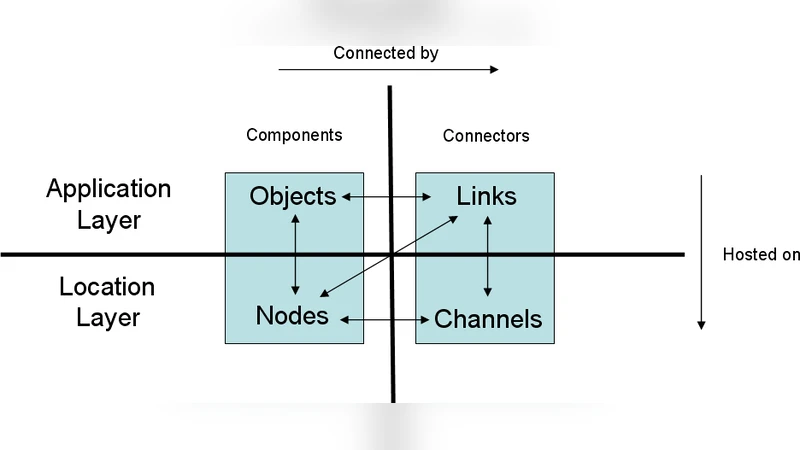
To fill this gap, the paper introduces two process algebras developed by the authors: Webπ and CCSdp. Webπ extends the π‑calculus with “web‑style” dynamic connection primitives, treating links as first‑class objects that can be created, destroyed, or redirected at runtime. Each primitive carries an explicit time label, enabling precise modeling of reconfiguration latency and deadline constraints. CCSdp builds on CCS by adding dependency and dependency‑property operators. These operators capture the static and dynamic dependency graph among components and attach reliability weights to each link, thereby allowing quantitative analysis of fault propagation before and after reconfiguration. Both algebras also support timed actions, satisfying the real‑time aspect of the requirements.
A concise case study illustrates the expressive power of the two algebras. The scenario involves a control system with multiple sensors and actuators; when a sensor fails, a replacement sensor must be dynamically bound, and the actuator configuration must be updated. Using Webπ, the authors model the sensor swap and connection re‑wiring with a handful of timed primitives, directly deriving the total reconfiguration time. With CCSdp, they construct a dependency graph that reflects how sensor and actuator failures affect overall system reliability, and they compute a reliability degradation factor resulting from the reconfiguration. Compared with traditional formalisms, the models are more compact, clearer, and enable early detection of design errors. Moreover, the extracted timing and reliability parameters can be fed into existing model‑checking or simulation tools, demonstrating practical applicability.
In conclusion, the paper convincingly argues that current formal methods fall short of supporting the triad of dynamic reconfiguration, real‑time constraints, and dependability analysis. Webπ and CCSdp represent a significant advancement by meeting all four stipulated requirements and by providing a unified framework that can be readily integrated into existing verification pipelines. The authors suggest future work on scaling the algebras to larger, more complex systems and on developing automated toolchains that combine modeling, verification, and performance analysis for dependable adaptive real‑time applications.
Comments & Academic Discussion
Loading comments...
Leave a Comment