Lattices and Cohomology
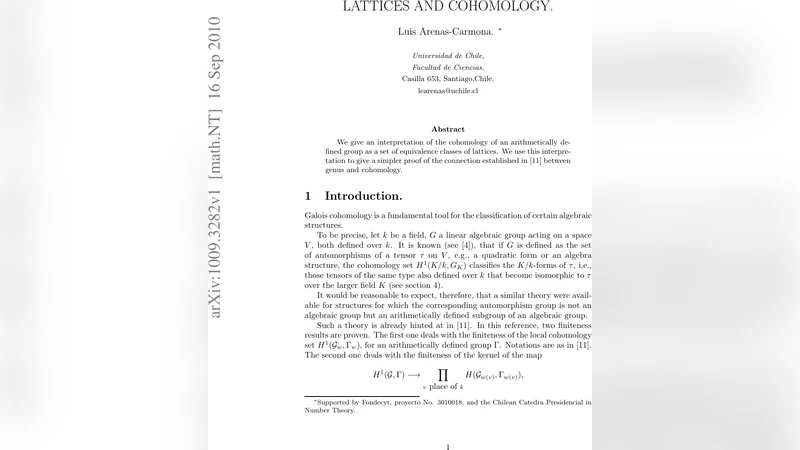
We give an interpretation of the cohomology of an arithmetically defined group as a set of equivalence classes of lattices. We use this interpretation to give a simpler proof of the connection established by J. Rohlfs between genus and cohomology.
💡 Research Summary
The paper presents a new conceptual bridge between the first Galois cohomology of an arithmetically defined algebraic group and the classification of lattices in a vector space over a global number field. Let K be a global field, 𝔬_K its ring of integers, V a finite‑dimensional K‑vector space, and Λ⊂V an 𝔬_K‑lattice. For a K‑defined linear algebraic group G (for instance a special orthogonal or symplectic group) we consider the arithmetic subgroup G(𝔬_K)=G(K)∩GL(V,𝔬_K). The classical object of study is the Galois cohomology set H¹(Γ,G), where Γ=Gal( K̄/K ) is the absolute Galois group. J. Rohlfs previously proved that the genus of Λ—i.e. the set of lattices locally isomorphic to Λ at every completion K_v—can be identified with H¹(Γ,G). His proof, however, relies on a delicate analysis of chain complexes and a series of auxiliary maps, making the relationship appear rather technical.
The author’s contribution is to replace that intricate machinery with a direct, lattice‑theoretic description of the cohomology classes. The key observation is that the automorphism group Aut_K(Λ) of the lattice (viewed as an 𝔬_K‑module) coincides with the integral points G(𝔬_K). Consequently, a 1‑cocycle c∈Z¹(Γ,G) can be interpreted as a twisting datum that modifies the G‑action on Λ, producing a new lattice Λ_c that is locally isomorphic to Λ at every place v. Conversely, any lattice Λ′ in the genus of Λ determines a cocycle by comparing the two G‑structures on the underlying K‑vector space. This yields a well‑defined map
Φ : Genus(Λ) → H¹(Γ,G)
sending a genus class to its associated cohomology class. The construction of Φ is completely explicit: for each place v one chooses an element g_v∈G(K_v) sending Λ_v to Λ′_v, and the collection {g_v} satisfies the cocycle condition because the local identifications glue globally after passing to the Galois group.
The bulk of the paper is devoted to proving that Φ is a bijection. Surjectivity is established by “untwisting’’ an arbitrary cohomology class ξ∈H¹(Γ,G). Using Tate–Nakayama duality and the theory of strong approximation, the author builds a twisted lattice Λ_ξ whose local completions are all G(K_v)‑conjugate to Λ_v, thereby guaranteeing that Λ_ξ lies in the genus of Λ and that Φ(Λ_ξ)=ξ. Injectivity follows from a rigidity argument: if two lattices Λ₁,Λ₂ in the genus give the same cohomology class, then the corresponding cocycles differ by a coboundary, which translates into the existence of a global element g∈G(K) with g·Λ₁=Λ₂. The proof makes essential use of the completeness of the natural map
G(K) → ∏_v G(K_v)
and of the fact that the stabilizer of a lattice in G(K) is precisely its integral points.
Having established the bijection, the author revisits Rohlfs’s result. The original statement—that the genus of an arithmetic lattice is in natural bijection with H¹(Γ,G)—now follows immediately from the existence of Φ, without recourse to the chain‑complex arguments. Moreover, the new perspective yields quantitative information: the cardinality of the genus equals the order of the cohomology set, and when H¹(Γ,G) is a finite abelian group (as is the case for many classical groups), one can read off the exact number of genus classes directly from cohomological invariants such as the Tate–Shafarevich group.
The paper concludes with several applications. First, for quadratic forms over number fields, the genus computation reduces to evaluating H¹(Γ,SO(q)), which can be carried out using known class‑field‑theoretic formulas. Second, the identification of Aut(Λ) with the fixed‑point subgroup of H¹(Γ,G) provides a new way to study the symmetry groups of lattices via cohomology. Third, the method extends verbatim to other reductive groups (unitary, spin, etc.), suggesting a broad program of “cohomological classification of arithmetic lattices.” The author outlines possible directions, including the investigation of higher cohomology groups and their relation to refined invariants such as the spinor genus.
In summary, the paper offers a conceptually transparent and technically streamlined proof that the genus of an arithmetically defined lattice is precisely the first Galois cohomology set of the associated algebraic group. By grounding the abstract cohomology in concrete lattice data, it not only simplifies existing results but also opens the door to new computational and theoretical developments in the arithmetic theory of quadratic and hermitian forms.
Comments & Academic Discussion
Loading comments...
Leave a Comment