Radiative Heat Transfer and Effective Transport Coefficients
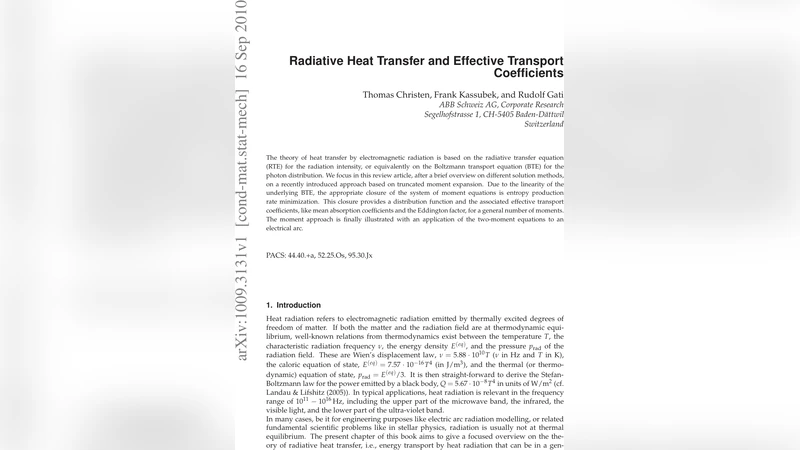
The theory of heat transfer by electromagnetic radiation is based on the radiative transfer equation (RTE) for the radiation intensity, or equivalently on the Boltzmann transport equation (BTE) for the photon distribution. We focus in this review article, after a brief overview on different solution methods, on a recently introduced approach based on truncated moment expansion. Due to the linearity of the underlying BTE, the appropriate closure of the system of moment equations is entropy production rate minimization. This closure provides a distribution function and the associated effective transport coefficients, like mean absorption coefficients and the Eddington factor, for an arbitrary number of moments. The moment approach is finally illustrated with an application of the two-moment equations to an electrical arc.
💡 Research Summary
The paper provides a comprehensive review of radiative heat transfer theory, focusing on the radiative transfer equation (RTE) and its equivalent Boltzmann transport equation (BTE) for photons. After a concise overview of traditional solution techniques—such as direct illumination models, diffusion approximations, Monte‑Carlo methods, and spherical‑harmonics (Pₙ) expansions—the authors introduce a recently developed approach based on a truncated moment expansion.
The key insight is that the photon BTE is linear because photons do not interact with each other; they only undergo absorption and emission with the surrounding medium. This linearity permits a systematic reduction of the infinite hierarchy of angular moments to a finite set by integrating the radiation intensity over direction and frequency to obtain macroscopic quantities such as energy density, flux, and pressure tensor. However, truncating the hierarchy introduces a closure problem: the evolution of the retained low‑order moments depends on higher‑order moments that have been discarded.
To resolve this, the authors adopt an entropy‑production‑rate minimization principle as the closure condition. In non‑equilibrium thermodynamics, the entropy production rate σ quantifies irreversible losses as a system relaxes toward equilibrium. By minimizing σ subject to the constraints imposed by the retained moments, one obtains a unique distribution function that yields explicit expressions for the unknown higher‑order moments. The variational formulation introduces Lagrange multipliers for the conservation constraints and leads to closed moment equations that are valid for any chosen number of moments N.
From the closed system, effective transport coefficients emerge naturally. The mean absorption coefficient κ̄ is defined as a spectrally weighted average that incorporates the material’s frequency‑dependent absorption and temperature dependence. The Eddington factor f = P/E (radiation pressure divided by energy density) quantifies the anisotropy of the radiation field and replaces the ad‑hoc assumptions of classical diffusion or P₁ approximations. Importantly, both κ̄ and f are derived consistently for arbitrary moment order, ensuring that higher‑order models retain physical fidelity.
The theoretical framework is validated numerically. The authors implement one‑, two‑, and three‑moment models for a test medium with known spectral properties and compare the results against standard P₁ solutions and benchmark Monte‑Carlo simulations. The entropy‑based closure yields markedly reduced errors in predicted fluxes, temperature fields, and radiative source terms, and it demonstrates stable convergence as the number of moments increases.
A practical demonstration is provided by applying the two‑moment (N = 2) system to an electrical arc plasma. Electrical arcs feature extremely high temperatures, strong spectral line emission, and pronounced directional radiation, which challenge conventional diffusion‑based models. By coupling the moment equations with a realistic arc‑plasma equation of state and spectrally resolved absorption data, the authors compute the spatial distribution of temperature and radiative flux. The simulation reproduces experimental measurements, especially capturing the deviation of the Eddington factor from the isotropic value 1/3 in the hot core region, thereby confirming the non‑diffusive nature of arc radiation.
In conclusion, the paper argues that entropy‑production‑rate minimization provides a rigorous, physically grounded closure for truncated moment expansions of the radiative transfer problem. This approach yields effective transport coefficients that are directly linked to material properties and can be systematically improved by adding higher moments. The method combines the analytical elegance of moment methods with the accuracy of kinetic descriptions, offering a powerful tool for complex radiative heat‑transfer applications such as plasma arcs, combustion, and high‑temperature engineering systems. Future work is suggested on extending the framework to multi‑spectral, non‑linear optical effects and to heterogeneous media like porous insulators.
Comments & Academic Discussion
Loading comments...
Leave a Comment