Characterizing the community structure of complex networks
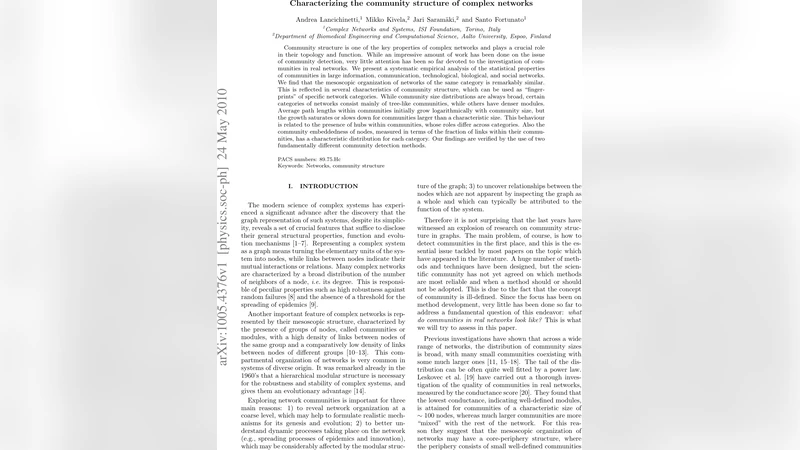
Community structure is one of the key properties of complex networks and plays a crucial role in their topology and function. While an impressive amount of work has been done on the issue of community detection, very little attention has been so far devoted to the investigation of communities in real networks. We present a systematic empirical analysis of the statistical properties of communities in large information, communication, technological, biological, and social networks. We find that the mesoscopic organization of networks of the same category is remarkably similar. This is reflected in several characteristics of community structure, which can be used as ``fingerprints’’ of specific network categories. While community size distributions are always broad, certain categories of networks consist mainly of tree-like communities, while others have denser modules. Average path lengths within communities initially grow logarithmically with community size, but the growth saturates or slows down for communities larger than a characteristic size. This behaviour is related to the presence of hubs within communities, whose roles differ across categories. Also the community embeddedness of nodes, measured in terms of the fraction of links within their communities, has a characteristic distribution for each category. Our findings are verified by the use of two fundamentally different community detection methods.
💡 Research Summary
The paper conducts a large‑scale empirical study of community structure across a diverse set of real‑world networks, including information, communication, technological, biological, and social systems. While much of the literature has focused on developing algorithms to detect communities, this work shifts attention to the statistical properties of the communities that actually appear in real data.
The authors select more than ten networks, grouping them into four broad categories: information/communication, technological, biological, and social. For each network they apply two fundamentally different community detection methods – the modularity‑optimisation based Louvain algorithm and the flow‑based Infomap method. Because the two techniques rely on distinct principles (density optimisation versus information‑theoretic compression), consistent findings across both methods demonstrate that the observed patterns are not artefacts of a particular algorithm.
Key findings are as follows:
-
Broad, heavy‑tailed community size distributions – In every network the distribution of community sizes follows a power‑law‑like tail, indicating the coexistence of many small modules and a few very large ones. However, the shape of the distribution varies by category. Social and information networks tend to contain a larger proportion of very large communities, whereas technological networks are dominated by small, tree‑like modules. Biological networks display an intermediate pattern, reflecting a mixture of functional and structural modules.
-
Internal average path length scaling – The average shortest‑path distance between nodes inside a community grows roughly logarithmically with community size for small to medium communities (up to about 50–100 nodes). Beyond a characteristic size (≈100–200 nodes) the growth saturates or slows dramatically. This behaviour is linked to the emergence of hub nodes inside communities that dramatically shorten internal distances. The role of these hubs differs across categories: in social networks hubs act as bridges connecting many members, facilitating rapid information flow; in biological networks hubs are often central enzymes or proteins that concentrate functional interactions; in technological networks hubs are fewer, and the network’s hierarchical routing architecture contributes to the observed slowdown.
-
Category‑specific embeddedness profiles – Embeddedness, defined as the fraction of a node’s links that stay within its own community, exhibits a characteristic distribution for each network class. Social networks show a high‑embeddedness peak, reflecting strong intra‑group cohesion. Technological networks display a low‑embeddedness bias, indicating many nodes maintain substantial external connections, which is consistent with design goals of robustness and redundancy. Information networks sit in between, while biological networks show a bimodal pattern, mirroring the coexistence of tightly‑bound functional complexes and more loosely coupled pathways.
-
Robustness across detection methods – Quantitative comparison of the two detection algorithms shows that the main statistical signatures (size distribution, internal distance scaling, embeddedness) remain stable regardless of the method used. This reinforces the claim that the identified “fingerprints” are intrinsic properties of the networks rather than methodological artefacts.
The authors argue that these mesoscopic signatures constitute a “fingerprint” of the network’s domain, enabling one to infer the functional class of an unknown network simply from its community statistics. Moreover, they suggest that community structure should be regarded not only as a target for detection but also as a lens through which to understand the underlying functional, evolutionary, and design constraints of complex systems.
In conclusion, the study provides a comprehensive characterization of community structure across multiple domains, highlighting universal features (broad size distributions) and domain‑specific traits (tree‑like vs. dense modules, hub roles, embeddedness patterns). These insights have practical implications for network design, anomaly detection, and modeling of dynamical processes such as diffusion or contagion, and they open avenues for future work on temporal evolution of communities and multi‑scale interactions.
Comments & Academic Discussion
Loading comments...
Leave a Comment