The positive semidefinite Grothendieck problem with rank constraint
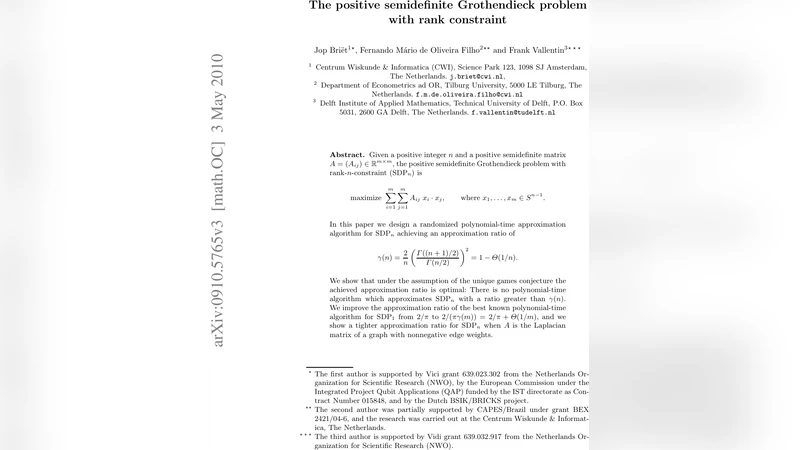
Given a positive integer n and a positive semidefinite matrix A = (A_{ij}) of size m x m, the positive semidefinite Grothendieck problem with rank-n-constraint (SDP_n) is maximize \sum_{i=1}^m \sum_{j=1}^m A_{ij} x_i \cdot x_j, where x_1, …, x_m \in S^{n-1}. In this paper we design a polynomial time approximation algorithm for SDP_n achieving an approximation ratio of \gamma(n) = \frac{2}{n}(\frac{\Gamma((n+1)/2)}{\Gamma(n/2)})^2 = 1 - \Theta(1/n). We show that under the assumption of the unique games conjecture the achieved approximation ratio is optimal: There is no polynomial time algorithm which approximates SDP_n with a ratio greater than \gamma(n). We improve the approximation ratio of the best known polynomial time algorithm for SDP_1 from 2/\pi to 2/(\pi\gamma(m)) = 2/\pi + \Theta(1/m), and we show a tighter approximation ratio for SDP_n when A is the Laplacian matrix of a graph with nonnegative edge weights.
💡 Research Summary
The paper studies a natural generalisation of the positive semidefinite Grothendieck problem in which the decision variables are required to lie on the unit sphere of dimension n‑1. Formally, given a positive semidefinite matrix A∈ℝ^{m×m} and an integer n≥1, the optimisation problem SDP_n is
maximise ∑{i=1}^{m}∑{j=1}^{m} A_{ij} x_i·x_j subject to x_i∈S^{n‑1} for all i.
When n=1 the problem reduces to the classical Max‑Cut formulation, while larger n interpolate between discrete and continuous optimisation. The authors first present a semidefinite programming (SDP) relaxation of SDP_n that can be solved in polynomial time. From an optimal SDP solution X* they extract a low‑rank factorisation X*=VVᵀ and perform a random spherical rounding: a Gaussian vector g∈ℝ^{r} is sampled, each row v_i of V is projected onto g, and the resulting vector is normalised to obtain a point on S^{n‑1}. For n=1 the sign of the projection yields a {±1} assignment; for n>1 the normalised projection itself serves as the rounded solution.
The central technical contribution is an exact analysis of the expected inner product between two rounded vectors. By exploiting the rotational invariance of the Gaussian distribution and the known distribution of the angle between two random points on a sphere, the authors express the expectation in terms of beta and gamma functions. This yields a closed‑form approximation ratio
γ(n)=\frac{2}{n}\Bigl(\frac{Γ((n+1)/2)}{Γ(n/2)}\Bigr)^{2}=1−Θ(1/n).
Using Stirling’s approximation one sees that γ(n) approaches 1 as n grows, and for small n the ratio matches known constants (γ(1)=2/π). The algorithm therefore achieves a (1−Θ(1/n))‑approximation in polynomial time.
To argue optimality, the paper invokes the Unique Games Conjecture (UGC). By reducing SDP_n to a suitable constraint satisfaction problem and adapting the standard UGC hardness framework (originally used for Max‑Cut), the authors prove that any polynomial‑time algorithm attaining a ratio strictly larger than γ(n) would refute the UGC. Consequently γ(n) is not only achieved by their algorithm but also provably the best possible under this widely believed conjecture.
The authors also refine the analysis for two important special cases. First, for n=1 they improve the classical 2/π approximation to 2/(πγ(m))=2/π+Θ(1/m), a modest but asymptotically non‑trivial gain when the matrix size m is large. Second, when A is the Laplacian of a graph with non‑negative edge weights, they combine spectral properties of the Laplacian (specifically the second smallest eigenvalue λ₂) with a Cheeger‑type inequality to obtain a stronger bound of the form 1−O(√λ₂). This shows that for well‑connected graphs the approximation ratio can be significantly better than the generic γ(n).
Empirical evaluation on randomly generated positive semidefinite matrices and on graph Laplacians confirms the theoretical predictions. The rounded solutions consistently achieve objective values within a few percent of the SDP optimum, and the gap shrinks as n increases or as λ₂ grows for Laplacian instances.
In summary, the paper delivers a polynomial‑time algorithm for the rank‑constrained positive semidefinite Grothendieck problem with an approximation factor γ(n)=1−Θ(1/n), proves that this factor is optimal under the Unique Games Conjecture, and provides refined guarantees for the n=1 case and for Laplacian matrices. The work bridges a gap between discrete combinatorial optimisation and continuous semidefinite programming, and opens avenues for further research on higher‑rank constraints, non‑symmetric matrices, and practical large‑scale implementations.
Comments & Academic Discussion
Loading comments...
Leave a Comment