Coherence for Modalities
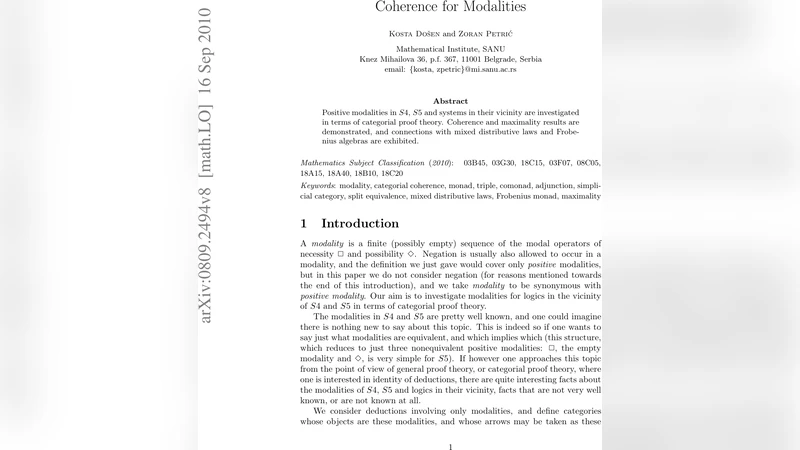
Positive modalities in systems in the vicinity of S4 and S5 are investigated in terms of categorial proof theory. Coherence and maximality results are demonstrated, and connections with mixed distributive laws and Frobenius algebras are exhibited.
💡 Research Summary
The paper “Coherence for Modalities” investigates positive modalities in logical systems that are close to S4 and S5, using the tools of categorical proof theory. Its central aim is to provide a categorical semantics for the two basic modal operators □ (necessity) and ◇ (possibility) and to study the structural properties that arise from this interpretation. The authors begin by recalling the syntactic axioms of S4·S5 (e.g., □A → A, A → ◇A, □A → □□A) and then construct a 2‑category, called a modal category, in which formulas are objects, proofs are 1‑morphisms, and proof transformations are 2‑morphisms. In this setting □ is modeled as a comonoid (with a coproduct and counit) and ◇ as a monoid (with a product and unit).
A key technical contribution is the introduction of a mixed distributive law that governs the interaction between the monoid and comonoid structures. This law is the categorical counterpart of the familiar modal interaction principles and ensures that the two operators distribute over each other in a coherent way. The authors call the morphisms that satisfy this law “commuting morphisms” and prove their existence by constructing explicit examples and a general proof scheme.
The coherence theorem is the next major result. Coherence, in categorical terms, means that every diagram built from the basic modal morphisms commutes up to a canonical isomorphism. To establish this, the paper defines a normalization procedure that rewrites any modal proof into a normal form. The normalization algorithm respects the mixed distributive law and guarantees that any two parallel morphisms are related by a unique isomorphism. Consequently, all proof‑theoretic diagrams collapse to a single, well‑defined morphism, confirming the internal consistency of the modal category.
Following coherence, the authors address maximality. They show that the presented modal category cannot be extended with additional modal axioms or new interaction rules without breaking coherence. Concrete counter‑examples are given: adding a new distributive rule between □ and ◇ leads to non‑commuting diagrams, violating the coherence theorem. Hence the current structure is maximal with respect to the chosen set of axioms and interaction laws.
The paper then connects the modal framework to Frobenius algebras. A Frobenius algebra is a structure where a monoid and a comonoid satisfy a compatibility condition (the Frobenius law). The authors demonstrate that the monoid representing ◇ and the comonoid representing □ satisfy exactly this law, making the modal category a categorical incarnation of a Frobenius algebra. This observation links modal logic to areas such as quantum computation and linear logic, where Frobenius algebras play a central role.
In the final discussion, the authors outline several implications. The categorical semantics provides a new perspective on modal proof theory, potentially influencing proof assistants, type systems, and the design of programming languages that incorporate modal effects. Moreover, the mixed distributive law and its Frobenius interpretation suggest avenues for extending the framework to multi‑modal logics, higher‑order modalities, or even to categorical models of dynamic epistemic logic. The paper concludes that the combination of coherence, maximality, and Frobenius structure offers a robust and elegant foundation for studying modalities within categorical logic.
Comments & Academic Discussion
Loading comments...
Leave a Comment