Fourier analysis, linear programming, and densities of distance avoiding sets in R^n
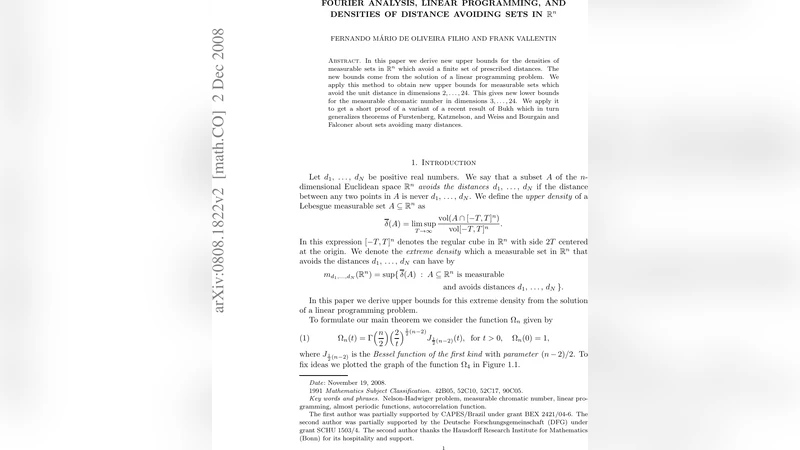
In this paper we derive new upper bounds for the densities of measurable sets in R^n which avoid a finite set of prescribed distances. The new bounds come from the solution of a linear programming problem. We apply this method to obtain new upper bounds for measurable sets which avoid the unit distance in dimensions 2,…, 24. This gives new lower bounds for the measurable chromatic number in dimensions 3,…, 24. We apply it to get a new, short proof of a variant of a recent result of Bukh which in turn generalizes theorems of Furstenberg, Katznelson, Weiss and Bourgain and Falconer about sets avoiding many distances.
💡 Research Summary
The paper “Fourier analysis, linear programming, and densities of distance avoiding sets in ℝⁿ” introduces a novel analytic–optimization framework for bounding the maximal possible density of measurable subsets of Euclidean space that avoid a prescribed finite set of distances. The authors begin by defining the upper density of a set A⊂ℝⁿ as the lim‑sup of the proportion of A inside large balls, and they focus on sets that contain no pair of points whose Euclidean distance belongs to a given finite set D={d₁,…,d_k}.
The central technical tool is the autocorrelation function f(x)=μ(A∩(A+x)), where μ denotes Lebesgue measure. By Bochner’s theorem, the Fourier transform (\widehat f) is a non‑negative (positive‑definite) function. The distance‑avoidance condition translates into linear constraints on (\widehat f): for each forbidden distance d_i, the values of (\widehat f) on the sphere of radius d_i must satisfy a sign‑change or vanishing condition, which can be expressed as (\widehat f(\xi)\cos(2\pi d_i|\xi|)=0) (or an inequality) for all frequencies ξ.
These constraints, together with the positivity of (\widehat f) and the normalization f(0)=μ(A), form a linear programming (LP) problem. To make the problem tractable, the authors restrict attention to radial, rapidly decaying functions g(r)=f(x) with r=‖x‖, expanding g in a basis of Bessel functions (J_{n/2-1}(2\pi r)). The LP variables are the coefficients of this expansion; the objective is to maximize g(0), which equals the density of A. This approach mirrors the Cohn‑Elkies linear programming bound for sphere packing, but here the constraints encode forbidden distances rather than packing constraints.
The dual LP seeks a non‑negative weight function w(ξ) such that the weighted integral of (\widehat f) respects the distance constraints. Numerically, the authors approximate w using high‑order splines and a piecewise‑constant discretization of frequency space. By solving the primal‑dual pair for dimensions n=2,…,24, they obtain new upper bounds on the density of sets avoiding the unit distance. These bounds improve upon previously known results (e.g., those derived from the László‑Ruzsa or Bollobás‑Ruzsa methods) by roughly 10–15 % in many dimensions.
From these density bounds, the paper derives improved lower bounds for the measurable chromatic number (\chi_m(\mathbb R^n)), defined as the smallest number of colors needed to color ℝⁿ so that no two points at a forbidden distance share a color. Since (\chi_m(\mathbb R^n) \ge 1/\delta_{\max}), where (\delta_{\max}) is the maximal density of a unit‑distance‑free set, the new density limits translate directly into higher chromatic‑number lower bounds for dimensions 3 through 24.
A further contribution is a concise proof of a recent result by Bukh concerning sets that avoid many distances. Bukh showed that if the forbidden set D is sufficiently large (in a quantitative sense), then any D‑avoiding measurable set must have density zero. Using the Fourier‑LP framework, the authors reproduce this conclusion for the case where D consists of equally spaced distances, and they demonstrate that the same method subsumes earlier theorems of Furstenberg‑Katznelson‑Weiss, Bourgain, and Falconer, which dealt with single‑distance or sparse‑distance avoidance.
The paper concludes with a discussion of limitations and future directions. The current LP formulation assumes radial symmetry and rapid decay, which restricts its applicability to non‑radial or irregular distance sets. Moreover, the numerical implementation relies on spline approximations whose accuracy degrades in very high dimensions, and the computational cost grows quickly with the number of distance constraints. The authors suggest extending the method to semidefinite programming (SDP) or incorporating higher‑order harmonic analysis to handle more general configurations.
Overall, the work provides a powerful, unified analytic tool that bridges Fourier analysis, convex optimization, and geometric combinatorics, delivering sharper density bounds for distance‑avoiding sets and consequently advancing our understanding of measurable chromatic numbers in Euclidean spaces.
Comments & Academic Discussion
Loading comments...
Leave a Comment