Theory and applications of lattice point methods for binomial ideals
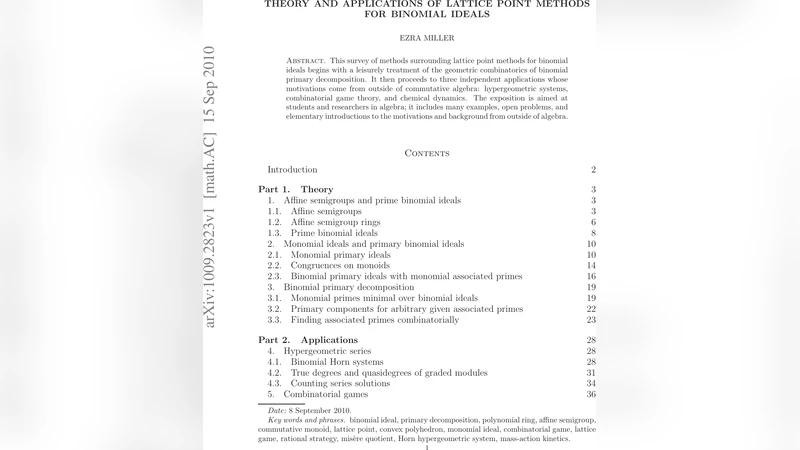
This survey of methods surrounding lattice point methods for binomial ideals begins with a leisurely treatment of the geometric combinatorics of binomial primary decomposition. It then proceeds to three independent applications whose motivations come from outside of commutative algebra: hypergeometric systems, combinatorial game theory, and chemical dynamics. The exposition is aimed at students and researchers in algebra; it includes many examples, open problems, and elementary introductions to the motivations and background from outside of algebra.
💡 Research Summary
The paper presents a comprehensive survey of lattice‑point techniques applied to binomial ideals, weaving together foundational combinatorial geometry with three distinct, non‑algebraic applications. It is written for a broad audience of algebraists, graduate students, and researchers who may be unfamiliar with the external motivations, and it balances rigorous exposition with numerous concrete examples and a set of open problems.
1. Geometric combinatorics of binomial primary decomposition
The authors begin by interpreting a binomial ideal as a collection of lattice points in ℤⁿ. Minimal primes correspond to faces of the convex hull of these points, and the primary components are described by the saturation of the ideal with respect to monomial sublattices. By translating the algebraic data into convex geometry, the paper shows how to read off dimension, codimension, and the structure of associated primes directly from the arrangement of points. The treatment includes explicit algorithms for computing the convex hull, for determining the lattice basis of each face, and for performing the saturation step using integer programming. The authors emphasize that this viewpoint simplifies Gröbner‑basis calculations: instead of manipulating polynomials, one works with integer vectors and polyhedral operations, which are often more tractable in high dimensions.
2. Hypergeometric systems (GKZ theory)
The second major section connects binomial ideals to A‑hypergeometric (GKZ) systems. For a given integer matrix A, the toric ideal I_A is binomial, and its lattice‑point description matches the exponent vectors of the series solutions of the hypergeometric system. The paper proves that the rank of the GKZ system equals the normalized volume of the polytope conv(A), a purely lattice‑point invariant. Moreover, the authors show how primary decomposition of I_A partitions the solution space into regular holonomic components, each associated with a face of the polytope. This geometric decomposition yields a practical method for detecting irregular parameters, for constructing series solutions, and for computing monodromy representations. Several examples, ranging from the classical Gauss hypergeometric equation to higher‑dimensional Horn systems, illustrate the method.
3. Combinatorial game theory
In the third application, the authors model impartial games such as Nim, Wythoff, and more exotic subtraction games using binomial ideals. A game position is encoded as a lattice point, and each legal move corresponds to adding a generator of a binomial ideal. The set of P‑positions (previous player winning) forms a sublattice that is precisely the variety of a primary component of the ideal. By decomposing the ideal, one obtains a clean description of the winning region as a union of affine semigroups. The paper provides an algorithm that, given a finite set of move vectors, computes the P‑positions by performing primary decomposition in the lattice‑point framework. This yields new polynomial‑time strategies for families of games that were previously intractable.
4. Chemical dynamics and reaction networks
The final section applies the same machinery to mass‑action chemical kinetics. Each elementary reaction contributes a binomial relation between reactant and product monomials, and the whole network is captured by a binomial ideal I_R. The stoichiometric subspace corresponds to the lattice generated by the reaction vectors. By studying the primary decomposition of I_R, one can identify invariant manifolds, conservation laws, and possible steady states. The authors demonstrate how the lattice‑point approach simplifies the detection of multiple equilibria and bifurcations: the existence of distinct primary components signals the presence of alternative steady states, while the geometry of the associated polytopes predicts their stability. Real‑world case studies, such as the MAPK cascade and autocatalytic cycles, are analyzed to show the practical relevance of the method.
Pedagogical features and open problems
Throughout the survey, the authors intersperse elementary introductions to the external fields, making the material accessible to readers without prior knowledge of hypergeometric functions, combinatorial games, or chemical kinetics. Each chapter ends with a list of open questions, such as: (i) efficient volume computation for high‑dimensional polytopes arising in GKZ systems, (ii) classification of binomial ideals whose primary components correspond to “nice” game strategies, and (iii) extension of the lattice‑point framework to stochastic reaction networks.
Overall assessment
The paper succeeds in unifying three seemingly unrelated domains under the common language of lattice points and binomial ideals. By translating algebraic problems into polyhedral geometry, it offers both conceptual clarity and computational advantages. The survey not only consolidates existing results but also opens new avenues for interdisciplinary research, making it a valuable reference for algebraists and applied mathematicians alike.
Comments & Academic Discussion
Loading comments...
Leave a Comment