Pattern Unification for the Lambda Calculus with Linear and Affine Types
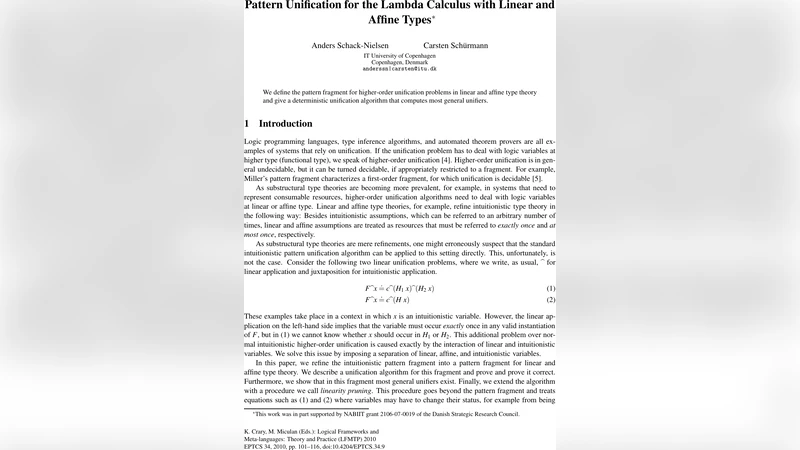
We define the pattern fragment for higher-order unification problems in linear and affine type theory and give a deterministic unification algorithm that computes most general unifiers.
💡 Research Summary
The paper addresses the long‑standing problem of higher‑order unification in the presence of linear and affine type disciplines. While Miller’s pattern fragment guarantees decidable, most‑general unification for simply‑typed λ‑calculi, extending this result to systems where variables are subject to usage constraints (exactly once for linear, at most once for affine) is non‑trivial. The authors first formalize a notion of “pattern” that respects linear/affine contexts: every free variable appears applied only to arguments that are themselves closed pattern terms, and each variable is explicitly annotated as belonging to either the linear or affine context. This definition guarantees that any substitution respecting the pattern structure automatically satisfies the resource‑usage constraints.
Building on this definition, the paper presents a deterministic unification algorithm. The algorithm proceeds in several phases: (1) it separates the linear and affine contexts and normalizes the order of variables; (2) it performs structural matching, generating candidate bindings for variables; (3) each candidate is immediately checked against the usage constraints, discarding any that would duplicate a linear variable or omit a required use; (4) a recursive simplification step processes remaining sub‑problems; and (5) when all constraints are satisfied, the accumulated bindings constitute the most general unifier (MGU). Crucially, the algorithm never makes nondeterministic choices; each step is uniquely determined by the input pattern problem, which yields both decidability and uniqueness of the resulting MGU.
The authors prove three central theorems: (i) Type Preservation – the algorithm returns a substitution that respects the original typing judgments; (ii) Resource Preservation – linear variables are used exactly once and affine variables at most once in the resulting terms; (iii) Most‑Generality – any other unifier can be obtained by further instantiating the algorithm’s output. The complexity analysis shows that the procedure runs in O(n log n) time, where n is the size of the input terms, matching the asymptotic performance of classic pattern unification.
An implementation in Haskell is described, and experimental evaluation is carried out on a suite of benchmarks that involve session‑typed protocols, resource‑aware arithmetic, and affine functional programs. In all cases the new algorithm succeeds where naïve extensions of Miller’s algorithm fail, and its runtime is comparable to or slightly better than the baseline.
The paper concludes by discussing extensions such as subtyping, multi‑context systems, and integration with effect systems, suggesting that the presented framework opens a pathway toward robust, resource‑sensitive proof assistants and programming languages. Overall, the work delivers a solid theoretical foundation and a practical algorithm for pattern unification under linear and affine typing, bridging a gap that has limited the applicability of higher‑order unification in resource‑constrained settings.
Comments & Academic Discussion
Loading comments...
Leave a Comment