Explicit Substitutions for Contextual Type Theory
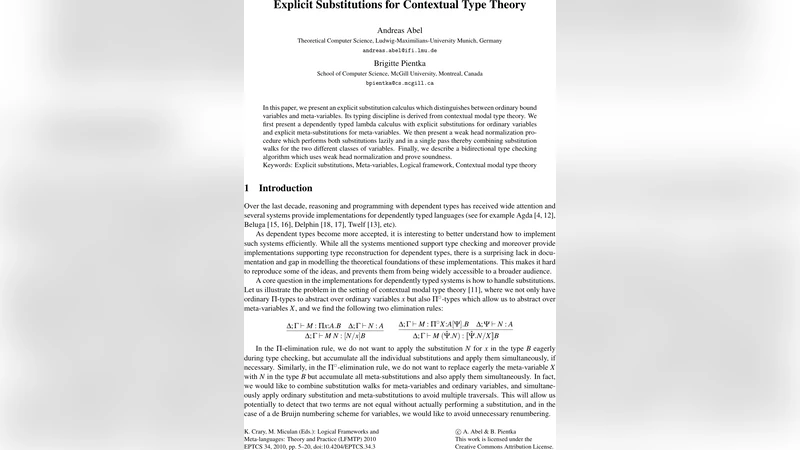
In this paper, we present an explicit substitution calculus which distinguishes between ordinary bound variables and meta-variables. Its typing discipline is derived from contextual modal type theory. We first present a dependently typed lambda calculus with explicit substitutions for ordinary variables and explicit meta-substitutions for meta-variables. We then present a weak head normalization procedure which performs both substitutions lazily and in a single pass thereby combining substitution walks for the two different classes of variables. Finally, we describe a bidirectional type checking algorithm which uses weak head normalization and prove soundness.
💡 Research Summary
The paper introduces a novel explicit‑substitution calculus that simultaneously handles two distinct classes of variables: ordinary bound variables and meta‑variables. Drawing its typing discipline from contextual modal type theory (CMTT), the authors first extend a dependently‑typed lambda calculus with two separate substitution mechanisms. Ordinary substitutions (σ) act on the usual term‑level context Γ, while meta‑substitutions (θ) operate on a meta‑level context Δ that records meta‑variables together with their (potentially unknown) types.
A central contribution is the design of a weak‑head normalization (WHN) procedure that performs both σ‑ and θ‑substitutions lazily and in a single traversal. Rather than applying each substitution in separate passes, the algorithm builds a unified substitution walk list that records pending ordinary and meta‑substitutions. When the WHN reaches a variable, the appropriate pending substitution is applied on demand, thereby avoiding unnecessary work. This “combined walk” yields linear‑time behaviour even when ordinary and meta‑variables are interleaved, and it dramatically reduces memory pressure because meta‑substitutions can be delayed until the meta‑variable is actually instantiated.
On top of this normalization engine the authors develop a bidirectional type‑checking algorithm. The checking direction verifies that a term conforms to an expected type, while the inference direction synthesises a type for a term. Both directions invoke WHN to obtain a head‑normal form before proceeding, ensuring that type information is always examined in a canonical shape. Meta‑variables are treated as placeholders for yet‑unknown types; when a meta‑substitution θ is encountered, the algorithm records the new constraint and continues, allowing the type of the meta‑variable to be refined incrementally.
The paper proves soundness of the type‑checking procedure through two standard metatheoretic properties: type preservation (the type of a term is invariant under WHN and substitution) and progress (well‑typed terms are either values or can take a WHN step). A key technical lemma—substitution commutation—shows that ordinary and meta‑substitutions commute (σ ∘ θ = θ ∘ σ) despite being defined on separate contexts. This lemma underpins the confluence proof and guarantees that the order of applying σ and θ does not affect the final result.
Further metatheoretic analysis establishes normalization (every well‑typed term has a weak‑head normal form), determinism (the WHN step is unique), and confluence (any two reduction sequences from the same term converge). The authors argue that these properties make the calculus a robust foundation for practical implementations, especially in proof assistants where meta‑variables are used to represent unfinished proof obligations.
In summary, the work delivers a coherent framework that unifies ordinary and meta‑level substitution, provides an efficient single‑pass weak‑head normalizer, and integrates these mechanisms into a sound bidirectional type‑checking algorithm. The approach promises concrete performance gains for systems that manipulate large numbers of meta‑variables, such as dependently‑typed programming languages, proof assistants, and meta‑programming tools. Future work is outlined to embed the calculus in a real implementation, evaluate its impact on proof search and elaboration, and explore extensions to richer type formers and effectful computations.
Comments & Academic Discussion
Loading comments...
Leave a Comment