On Isosceles Triangles and Related Problems in a Convex Polygon
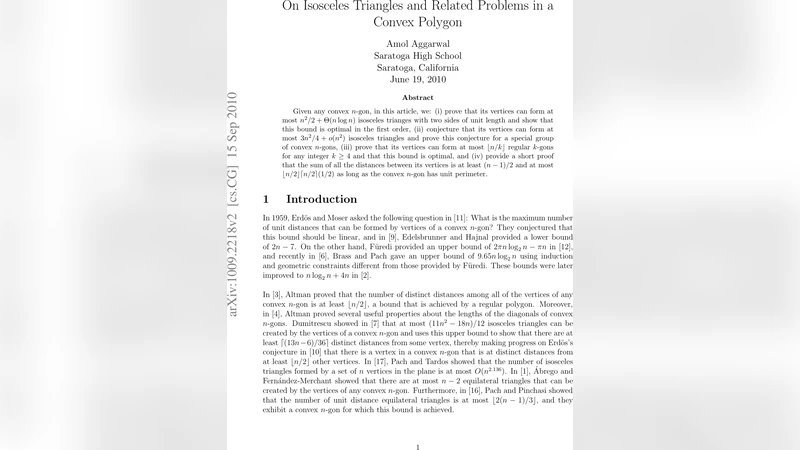
Given any convex $n$-gon, in this article, we: (i) prove that its vertices can form at most $n^2/2 + \Theta(n\log n)$ isosceles trianges with two sides of unit length and show that this bound is optimal in the first order, (ii) conjecture that its vertices can form at most $3n^2/4 + o(n^2)$ isosceles triangles and prove this conjecture for a special group of convex $n$-gons, (iii) prove that its vertices can form at most $\lfloor n/k \rfloor$ regular $k$-gons for any integer $k\ge 4$ and that this bound is optimal, and (iv) provide a short proof that the sum of all the distances between its vertices is at least $(n-1)/2$ and at most $\lfloor n/2 \rfloor \lceil n/2 \rceil(1/2)$ as long as the convex $n$-gon has unit perimeter.
💡 Research Summary
The paper investigates extremal combinatorial geometry problems concerning the vertices of a convex $n$‑gon. Four main results are presented.
- Unit‑side isosceles triangles.
The authors consider isosceles triangles whose two equal sides have length 1. By viewing the set of vertices as a unit‑distance graph, they show that each vertex can be incident to at most $O(\log n)$ unit‑distance edges (a consequence of classical Erdős‑Moser‑Szekeres type bounds). Double‑counting the triangles that have a given vertex as the apex yields an upper bound of
\
Comments & Academic Discussion
Loading comments...
Leave a Comment