Fast conservative and entropic numerical methods for the Boson Boltzmann equation
In this paper we derive accurate numerical methods for the quantum Boltzmann equation for a gas of interacting bosons. The schemes preserve the main physical features of the continuous problem, namely
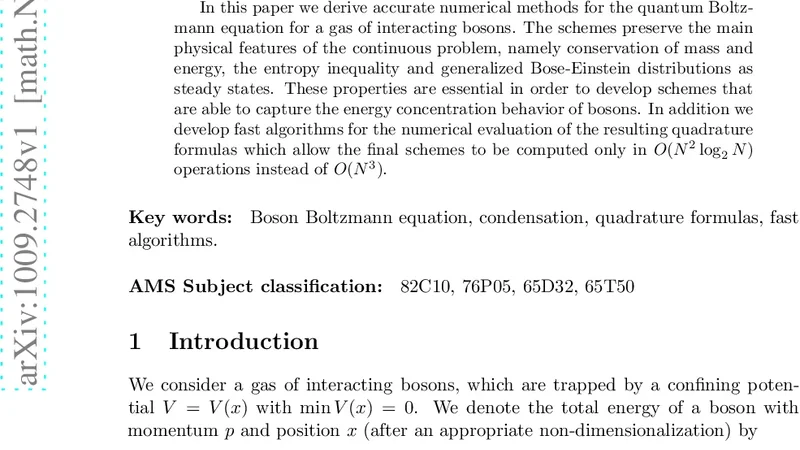
In this paper we derive accurate numerical methods for the quantum Boltzmann equation for a gas of interacting bosons. The schemes preserve the main physical features of the continuous problem, namely conservation of mass and energy, the entropy inequality and generalized Bose-Einstein distributions as steady states. These properties are essential in order to develop schemes that are able to capture the energy concentration behavior of bosons. In addition we develop fast algorithms for the numerical evaluation of the resulting quadrature formulas which allow the final schemes to be computed only in O(N^2 log N) operations instead of O(N^3).
💡 Research Summary
The paper presents a comprehensive framework for the numerical solution of the Boson Boltzmann equation (BBE), which governs the non‑equilibrium dynamics of a dilute gas of interacting bosons. The authors begin by emphasizing three fundamental physical properties of the continuous BBE: conservation of particle number (mass), conservation of total energy, and the entropy inequality that guarantees monotonic decay of the quantum entropy functional. Moreover, the equilibrium states of the BBE are the generalized Bose‑Einstein distributions, characterized by a chemical potential μ and inverse temperature β. Any reliable discretization must respect these structures; otherwise, spurious numerical artifacts such as unphysical energy blow‑up or failure to capture Bose‑Einstein condensation (BEC) can occur.
To address this, the authors construct a conservative‑entropy discretization. The collision integral is first symmetrized with respect to the exchange of pre‑ and post‑collision energies, yielding a form that naturally separates into a divergence‑free (mass‑energy conserving) part and a dissipative (entropy‑producing) part. The discretized collision operator is expressed as a bilinear form \
📜 Original Paper Content
🚀 Synchronizing high-quality layout from 1TB storage...