This document consists of two parts: the second part was submitted earlier as a new proof of Nash's theorem, and the first part is a note explaining a problem found in that proof. We are indebted to Sergiu Hart and Eran Shmaya for their careful study which led to their simultaneous discovery of this error. So far the error has not been fixed, but many of the results and techniques of the paper remain valid, so we will continue to make it available online. Abstract for the original paper: We give a novel proof of the existence of Nash equilibria in all finite games without using fixed point theorems or path following arguments. Our approach relies on a new notion intermediate between Nash and correlated equilibria called exchangeable equilibria, which are correlated equilibria with certain symmetry and factorization properties. We prove these exist by a duality argument, using Hart and Schmeidler's proof of correlated equilibrium existence as a first step. In an appropriate limit exchangeable equilibria converge to the convex hull of Nash equilibria, proving that these exist as well. Exchangeable equilibria are defined in terms of symmetries of the game, so this method automatically proves the stronger statement that a symmetric game has a symmetric Nash equilibrium. The case without symmetries follows by a symmetrization argument.
Deep Dive into A partial proof of Nashs Theorem via exchangeable equilibria.
This document consists of two parts: the second part was submitted earlier as a new proof of Nash’s theorem, and the first part is a note explaining a problem found in that proof. We are indebted to Sergiu Hart and Eran Shmaya for their careful study which led to their simultaneous discovery of this error. So far the error has not been fixed, but many of the results and techniques of the paper remain valid, so we will continue to make it available online. Abstract for the original paper: We give a novel proof of the existence of Nash equilibria in all finite games without using fixed point theorems or path following arguments. Our approach relies on a new notion intermediate between Nash and correlated equilibria called exchangeable equilibria, which are correlated equilibria with certain symmetry and factorization properties. We prove these exist by a duality argument, using Hart and Schmeidler’s proof of correlated equilibrium existence as a first step. In an appropriate limit
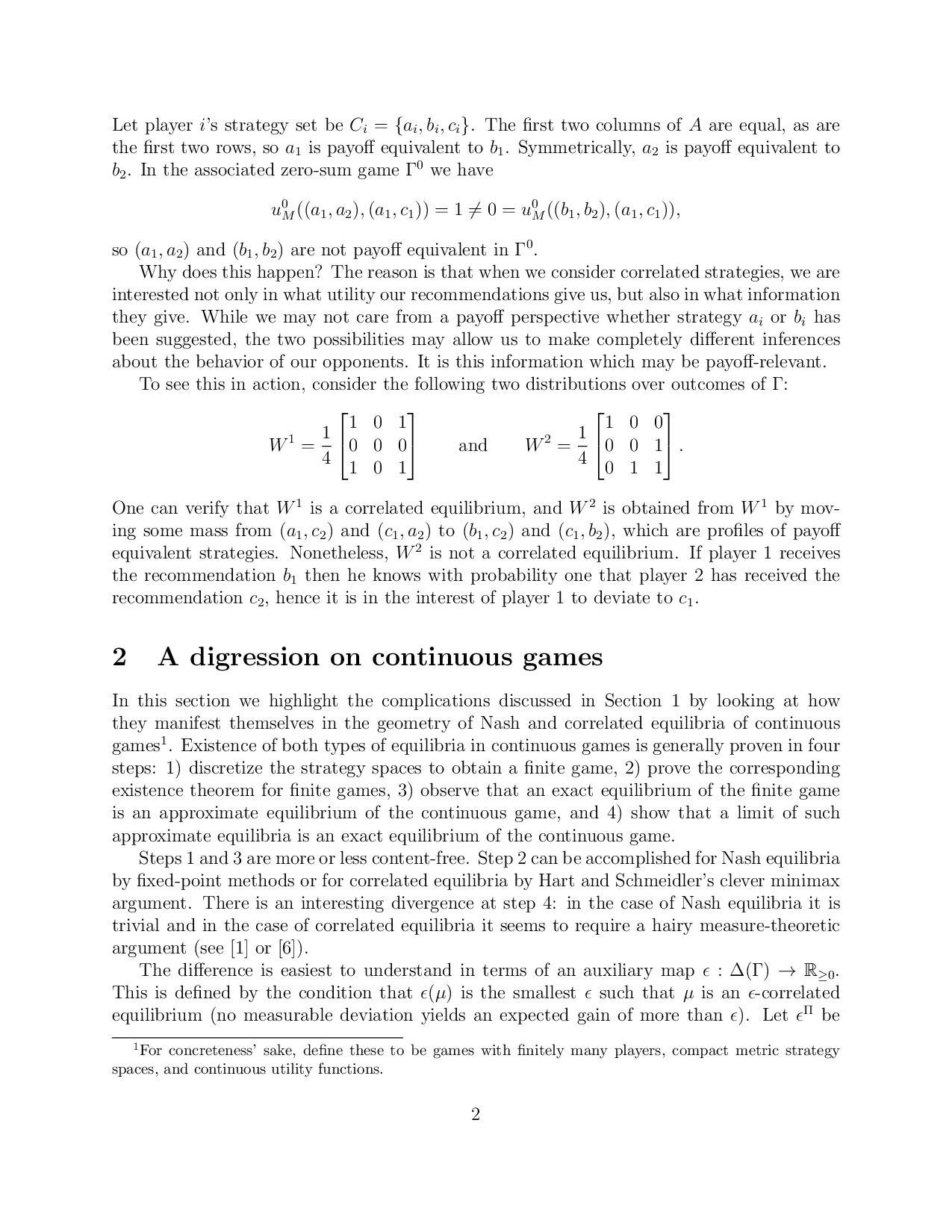
Let player i's strategy set be C i = {a i , b i , c i }. The first two columns of A are equal, as are the first two rows, so a 1 is payoff equivalent to b 1 . Symmetrically, a 2 is payoff equivalent to b 2 . In the associated zero-sum game Γ 0 we have u 0 M ((a 1 , a 2 ), (a 1 , c 1 )) = 1 = 0 = u 0 M ((b 1 , b 2 ), (a 1 , c 1 )), so (a 1 , a 2 ) and (b 1 , b 2 ) are not payoff equivalent in Γ 0 . Why does this happen? The reason is that when we consider correlated strategies, we are interested not only in what utility our recommendations give us, but also in what information they give. While we may not care from a payoff perspective whether strategy a i or b i has been suggested, the two possibilities may allow us to make completely different inferences about the behavior of our opponents. It is this information which may be payoff-relevant.
To see this in action, consider the following two distributions over outcomes of Γ:
One can verify that W1 is a correlated equilibrium, and W 2 is obtained from W 1 by moving some mass from (a 1 , c 2 ) and (c 1 , a 2 ) to (b 1 , c 2 ) and (c 1 , b 2 ), which are profiles of payoff equivalent strategies. Nonetheless, W 2 is not a correlated equilibrium. If player 1 receives the recommendation b 1 then he knows with probability one that player 2 has received the recommendation c 2 , hence it is in the interest of player 1 to deviate to c 1 .
In this section we highlight the complications discussed in Section 1 by looking at how they manifest themselves in the geometry of Nash and correlated equilibria of continuous games 1 . Existence of both types of equilibria in continuous games is generally proven in four steps: 1) discretize the strategy spaces to obtain a finite game, 2) prove the corresponding existence theorem for finite games, 3) observe that an exact equilibrium of the finite game is an approximate equilibrium of the continuous game, and 4) show that a limit of such approximate equilibria is an exact equilibrium of the continuous game.
Steps 1 and 3 are more or less content-free.
Step 2 can be accomplished for Nash equilibria by fixed-point methods or for correlated equilibria by Hart and Schmeidler’s clever minimax argument. There is an interesting divergence at step 4: in the case of Nash equilibria it is trivial and in the case of correlated equilibria it seems to require a hairy measure-theoretic argument (see [1] or [6]).
The difference is easiest to understand in terms of an auxiliary map : ∆(Γ) → R ≥0 . This is defined by the condition that (µ) is the smallest such that µ is an -correlated equilibrium (no measurable deviation yields an expected gain of more than ). Let Π be the restriction of to ∆ Π (Γ). Then Π (µ) is also the smallest such that µ is an -Nash equilibrium in the usual sense.
We can study the map via two different topologies on its domain ∆(Γ): the weak and strong topologies. Two measures are near each other in the strong topology if you can get from one to the other without moving much mass. They are near each other in the weak topology if you can get from one to the other without moving much mass very far.
It is easy to show that is continuous with respect to the strong topology, but this is not very useful because ∆(Γ) is not compact with respect to this topology (at least when Γ is not a finite game) so the limiting arguments do not go through. It is compact with respect to the weak topology and viewing ∆ Π (Γ) as a space of tuples it is easy to show that Π is continuous with respect to the weak topology, hence we get the necessary limiting argument for the existence of Nash equilibria.
For correlated equilibria the situation is different: is not weakly continuous! The argument is essentially the same as why W 1 was a correlated equilibrium in Example 2 but W 2 was not. We can move some mass a little bit (thinking now of strategically equivalent strategies as being quite “close” to each other) and change the information conveyed by the correlating device drastically. This changes an exact correlated equilibrium to a distribution for which is bounded away from zero, no matter how small the distance we moved the mass.
In particular this shows that is not weakly upper semicontinuous. In fact this doesn’t matter; all we really need for the existence proof is weak lower semicontinuity. It turns out has this property, but proving it is a delicate technical matter (again, see [1] or [6]).
The fact that Nash equilibria behave nicely with respect to strategic equivalence is what allows us to turn problems regarding mixed Nash equilibria of polynomial games into finitedimensional problems in moment spaces: see for example [2] and [3]. The failure of correlated equilibria to behave nicely with respect to strategic equivalence is captured by the fact that the corresponding problems for correlated equilibria are inherently infinite-dimensional [4].
The erroneous proof of Lemma 4.6 claims to construct, for any symmetric mixed strategy y
…(Full text truncated)…
This content is AI-processed based on ArXiv data.