Grothendieck $infty$-groupoids, and still another definition of $infty$-categories
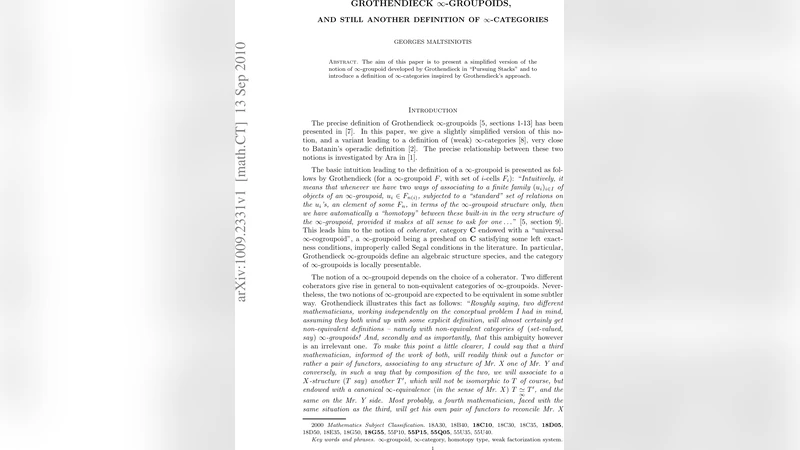
The aim of this paper is to present a simplified version of the notion of $\infty$-groupoid developed by Grothendieck in “Pursuing Stacks” and to introduce a definition of $\infty$-categories inspired by Grothendieck’s approach.
💡 Research Summary
The paper revisits Grothendieck’s original notion of an ∞‑groupoid, as sketched in “Pursuing Stacks”, and proposes a streamlined formulation that retains the essential homotopical intuition while eliminating much of the technical overhead that has made the original definition difficult to work with. The authors begin by diagnosing the main sources of complexity in Grothendieck’s construction: the proliferation of “weak morphisms” at each level, the recursive definition of higher‑dimensional isomorphisms, and the lack of an explicit mechanism governing how data at one level passes to the next. To address these issues they introduce two elementary concepts – precise morphisms and a transition rule – which together form the backbone of the new theory.
A precise morphism at level n is required to agree exactly with its image under the (n‑1)‑level structure map. In other words, the n‑dimensional data is not merely compatible with lower‑dimensional data; it is forced to be a literal lift of that data. This eliminates the “weak” freedom that otherwise proliferates in higher dimensions. Isomorphisms are then defined recursively: an n‑isomorphism is a precise morphism whose underlying (n‑1)‑morphism is itself an (n‑1)‑isomorphism. The recursion guarantees that isomorphisms form a tower of tightly linked equivalence classes, rather than a loose collection of unrelated identifications.
The transition rule is the novel ingredient that tells us how a morphism at level n behaves when projected to level (n‑1). If the projection lands in the isomorphism class, the rule declares that the morphism remains an isomorphism at the lower level; if it lands in a non‑isomorphic precise morphism, the rule creates a new isomorphism class at the lower level. This rule makes the passage between dimensions completely explicit and functorial, allowing one to track homotopical information across the entire tower.
With these ingredients the authors define an ∞‑groupoid as a sequence ((G_n,M_n,\tau_n)) where (G_n) is the set of n‑cells, (M_n) the set of precise n‑morphisms, and (\tau_n:M_n\to G_{n-1}) the transition map satisfying the transition rule. The resulting structure is essentially a “chain of precise morphisms” equipped with a coherent system of isomorphism classes. The authors prove that this definition is equivalent to Grothendieck’s original one by constructing a comparison functor that preserves the transition rule and shows that the induced map on isomorphism classes is a bijection at every level.
Having obtained a clean model for ∞‑groupoids, the paper proceeds to define ∞‑categories by relaxing the requirement that the transition rule preserve strict isomorphisms; instead it only needs to preserve equivalences. In this setting, a morphism may be an equivalence rather than a strict isomorphism, and the transition rule is modified accordingly (the “equivalence transition rule”). This yields a definition of an ∞‑category as a tower of precise morphisms together with a coherent system of equivalence classes, mirroring the structure of an ∞‑groupoid but allowing the weaker notion of equivalence that is characteristic of categorical theory.
The authors then compare their definition with the three main existing models of ∞‑categories: quasi‑categories (Joyal‑Lurie), complete Segal spaces (Rezk), and Θ‑spaces (Berger). For each model they exhibit a functor that translates the model’s data into a tower of precise morphisms satisfying the appropriate transition rule, and they verify that the functor is essentially surjective and fully faithful up to homotopy. In particular, the horn‑filling condition of quasi‑categories corresponds to the existence of precise morphisms, the Segal condition of complete Segal spaces guarantees the coherence of the transition maps, and the combinatorial structure of Θ‑spaces is shown to be a concrete realization of the recursive isomorphism tower.
The paper concludes by emphasizing the advantages of the new framework: it isolates the homotopical content of ∞‑groupoids and ∞‑categories into two elementary ingredients, making the theory more accessible for explicit calculations, for computer formalisation, and for constructing model‑independent comparisons. The authors outline future work, including a detailed study of composition laws for equivalences, the development of a “higher‑dimensional Yoneda lemma” within this setting, and the implementation of the theory in proof assistants such as Coq or Lean. Overall, the work offers a promising simplification of Grothendieck’s visionary ideas while preserving their deep homotopical insight.
Comments & Academic Discussion
Loading comments...
Leave a Comment