A discrete Gauss-Bonnet type theorem
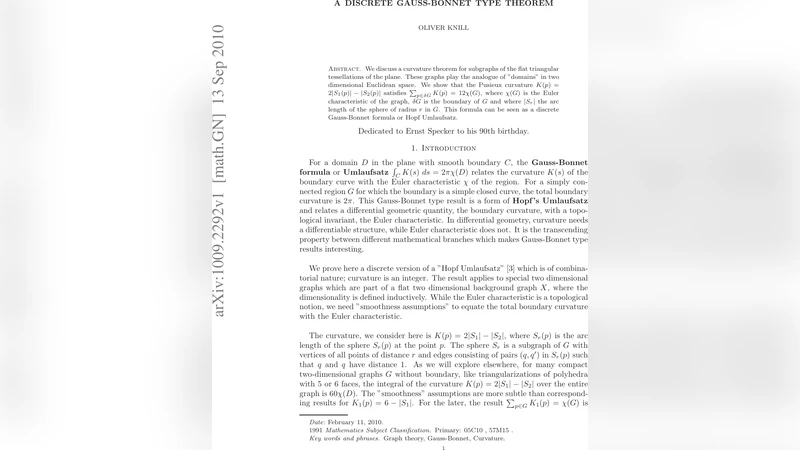
We prove a prototype curvature theorem for subgraphs G of the flat triangular tesselation which play the analogue of “domains” in two dimensional Euclidean space: The Pusieux curvature K(p) = 2|S1(p)| - |S2(p)| is equal to 12 times the Euler characteristic when summed over the boundary of G. Here |S1(p)| is the arc length of the unit sphere of p and |S2(p)| is the arc length of the sphere of radius 2. This curvature 12 formula is discrete Gauss-Bonnet formula or Hopf Umlaufsatz. The curvature introduced here is motivated by analogue constructions in the continuum like the Jacobi equations for geodesic flows. For the first order curvature K1(p) = 6-|S1(p)|, Gauss-Bonnet results are much easier to show, are less “differential geometric” but generalize to rather general 2-dimensional graphs G=(V,E): The sum of the K1 curvatures over the entire graph is 6 times the Euler characteristic of G, where the Euler characteristic is defined as v-e+f where v=|V|,e=|E| and f is the number of triangles. For many abstract two dimensional graphs, the sum over all K curvatures is 60 times the Euler characteristic. Under which conditions this curvature 60 theorem holds is still under investigation. In our proof of the curvature 12 theorem, the concept of dimension for abstract graphs plays an important role: a vertex p of a finite abstract graph X=(V,E) is called 0-dimensional, if p is not connected to any other vertex. A subset G of X is called 0-dimensional if every point of G is 0-dimensional in G. A vertex p of G is called 1-dimensional if S1(p) is zero dimensional. A finite subset G of X is called 1-dimensional if any of the points in G is 1-dimensional. A point p of G is called 2 dimensional, if S1(p) is a one-dimensional graph and a subset G of the graph is called 2-dimensional, if every vertex p of G is 2-dimensional.
💡 Research Summary
The paper presents a discrete analogue of the Gauss‑Bonnet theorem for finite subgraphs G of the regular triangular tiling of the Euclidean plane. The authors introduce a curvature function, called the Pusieux curvature, defined at each vertex p by
\
Comments & Academic Discussion
Loading comments...
Leave a Comment