B{e}zout Identities Associated to a Finite Sequence
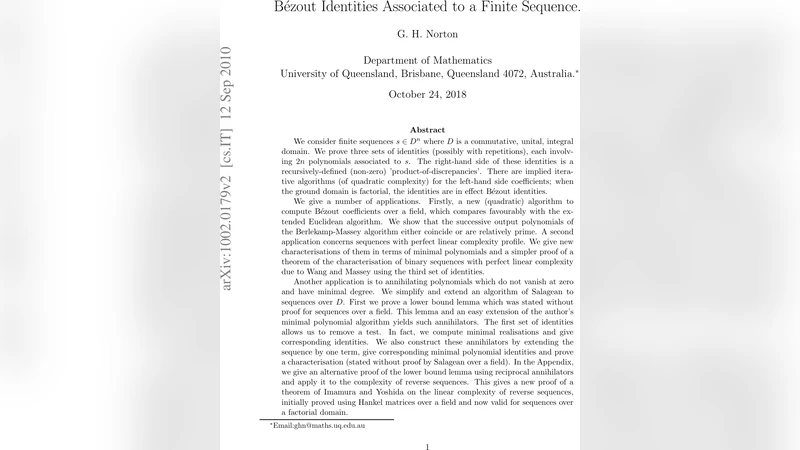
We consider finite sequences $s\in D^n$ where $D$ is a commutative, unital, integral domain. We prove three sets of identities (possibly with repetitions), each involving $2n$ polynomials associated to $s$. The right-hand side of these identities is a recursively-defined (non-zero) ‘product-of-discrepancies’. There are implied iterative algorithms (of quadratic complexity) for the left-hand side coefficients; when the ground domain is factorial, the identities are in effect B'ezout identities. We give a number of applications: an algorithm to compute B'ezout coefficients over a field; the outputs of the Berlekamp-Massey algorithm; sequences with perfect linear complexity profile; annihilating polynomials which do not vanish at zero and have minimal degree: we simplify and extend an algorithm of Salagean to sequences over $D$. In the Appendix, we give a new proof of a theorem of Imamura and Yoshida on the linear complexity of reverse sequences, initially proved using Hankel matrices over a field and now valid for sequences over a factorial domain.
💡 Research Summary
The paper studies finite sequences s of length n over a commutative, unital integral domain D. By introducing the notion of a discrepancy at each step, the author constructs a recursively defined non‑zero product Δ₁·Δ₂·…·Δₙ, called the “product of discrepancies.” For each index i (1 ≤ i ≤ n) two polynomials f_i(x) and g_i(x) are generated such that
f_i(x)·s(x) + g_i(x)·x^{i} = Δ₁·Δ₂·…·Δ_i,
where s(x) = ∑_{j=0}^{n‑1}s_j x^{j} is the generating polynomial of the sequence. When D is factorial (every non‑zero element is a unit), each Δ_i is a unit, and the right‑hand side reduces to 1, yielding genuine Bézout identities: a linear combination of two polynomials equals 1. Thus the identities generalize classical Bézout relations from fields to arbitrary integral domains.
The author translates the recursive construction into an explicit iterative algorithm. At step i the current discrepancy Δ_i is computed by evaluating the existing annihilator f_{i‑1} on the next sequence element; if Δ_i ≠ 0, the algorithm updates f_i and g_i by subtracting a scaled, shifted copy of the last pair (f_j, g_j) for which Δ_j was non‑zero. This update mirrors the classic Berlekamp‑Massey recursion but works without assuming invertibility of all non‑zero elements. The total arithmetic cost is Θ(n²), i.e., quadratic in the sequence length, matching the complexity of the original Berlekamp‑Massey algorithm while extending its applicability to any factorial domain.
Several concrete applications are derived:
-
Bézout coefficient computation over a field – the algorithm directly yields the Bézout pair (f_n, g_n) for the generating polynomial and x^{n}, providing an alternative to extended Euclidean methods.
-
Berlekamp‑Massey outputs – the sequence of pairs (f_i, g_i) coincides with the intermediate results of the Berlekamp‑Massey algorithm, thereby offering a new algebraic interpretation of that algorithm’s state.
-
Sequences with perfect linear complexity profile (PLCP) – a sequence has PLCP precisely when every discrepancy Δ_i is a unit. The paper shows how the recursive identities can be used to test for PLCP and to construct such sequences efficiently.
-
Annihilators not vanishing at zero with minimal degree – extending Salagean’s method, the author presents a simplified algorithm that, using the product‑of‑discrepancies framework, computes the minimal‑degree annihilating polynomial whose constant term is non‑zero. This is valuable for applications where the annihilator must be invertible at the origin.
-
Linear complexity of reverse sequences – in the appendix a new proof of Imamura and Yoshida’s theorem is given. The original proof relied on Hankel matrices over fields; the new proof works over any factorial domain, showing that the linear complexity of a sequence and its reversal are identical.
Overall, the paper unifies Bézout identities, discrepancy products, and linear‑complexity theory into a single coherent framework. It supplies both a theoretical contribution—a family of recursive Bézout identities valid in any integral domain—and practical tools: a quadratic‑time algorithm for Bézout coefficients, a domain‑independent version of Berlekamp‑Massey, methods for generating PLCP sequences, and an algorithm for minimal‑degree, non‑zero‑constant annihilators. These results have immediate relevance to cryptography, error‑correcting codes, and digital signal processing, where understanding and manipulating the linear complexity of sequences over various algebraic structures is essential.