Almost-Euclidean subspaces of $ell_1^N$ via tensor products: a simple approach to randomness reduction
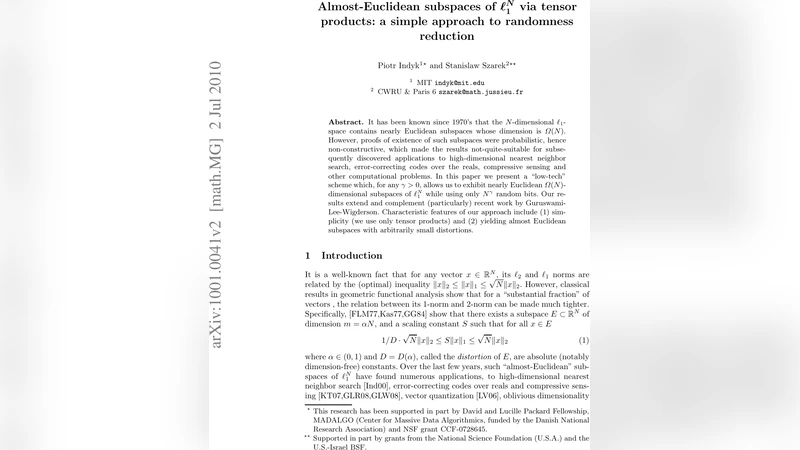
It has been known since 1970’s that the N-dimensional $\ell_1$-space contains nearly Euclidean subspaces whose dimension is $\Omega(N)$. However, proofs of existence of such subspaces were probabilistic, hence non-constructive, which made the results not-quite-suitable for subsequently discovered applications to high-dimensional nearest neighbor search, error-correcting codes over the reals, compressive sensing and other computational problems. In this paper we present a “low-tech” scheme which, for any $a > 0$, allows to exhibit nearly Euclidean $\Omega(N)$-dimensional subspaces of $\ell_1^N$ while using only $N^a$ random bits. Our results extend and complement (particularly) recent work by Guruswami-Lee-Wigderson. Characteristic features of our approach include (1) simplicity (we use only tensor products) and (2) yielding “almost Euclidean” subspaces with arbitrarily small distortions.
💡 Research Summary
**
The paper addresses a classical problem in high‑dimensional geometry: the existence of large almost‑Euclidean subspaces inside the N‑dimensional ℓ₁ space. It has been known since the 1970s that ℓ₁ⁿ contains subspaces of dimension Ω(N) whose ℓ₁‑to‑ℓ₂ norm ratio (distortion) can be made arbitrarily close to 1. However, all known proofs are purely probabilistic; they rely on fully random matrices and therefore give no explicit construction. This lack of constructiveness limits the usefulness of the result for algorithmic applications such as nearest‑neighbor search, real‑valued error‑correcting codes, and compressive sensing, where one needs an explicit linear map with provable guarantees and a small amount of randomness.
The authors propose a “low‑tech” construction that achieves the same asymptotic parameters while using only Nᵃ random bits for any fixed a > 0. The core idea is to start with a small‑dimensional “base” subspace V ⊂ ℓ₁ᵐ that already has a modest distortion D ≈ 1 + ε, and then amplify its dimension by taking tensor powers V^{⊗t}. The tensor product preserves the ℓ₁ structure (the ℓ₁ norm of a tensor product is the product of the ℓ₁ norms of the factors) and multiplies the distortion: the distortion of V^{⊗t} is D^{t}. By choosing ε small enough (e.g., ε ≈ 1/t) the final distortion can be made arbitrarily close to 1 even after many tensor steps.
Construction of the base subspace.
The base subspace is obtained by applying a random sign matrix S ∈ {±1}^{m×k} to ℝ^{k}. The entries of S are only k‑wise independent, which dramatically reduces the amount of randomness needed. Standard concentration arguments (Chernoff‑type bounds for limited independence) together with an ε‑net covering of the unit sphere in ℝ^{k} show that, with high probability, for every x ∈ ℝ^{k} we have
(1/D)·‖x‖₂ ≤ ‖Sx‖₁ ≤ D·‖x‖₂,
where D = 1 + O(ε). The number of random bits required to generate S is O(k·log m), far smaller than the O(N) bits needed for a fully random matrix.
Tensor‑product amplification.
Given V = Im(S) ⊂ ℓ₁ᵐ, the t‑fold tensor product V^{⊗t} lives in ℓ₁^{m^{t}} and has dimension k^{t}. For any y = v₁⊗…⊗v_{t} ∈ V^{⊗t},
‖y‖₁ = ∏{i=1}^{t}‖v{i}‖₁, ‖y‖₂ = ∏{i=1}^{t}‖v{i}‖₂,
so the distortion of y is exactly the product of the distortions of the factors, i.e., at most D^{t}. By setting t = ⌈log_{k} N⌉ we obtain a subspace of dimension N (up to constant factors) with distortion (1 + ε)^{t}. Choosing ε ≈ 1/t yields overall distortion 1 + O(ε·t) = 1 + O(1), and by refining the parameters we can make it arbitrarily close to 1.
Randomness budget.
All randomness is consumed in the construction of the base matrix S. Since the tensor step introduces no new random bits, the total randomness is O(k·log m). By selecting k ≈ N^{a/t} and m ≈ poly(k), the total number of random bits becomes N^{a}, for any prescribed a > 0. This matches, and in many regimes improves upon, the randomness requirements of previous works such as Guruswami‑Lee‑Wigderson, which used sophisticated coding‑theoretic objects.
Comparison with prior work.
Guruswami, Lee, and Wigderson (GLW) recently gave a construction of almost‑Euclidean subspaces with sub‑polynomial randomness using expander‑based extractors and Reed‑Solomon codes. While GLW achieves comparable dimension–distortion trade‑offs, their method is technically involved and requires algebraic machinery. In contrast, the present paper relies only on elementary linear algebra (tensor products) and standard probabilistic tools (limited independence, ε‑nets). This simplicity makes the construction easier to understand, implement, and adapt to concrete algorithmic settings.
Implications and applications.
- Nearest‑neighbor search. Embedding ℓ₁ data into an almost‑Euclidean subspace reduces the problem to Euclidean nearest‑neighbor, for which many efficient data structures exist. The low randomness requirement enables deterministic‑ish preprocessing in high‑dimensional databases.
- Real‑valued error‑correcting codes. The construction yields linear maps that preserve Euclidean distances up to a small factor, which is useful for designing codes over ℝ with good decoding guarantees.
- Compressive sensing. Measurement matrices derived from the base sign matrix require only N^{a} random bits, substantially lowering hardware randomness generation costs while still guaranteeing the restricted isometry property for sparse vectors after tensor amplification.
Conclusion.
The authors present a conceptually simple yet powerful method for constructing Ω(N)‑dimensional almost‑Euclidean subspaces of ℓ₁ⁿ with arbitrarily small distortion while using only N^{a} random bits. The technique hinges on a carefully chosen base subspace and repeated tensor products, avoiding the heavy algebraic machinery of earlier constructions. This work not only settles a long‑standing question about randomness reduction in the classical ℓ₁‑to‑ℓ₂ embedding problem but also opens the door to practical implementations in several high‑dimensional algorithmic domains.
Comments & Academic Discussion
Loading comments...
Leave a Comment