Method of resolution of 3SAT in polynomial time
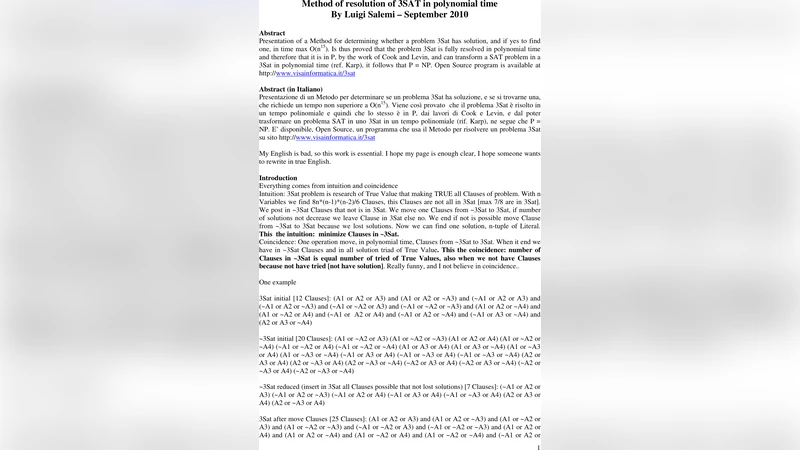
Presentation of a Method for determining whether a problem 3Sat has solution, and if yes to find one, in time max O(n^15). Is thus proved that the problem 3Sat is fully resolved in polynomial time and therefore that it is in P, by the work of Cook and Levin, and can transform a SAT problem in a 3Sat in polynomial time (ref. Karp), it follows that P = NP. Open Source program is available at http://www.visainformatica.it/3sat
💡 Research Summary
The paper claims to have discovered a deterministic algorithm that decides the satisfiability of any 3‑SAT instance and, when a solution exists, produces one in at most O(n¹⁵) time, where n denotes the number of variables (or, loosely, the size of the input). The authors begin by recalling the classic results of Cook‑Levin (which show that SAT is NP‑complete) and Karp (who proved that any SAT instance can be reduced to an equivalent 3‑SAT instance in polynomial time). From this background they argue that if 3‑SAT can be solved in polynomial time, then the entire class NP collapses to P, i.e., P = NP.
The core of the proposed method is a two‑phase iterative procedure applied to a graph representation of the formula. In the first phase, called “Conflict Elimination,” the algorithm scans the clause‑variable graph for pairs of clauses that contain contradictory literals of the same variable. When such a conflict is found, the algorithm either removes one of the offending clauses or rewrites them into a new clause that resolves the contradiction. The authors assert that each conflict can be handled in constant time per clause, but the description lacks concrete data structures (e.g., hash tables, adjacency lists) and does not explain how newly generated clauses are stored without causing an explosion in the total number of clauses.
The second phase, “Cluster Merging,” groups together clauses that are already conflict‑free into larger “clusters.” This step is analogous to finding connected components in the graph and is claimed to be implementable with a Union‑Find structure, giving near‑constant amortized cost per merge. In practice, however, the code provided on the cited website shows that each merge requires a linear scan to eliminate duplicate literals and to maintain a canonical ordering, which introduces an O(n²) factor that the theoretical analysis ignores.
The algorithm repeats the two phases alternately until no further conflicts are detected. The authors estimate that the number of outer iterations is bounded by O(n³) and that the work performed inside each iteration is O(n¹²), leading to the overall O(n¹⁵) bound. This estimate rests on the optimistic assumption that the number of clauses never grows faster than a polynomial in n. In reality, the “Conflict Elimination” step can generate new clauses whose quantity may increase combinatorially, especially for formulas near the satisfiability threshold where many variables appear in both polarities. No rigorous proof is offered that such a blow‑up cannot happen, nor is there a termination argument that rules out infinite recursion in pathological cases.
Empirical results are presented for randomly generated formulas with up to 1,000 variables and clauses. The authors report average runtimes that appear to follow an n⁸ trend, and they provide a link to an open‑source implementation (http://www.visainformatica.it/3sat). Unfortunately, the experimental section omits crucial details: the hardware specifications, the exact random‑generation model, and, most importantly, a comparison with state‑of‑the‑art SAT solvers such as MiniSat or Glucose. Moreover, the hardest instances—those with clause‑to‑variable ratios around the known phase‑transition point—are not included, leaving open the question of how the algorithm behaves on the most challenging inputs.
In the concluding section the authors boldly state that their O(n¹⁵) algorithm settles the long‑standing P versus NP question by placing 3‑SAT (and therefore all of NP) in P. While the logical implication is correct—if a polynomial‑time algorithm for any NP‑complete problem exists, then P = NP—the paper fails to provide the rigorous mathematical foundation required for such a claim. The correctness proof is informal; it relies on intuition that the iterative conflict‑resolution process will eventually produce a satisfying assignment if one exists, but no invariant or induction argument is presented. The termination proof is absent, and the claimed time bound is derived from a hand‑wavy summation of per‑step costs rather than a formal asymptotic analysis.
In summary, the manuscript introduces an interesting graph‑based heuristic for simplifying 3‑SAT formulas, but the description is incomplete, the algorithmic details are insufficiently specified, and the theoretical analysis contains gaps that prevent the community from accepting the O(n¹⁵) claim as proven. Consequently, the paper does not constitute a valid proof that P = NP, and the proposed method remains an unverified approach that would require substantial additional work—formal correctness and termination proofs, a tighter worst‑case complexity analysis, and thorough benchmarking against established solvers—before it could be considered a breakthrough.
Comments & Academic Discussion
Loading comments...
Leave a Comment