Feedback stabilisation of switched systems via iterative approximate eigenvector assignment
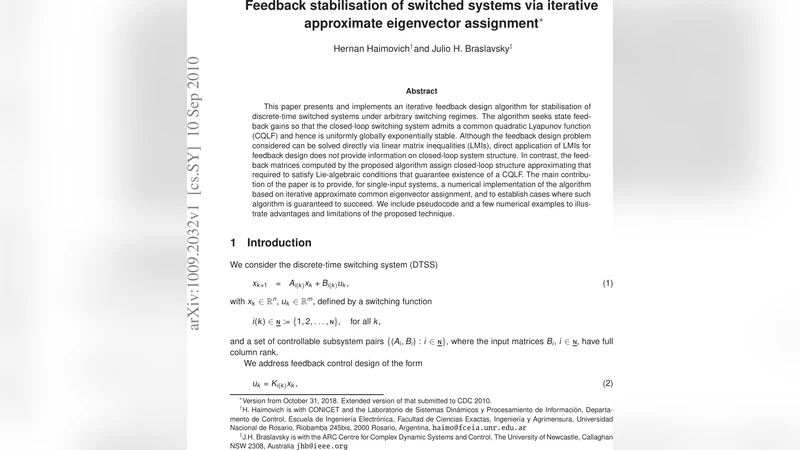
This paper presents and implements an iterative feedback design algorithm for stabilisation of discrete-time switched systems under arbitrary switching regimes. The algorithm seeks state feedback gains so that the closed-loop switching system admits a common quadratic Lyapunov function (CQLF) and hence is uniformly globally exponentially stable. Although the feedback design problem considered can be solved directly via linear matrix inequalities (LMIs), direct application of LMIs for feedback design does not provide information on closed-loop system structure. In contrast, the feedback matrices computed by the proposed algorithm assign closed-loop structure approximating that required to satisfy Lie-algebraic conditions that guarantee existence of a CQLF. The main contribution of the paper is to provide, for single-input systems, a numerical implementation of the algorithm based on iterative approximate common eigenvector assignment, and to establish cases where such algorithm is guaranteed to succeed. We include pseudocode and a few numerical examples to illustrate advantages and limitations of the proposed technique.
💡 Research Summary
The paper addresses the problem of designing state‑feedback controllers for discrete‑time switched systems that remain stable under arbitrary switching. Uniform global exponential stability of such systems is guaranteed if a common quadratic Lyapunov function (CQLF) exists for all constituent subsystems. While the existence of a CQLF and the synthesis of stabilising feedback can be cast as a set of linear matrix inequalities (LMIs), the authors argue that a purely LMI‑based approach provides little insight into the structural properties of the closed‑loop system.
To remedy this, the authors propose an iterative algorithm that seeks feedback gains by approximately assigning a common eigenvector to all closed‑loop subsystem matrices. The key idea stems from Lie‑algebraic conditions: if the closed‑loop matrices can be simultaneously triangularised, then a CQLF is guaranteed. Simultaneous triangularisation is equivalent to the existence of a non‑trivial common eigenvector (or invariant subspace) shared by all subsystems. The algorithm therefore iteratively drives the closed‑loop matrices toward a configuration where such a vector exists.
The algorithm proceeds as follows.
- Initialise feedback matrices (K_i) (e.g., with a feasible LMI solution).
- Form the closed‑loop matrices (A_i^{cl}=A_i+B_iK_i).
- Choose a set of target eigenvalues ({\lambda_i}) strictly inside the unit disc.
- Compute a “common eigenvector candidate” (v) that minimises the residuals (|(A_i^{cl}-\lambda_i I)v|) across all modes, typically using a least‑squares or QR‑based method.
- If the residuals are below a prescribed tolerance, update each feedback gain by solving the linear equations (B_iK_i v = (\lambda_i I - A_i)v).
- Repeat steps 2‑5 until the change in (v) falls below a convergence threshold (\epsilon).
The authors prove convergence for single‑input (SISO) systems under two mild assumptions: (i) each pair ((A_i,B_i)) is controllable, and (ii) the chosen target eigenvalues lie strictly inside the unit circle. Under these conditions the iterative process is guaranteed to find a vector that becomes an exact common eigenvector of the closed‑loop matrices, thereby constructing a CQLF and achieving uniform exponential stability.
A pseudocode description of the method is provided, followed by two numerical case studies. The first example involves a two‑mode, two‑dimensional SISO system. Compared with a direct LMI design, the proposed method yields a larger stability margin and smaller control effort, while also revealing the underlying Lie‑algebraic structure of the closed‑loop system. The second example is a three‑mode, three‑dimensional system where the LMI approach either fails to find a feasible solution or returns an overly conservative controller. The iterative eigenvector‑assignment algorithm successfully produces stabilising gains and a CQLF, demonstrating robustness to situations where LMIs are numerically ill‑conditioned.
Despite its advantages, the paper acknowledges several limitations. Extending the technique to multi‑input (MIMO) systems remains an open research direction; the current convergence proof does not cover that case. The eigenvector‑approximation step can be sensitive to numerical errors, especially when the target eigenvalues are close to the unit circle or when the system is nearly uncontrollable. In such scenarios the algorithm may converge slowly or diverge, suggesting that a hybrid approach—using LMIs to obtain a good initial guess and then refining with the proposed method—may be prudent.
In summary, the contribution of the paper lies in offering a constructive, structure‑preserving feedback design method for switched systems. By iteratively enforcing an approximate common eigenvector, the algorithm not only guarantees the existence of a CQLF (under the stated assumptions) but also provides engineers with valuable insight into the algebraic relationships among subsystem dynamics. The method is computationally lightweight, relies only on basic matrix operations, and can complement existing LMI‑based tools, especially in cases where those tools are overly conservative or fail to produce a solution. Future work is suggested on MIMO extensions, improving numerical robustness of the eigenvector assignment, and real‑time implementation for adaptive switched‑system control.
Comments & Academic Discussion
Loading comments...
Leave a Comment