Measurement of the Cosmic Ray B/C Ratio with the AMS-01 Experiment
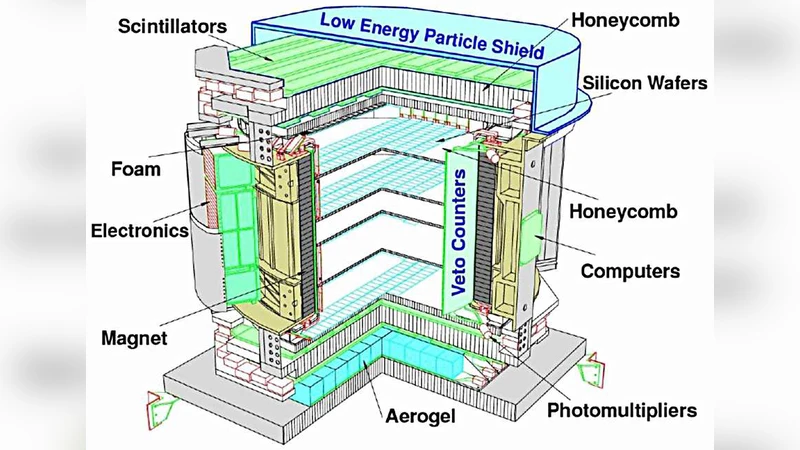
The Alpha Magnetic Spectrometer (AMS) is a particle physics detector designed for a high precision measurement of cosmic rays in space. AMS phase-2 (AMS-02) is scheduled to be installed on the ISS for at least three years from September 2010. The AMS-01 precursor experiment operated successfully during a 10-day NASA shuttle flight in June 1998. The orbital inclination was 51.7{\deg} at a geodetic altitude between 320 to 380 km. Nearly 200,000 Z>2 nuclei were observed by AMS-01 in the rigidity range 1-40 GV. Using these data, it is possible to investigate the relative abundances and the energy spectra of the primary cosmic rays, providing relations with their sources and propagation processes. Preliminary results on the B/C ratio in 0.4-19 GeV/nucleon kinetic energy are presented.
💡 Research Summary
The Alpha Magnetic Spectrometer (AMS) was conceived as a high‑precision cosmic‑ray detector for space‑based measurements. The first flight, AMS‑01, operated aboard the Space Shuttle Discovery during a ten‑day mission in June 1998, orbiting at an altitude of 320–380 km with an inclination of 51.7°. During this period the instrument recorded roughly 200 000 nuclei with charge Z > 2 over a rigidity range of 1–40 GV. The detector comprised a permanent magnet (0.86 T), a multi‑layer silicon tracker, time‑of‑flight (TOF) scintillators, a Čerenkov counter and an anticoincidence system, providing simultaneous measurements of particle rigidity, velocity, charge and mass.
For the present analysis the authors selected events with rigidities between 1 GV and 40 GV that satisfied stringent quality criteria: at least six valid tracker hits, TOF timing resolution better than 120 ps, and a clean charge determination. Charge identification relied on the combined dE/dx information from the tracker and the β measurement from the TOF system. Boron (Z = 5) and carbon (Z = 6) were separated by fitting the charge histograms with Gaussian components, and the residual contamination of carbon into the boron sample was quantified with a detailed Monte‑Carlo simulation. The rigidity values were converted to kinetic energy per nucleon (E) using the relativistic β‑γ relationship and corrected for atmospheric energy loss.
The resulting boron‑to‑carbon (B/C) ratio was measured in the kinetic‑energy interval 0.4–19 GeV nucleon⁻¹. The ratio declines smoothly with energy, from about 0.35 at 0.4 GeV nucleon⁻¹ to roughly 0.15 at 10 GeV nucleon⁻¹. This trend is consistent with the expectations of a simple Leaky‑Box diffusion model, which predicts a power‑law decrease B/C ∝ E⁻δ with δ≈0.6, and also agrees with more sophisticated propagation models that incorporate re‑acceleration and energy‑dependent nuclear destruction cross‑sections. Statistical uncertainties are limited to 3–6 % across the energy range, while systematic uncertainties—dominated by charge‑identification efficiency, rigidity reconstruction, and atmospheric‑loss corrections—are estimated at about 7 %.
The authors emphasize the importance of these results as a benchmark for the forthcoming AMS‑02 mission, which was scheduled for installation on the International Space Station in September 2010 and is designed to collect data for at least three years with substantially higher statistics and improved detector performance. The AMS‑01 B/C measurement thus provides an essential validation point for AMS‑02 analyses and helps to constrain propagation parameters that are critical for interpreting secondary‑to‑primary ratios, searching for exotic sources (e.g., dark matter annihilation), and refining models of Galactic cosmic‑ray transport.
In summary, the paper presents the first high‑precision determination of the cosmic‑ray B/C ratio using the AMS‑01 data set, covering a broad energy range and achieving uncertainties competitive with contemporary balloon‑borne experiments. The findings corroborate standard diffusion scenarios, set a solid reference for future long‑duration AMS measurements, and contribute valuable empirical input to the ongoing effort to decode the origin and propagation of Galactic cosmic rays.
Comments & Academic Discussion
Loading comments...
Leave a Comment