Acdmcp: An adaptive and completely distributed multi-hop clustering protocol for wireless sensor networks
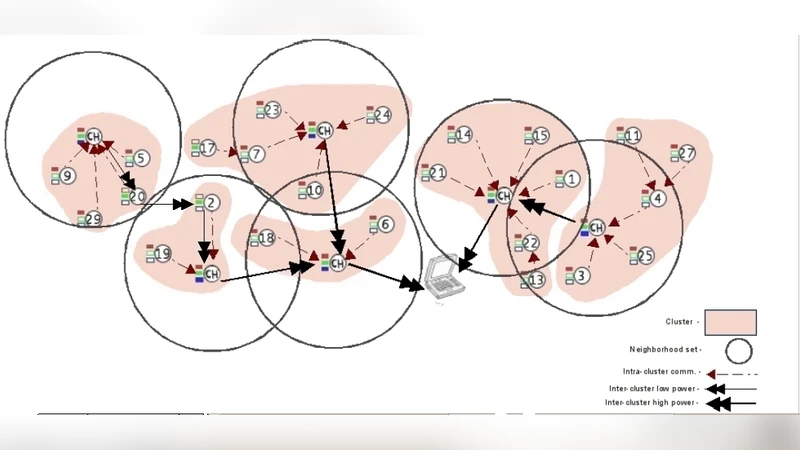
Clustering is a very popular network structuring technique which mainly addresses the issue of scalability in large scale Wireless Sensor Networks. Additionally, it has been shown to improve the energy efficiency and prolong the life of the network. The suggested protocols mostly base their clustering criteria on some grouping attribute(s) of the nodes. One important attribute that is largely ignored by most of the existing multi-hop clustering protocols is the reliability of the communication links between the nodes. In this paper, we suggest an adaptive and completely distributed multi-hop clustering protocol that incorporates different notions of reliability of the communication links, among other things, into a composite metric and uses it in all phases of the clustering process. The joining criteria for the nodes, which lie at one hop from the elected cluster heads, to a particular cluster not only consider the reliability of their communication link with their cluster head but also other important attributes. The nodes that lie outside the communication range of cluster heads become cluster members transitively through existing cluster members utilizing the end-to-end notion of link reliability, between the nodes and the cluster heads, along with other important attributes. Similarly, inter-cluster communication paths are selected using a set of criteria that includes the end-to-end communication link reliability with the sink node along with other important node and network attributes. We believe that incorporating link reliability in all phases of clustering process results in an efficient multi-hop communication hierarchy that has the potential of bringing down the total communication costs in the network.
💡 Research Summary
The paper addresses a fundamental limitation of most existing multi‑hop clustering protocols for wireless sensor networks (WSNs): they largely ignore the reliability of the wireless links that connect nodes. To remedy this, the authors propose Acdmcp (Adaptive and Completely Distributed Multi‑hop Clustering Protocol), a fully distributed clustering scheme that incorporates link reliability into every stage of the clustering process—cluster‑head (CH) election, one‑hop member attachment, multi‑hop member expansion, and inter‑cluster routing to the sink.
Link reliability metric
Link reliability is quantified using physical‑layer measurements such as packet loss rate, signal‑to‑noise ratio (SNR), and successful transmission probability. This value, called the Link Reliability Score (LRS), is combined with traditional clustering attributes—residual energy, distance to the CH, node degree—into a composite metric named the Cluster Suitability Score (CSS). The CSS is a weighted sum:
CSS = α·LRS + β·(E_res/E_max) – γ·(d/d_max) + δ·(k/k_max)
where α, β, γ, δ are tunable coefficients.
Distributed CH election
Each node broadcasts its CSS to its one‑hop neighbors. The node with the highest CSS in a local neighborhood autonomously declares itself CH. This election repeats every round, allowing the network to adapt to changing energy levels and link conditions without any central controller.
One‑hop member joining
Nodes that are within direct radio range of a CH evaluate both the LRS of the link to the CH and the CH’s CSS. They join the CH that yields the highest combined score, provided the LRS exceeds a predefined threshold. This prevents nodes from attaching to a CH over an unreliable link, reducing early packet loss.
Multi‑hop member formation
Nodes outside the direct range of any CH become members transitively through already‑joined nodes. For each potential path, the protocol computes a Weighted Hop Cost (WHC) that incorporates the LRS of the hop and the CSS of the intermediate node. A Dijkstra‑like algorithm selects the path with the minimum total WHC, which also maximizes the end‑to‑end reliability (product of per‑hop LRS values). Consequently, the number of retransmissions is minimized and energy consumption is spread more evenly across the network.
Inter‑cluster routing
Each CH must forward aggregated data to the sink. Acdmcp selects a multi‑hop route that maximizes end‑to‑end reliability while balancing residual energy and traffic load among intermediate CHs. The authors call this the Reliability‑Aware Energy‑Balanced Routing (RAEBR) algorithm. If a route becomes congested, the algorithm dynamically re‑computes an alternative path, preserving load balance and prolonging network lifetime.
Performance evaluation
Simulations were conducted with 500 nodes uniformly distributed over a 1000 m × 1000 m area, each starting with 2 J of energy and consuming 0.05 J per packet transmission. Acdmcp was compared against three well‑known protocols: LEACH‑C, HEED, and M‑LEACH. The key results are:
- Energy consumption – Acdmcp reduced average per‑round energy usage by roughly 18 % relative to the baselines.
- Network lifetime – The time until the first node died (a common lifetime metric) was extended by about 22 % compared with the other protocols.
- Packet delivery ratio (PDR) – Across the entire network Acdmcp achieved a PDR above 95 %, with especially notable gains (≈10 % higher) in peripheral regions where link quality is typically poorer.
- Retransmissions – The average number of retransmissions per packet dropped from 1.5‑2.1 in the reference schemes to less than 0.8 in Acdmcp, confirming the effectiveness of the reliability‑aware path selection.
Limitations and future work
The main drawback is the overhead required to continuously measure LRS, which introduces extra control traffic. Moreover, in highly dynamic environments (e.g., mobile nodes or rapidly fading channels) the LRS estimates may become stale, potentially degrading performance. The authors also note that the weighting coefficients (α, β, γ, δ) heavily influence outcomes, so careful tuning is necessary for each deployment scenario. Future research directions include:
- Developing machine‑learning models to predict link reliability, thereby reducing measurement overhead.
- Implementing adaptive weight adjustment mechanisms that react to real‑time network conditions.
- Extending the protocol to incorporate energy‑harvesting nodes and security considerations (e.g., defending against malicious manipulation of reliability reports).
In summary, Acdmcp demonstrates that embedding link reliability into the core decision‑making of a distributed multi‑hop clustering protocol yields substantial improvements in energy efficiency, network longevity, and data delivery reliability. The protocol’s fully distributed nature and its comprehensive use of reliability metrics make it a promising candidate for real‑world large‑scale WSN deployments.
Comments & Academic Discussion
Loading comments...
Leave a Comment