In this paper, we propose a new parallel algorithm which could work naturally on the parallel computer with arbitrary number of processors. This algorithm is named Virtual Transmission Method (VTM). Its physical backgroud is the lossless transmission line and microwave network. The basic idea of VTM is to insert lossless transmission lines into the sparse linear system to achieve distributed computing. VTM is proved to be convergent to solve SPD linear system. Preconditioning method and performance model are presented. Numerical experiments show that VTM is efficient, accurate and stable. Accompanied with VTM, we bring in a new technique to partition the symmetric linear system, which is named Generalized Node & Branch Tearing (GNBT). It is based on Kirchhoff's Current Law from circuit theory. We proved that GNBT is feasible to partition any SPD linear system.
Deep Dive into Virtual Transmission Method, A New Distributed Algorithm to Solve Sparse Linear System.
In this paper, we propose a new parallel algorithm which could work naturally on the parallel computer with arbitrary number of processors. This algorithm is named Virtual Transmission Method (VTM). Its physical backgroud is the lossless transmission line and microwave network. The basic idea of VTM is to insert lossless transmission lines into the sparse linear system to achieve distributed computing. VTM is proved to be convergent to solve SPD linear system. Preconditioning method and performance model are presented. Numerical experiments show that VTM is efficient, accurate and stable. Accompanied with VTM, we bring in a new technique to partition the symmetric linear system, which is named Generalized Node & Branch Tearing (GNBT). It is based on Kirchhoff’s Current Law from circuit theory. We proved that GNBT is feasible to partition any SPD linear system.
1
Virtual Transmission Method,
A New Distributed Algorithm to Solve Sparse Linear System
Fei Wei
Huazhong Yang
Department of Electronic Engineering, Tsinghua University, Beijing, China
Technical Report
Preprinted at arXiv.org
Abstract
In this paper, we propose a new parallel algorithm which could work naturally on the
parallel computer with arbitrary number of processors. This algorithm is named
Virtual Transmission Method (VTM). Its physical background is the lossless
transmission line and microwave network. The basic idea of VTM is to insert the
virtual transmission lines into the linear system to achieve distributed computing.
VTM is proved to be convergent to solve SPD linear system. Preconditioning
method and performance model are presented. Numerical experiments show that
VTM is efficient, accurate and stable.
Accompanied with VTM, we bring in a new technique to partition the symmetric
linear system, which is named Electric Vertex Splitting (EVS). It is based on
Kirchhoff’s Current Law from circuit theory. We proved that EVS is feasible to
partition any SPD linear system.
Key words: Distributed Algorithm, Sparse Linear System, Partitioning, Convergence,
Performance Modeling, Preconditioning, Transmission Line, Interconnect, Wire
New words: Virtual Transmission Method (VTM), Electric Vertex Splitting (EVS),
Transmission Delay Equations (TDE), Virtual Transmission Line (VTL), Interconnect,
Wire, Electric Graph, Neighbor-To-Neighbor (N2N), Conformal Splitting Existence
2
Theory, Impedance Matching, Lines Coupling, Wire Tearing.
- Introduction
The linear system, Ax = b, is widely encountered in scientific computing. When the
coefficient matrix A is symmetric-positive-definite (SPD), the linear system is called
SPD system, which is extremely common in engineering applications [1, 2]. For
example, most of the linear systems generated by the finite element method are SPD
systems. Therefore, in many scientific disciplines, solving SPD systems is an
inevitable task and the efficiency will be the dominant factor in those fields.
To solve the SPD system, there are two basic approaches, direct methods and
iterative methods.
The direct methods are mainly based on the Sparse Cholesky Factorization. In
order to efficiently compute the dense submatrices inside the sparse matrix,
supernodal method and multifrontal method are used [3].
The representatives of the iterative methods are Conjugate Gradient method (CG)
and Multigrid method (MG). CG is based on the Krylov subspace projection. If the
preconditioner is properly chosen, the convergence of CG will be fast. MG is efficient
for the linear systems generated from the elliptic partial differential equations [4].
All the algorithms mentioned above work well on the traditional single-processor
computers, but they would get into trouble on parallel computers [5, 6]. The parallel
version of Sparse Cholesky Factorization suffers from the limited concurrency which
depends on the distribution of the nonzero elements in the sparse matrix. For the
parallel CG, it is difficult to choose a proper preconditioner in a parallel way [4].
Another well known parallel method for large sparse linear system is the Domain
Decomposition Method (DDM). DDM refers to a collection of techniques which
revolve around the principle of divide and conquer [4]. Schur Complement method,
Additive Schwarz method and the Dual-Prime Finite Element Tearing and
Interconnection (FETI-DP) method are three commonly-adopted parallel methods of
DDM [7].
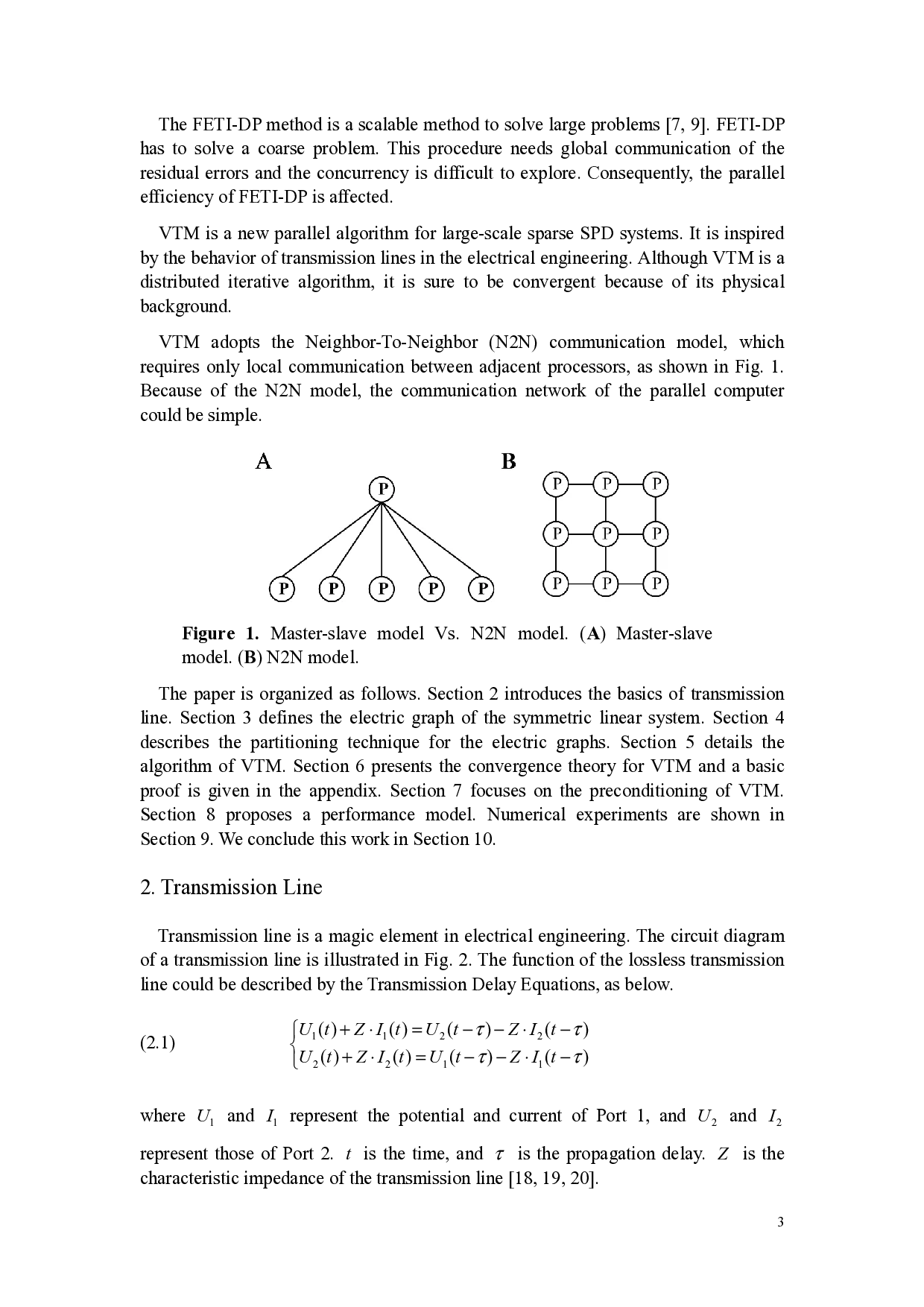
The Schur Complement method makes use of the master-slave model [8]. This
method first partitions the large linear system into a number of subsystems. Then
these subsystems are simplified and solved by the slave processors in parallel. After
that the simplified results are merged into a new linear system, which is much smaller
than the original one. At last this new system is solved by the master processor. This
model suffers from the heavy communication overheads imposed on the master
processor, especially when the number of slave processors is large. Consequently, the
scalability and concurrency of the Schur Complement method is limited.
The Additive Schwarz method is similar to the block Jacobi iteration. For a SPD
system, it needs two assumptions to be convergent, and the convergence speed
depends on these two assumptions [4].
3
The FETI-DP method is a scalable method to solve large problems [7, 9]. FETI-DP
has to solve a coarse problem. This procedure needs global communication of the
residual errors and the concurrency is difficult to explore. Consequently, the parallel
efficiency of FETI-DP is affected.
VTM is a new parallel algorithm for large-scale sparse SPD systems. It is inspired
by the behavior of transmission lines in the electrical engineering. Although VTM is a
distributed iterative algorithm, it is sure to be convergent because of its physical
back
…(Full text truncated)…
This content is AI-processed based on ArXiv data.