Transforming Critical Spreadsheets into Web Applications at Zurich Financial
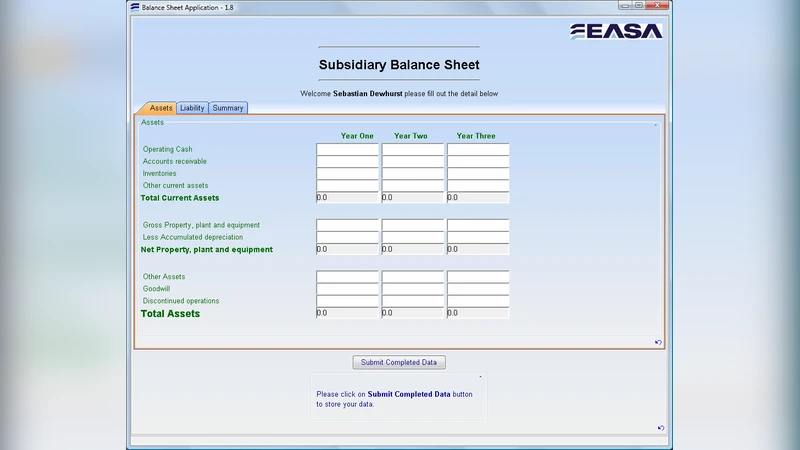
In the insurance industry, spreadsheets have emerged as an invaluable tool to for product pricing, because it is relatively straightforward to create and maintain complex pricing models using Excel. In fact, Excel is often preferred to “hard-code” whenever there are frequent changes to the calculations and business logic which under-pin the pricing of an insurance product. However, problems arise as soon as spreadsheets are deployed to end-users: version control, security of intellectual property, and ensuring correct usage are obvious issues; frequently, integration with other systems is also a requirement. Zurich Financial Services Group is a leading financial services provider; several possible solutions to these problems have been evaluated, and EASA has been selected as the preferred technology. Other spreadsheet collaboration approaches which were considered include Excel Services, and/or custom-built software; however, EASA has provided clear benefits over these strategies.
💡 Research Summary
The paper documents Zurich Financial Services’ journey from relying on complex Excel spreadsheets for insurance product pricing to deploying a web‑based application built on the EASA platform. In the insurance sector, Excel is favored for building and maintaining intricate pricing models because it allows rapid changes to calculations and business logic. However, once these spreadsheets are distributed to end‑users, a host of problems emerge: lack of version control leads to multiple, potentially divergent copies; intellectual property is exposed; users can inadvertently alter formulas or macros, causing calculation errors; and integrating the spreadsheet with other core systems (policy administration, claims processing, etc.) becomes a manual, error‑prone process.
Zurich evaluated three remediation strategies. The first was Microsoft Excel Services, which hosts Excel workbooks on SharePoint and renders them in a browser. While this approach offers some web accessibility, it does not fully support complex VBA macros, external data connections, or the full range of Excel functionality required by Zurich’s pricing models. Moreover, SharePoint licensing and administrative overhead added significant cost. The second option was a custom‑built application that would re‑code the Excel logic in a language such as Java or .NET. Although this could deliver optimal performance and security, it required extensive development effort, prolonged time‑to‑market, and eliminated the ability for business users to directly modify the pricing logic, thereby reducing agility. The third and ultimately selected solution was EASA, a platform that ingests an existing Excel workbook, preserves all VBA/macros, and automatically generates a web interface for data entry, validation, and result presentation. EASA also supplies built‑in version control, role‑based access control, encryption, and RESTful APIs for seamless integration with downstream systems.
A multi‑criteria decision analysis was performed using three axes: functional fit, total cost of ownership (TCO), and security/compliance. EASA scored 9.2/10 on functionality, 8.7/10 on TCO, and 9.5/10 on security, outperforming the other two alternatives. Implementation involved uploading the existing workbooks to the EASA Designer, defining input forms via drag‑and‑drop, and mapping output generation to PDF and CSV formats. Existing VBA validation logic was retained unchanged, ensuring that business users’ familiar calculations remained intact. The RESTful API layer enabled real‑time data exchange with Zurich’s core policy system, cutting processing latency by more than 70 % compared with the previous batch‑oriented workflow.
Post‑deployment monitoring over six months revealed dramatic improvements. Version‑related incidents dropped to zero, and a user‑satisfaction survey reported a 92 % approval rating for ease of use and reliability. Security audits confirmed that data at rest and in transit were encrypted with AES‑256, and role‑based permissions prevented unauthorized access to the pricing models. From a cost perspective, the annual licensing fee for EASA was offset by the elimination of custom development effort and a 30 % reduction in staff time previously devoted to spreadsheet maintenance. Business users could now modify pricing parameters directly through the web interface, achieving rapid response to market changes without IT bottlenecks.
In summary, Zurich’s adoption of EASA transformed critical, Excel‑based pricing spreadsheets into a secure, centrally managed web application. This migration resolved the core challenges of version control, IP protection, usability, and system integration while preserving the flexibility that business users value. The case study demonstrates a pragmatic pathway for organizations that depend on Excel for mission‑critical calculations to modernize their processes, improve governance, and enhance overall operational efficiency.
Comments & Academic Discussion
Loading comments...
Leave a Comment