Growth and structure of Slovenias scientific collaboration network
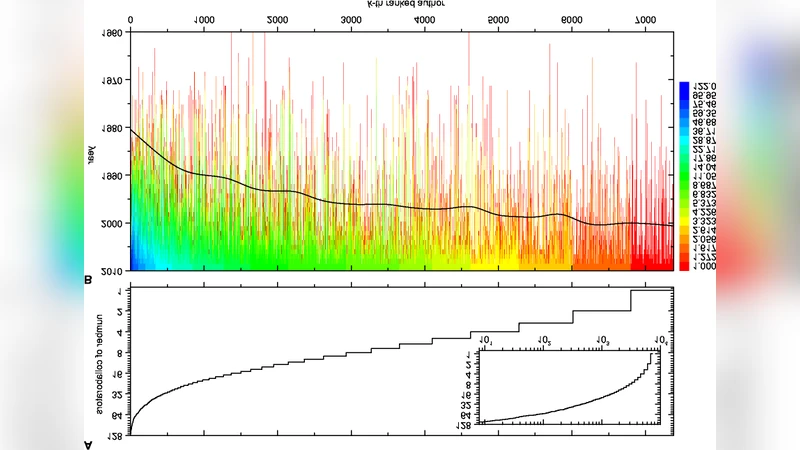
We study the evolution of Slovenia’s scientific collaboration network from 1960 till present with a yearly resolution. For each year the network was constructed from publication records of Slovene scientists, whereby two were connected if, up to the given year inclusive, they have coauthored at least one paper together. Starting with no more than 30 scientists with an average of 1.5 collaborators in the year 1960, the network to date consists of 7380 individuals that, on average, have 10.7 collaborators. We show that, in spite of the broad myriad of research fields covered, the networks form “small worlds” and that indeed the average path between any pair of scientists scales logarithmically with size after the largest component becomes large enough. Moreover, we show that the network growth is governed by near-liner preferential attachment, giving rise to a log-normal distribution of collaborators per author, and that the average starting year is roughly inversely proportional to the number of collaborators eventually acquired. Understandably, not all that became active early have till now gathered many collaborators. We also give results for the clustering coefficient and the diameter of the network over time, and compare our conclusions with those reported previously.
💡 Research Summary
The paper presents a longitudinal, year‑by‑year reconstruction of Slovenia’s scientific collaboration network from 1960 to the present. Using publication records of Slovene researchers, two scientists are linked in a given year if they have co‑authored at least one paper up to and including that year. Starting with fewer than 30 active researchers in 1960 (average degree ≈ 1.5), the network has grown to 7 380 individuals with an average of 10.7 collaborators per author.
The authors first describe the basic growth dynamics. The number of nodes increases roughly linearly after the early 1990s, a period that coincides with Slovenia’s independence and a surge in international scientific exchange. The average degree rises steadily, reflecting both the addition of new researchers and the increasing propensity of existing scientists to form new collaborations.
Topological analysis shows that once the giant component becomes sufficiently large (around the mid‑1990s), the average shortest‑path length ⟨ℓ⟩ scales logarithmically with network size (⟨ℓ⟩ ≈ log N). This “small‑world” behavior means that any two Slovenian scientists are typically separated by only four to six intermediate collaborators, despite the network’s expansion. The clustering coefficient C starts high (≈ 0.30–0.35) in the 1960s–70s, indicating tightly knit early research groups, and declines to ≈ 0.15–0.20 in later decades as interdisciplinary links proliferate. The network diameter peaks at about 12 steps in the early 1990s and then stabilizes around 8–9 steps.
To uncover the mechanism behind the growth, the authors examine the attachment probability p(k) that a new author connects to an existing author of degree k. Empirically, p(k) ∝ k^α with α ≈ 0.95, i.e., almost linear preferential attachment. This mechanism generates a degree distribution that is not a pure power law but follows a log‑normal form. Fitting the data yields a log‑normal with parameters μ ≈ 2.3 and σ ≈ 0.9, matching the observed distribution of collaborators per author.
An additional finding is the inverse relationship between a scientist’s entry year and their eventual degree. Early entrants tend to accumulate more collaborators on average, yet the relationship is not deterministic; many early‑career researchers remain peripheral, suggesting that personal factors (field of study, institutional support, international exposure) modulate the advantage of early entry.
The paper situates these results within the broader literature on scientific collaboration networks. Compared with larger nations such as the United States, Germany, or Japan, Slovenia’s network is smaller but exhibits comparable small‑world characteristics and clustering patterns. However, the log‑normal degree distribution and the near‑linear attachment exponent distinguish it from the often‑observed power‑law scaling in larger systems, highlighting the role of national size and research policy in shaping network evolution.
In conclusion, the study demonstrates that Slovenia’s scientific collaboration network has evolved from a sparse, highly clustered set of pioneers into a mature small‑world system governed by near‑linear preferential attachment. The findings provide quantitative evidence that can inform science‑policy decisions aimed at fostering collaboration, enhancing interdisciplinary research, and integrating national scientific communities into the global research landscape.
Comments & Academic Discussion
Loading comments...
Leave a Comment