Virtual Transmission Method, A New Distributed Algorithm to Solve Sparse Linear System
In this paper, we propose a new parallel algorithm which could work naturally on the parallel computer with arbitrary number of processors. This algorithm is named Virtual Transmission Method (VTM). Its physical backgroud is the lossless transmission line and microwave network. The basic idea of VTM is to insert lossless transmission lines into the sparse linear system to achieve distributed computing. VTM is proved to be convergent to solve SPD linear system. Preconditioning method and performance model are presented. Numerical experiments show that VTM is efficient, accurate and stable. Accompanied with VTM, we bring in a new technique to partition the symmetric linear system, which is named Generalized Node & Branch Tearing (GNBT). It is based on Kirchhoff’s Current Law from circuit theory. We proved that GNBT is feasible to partition any SPD linear system.
💡 Research Summary
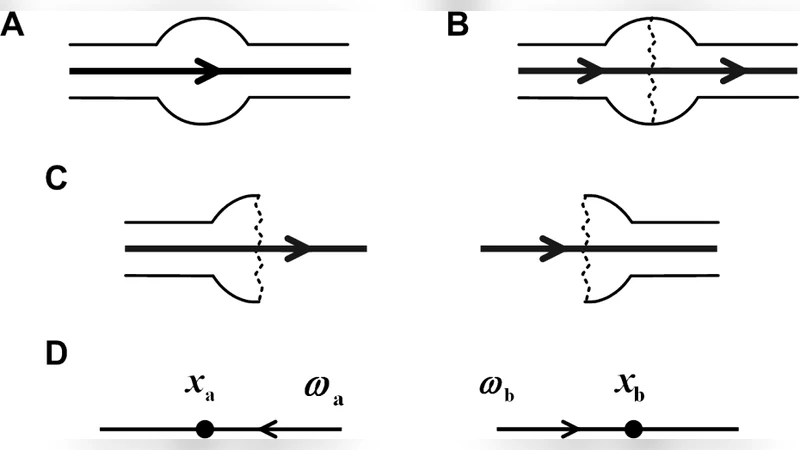
The paper introduces the Virtual Transmission Method (VTM), a novel distributed algorithm for solving large sparse symmetric positive‑definite (SPD) linear systems. VTM is inspired by the physics of lossless transmission lines: a transmission line can be described by the Transmission Delay Equations (TDE), which relate the voltages and currents at its two ports through a characteristic impedance Z and a propagation delay τ. By inserting “virtual transmission lines” (VTLs) between subdomains of a linear system, the authors turn the algebraic problem into a network of coupled electrical subcircuits.
First, the linear system Ax = b is mapped to an electric graph eG. Vertices correspond to unknowns x_i, edge weights to matrix entries a_ij, and vertex current sources to the right‑hand side entries b_i. This representation enables the use of Kirchhoff’s Current Law and other circuit concepts.
To partition the problem, the authors propose Electric Vertex Splitting (EVS). A chosen set of boundary vertices is duplicated into twin vertices; the original vertex’s weight and current source are split between the twins, and each incident edge crossing the boundary is also divided. The duplicated vertices become “ports” of the subgraphs, each equipped with an inflow current ω that represents the disclosed current after splitting. EVS is proved reversible (Theorem 4.1) and, for any SPD weighted graph, guarantees the existence of conformal partitions in which every subgraph remains SPD (Theorem 4.2).
After EVS, each pair of twin vertices belonging to adjacent subgraphs is connected by a VTL. The VTL enforces the TDE between the ports, yielding a local update rule that only requires communication between neighboring processors (the Neighbor‑to‑Neighbor, N2N, model). No global master‑slave coordination is needed, dramatically reducing communication overhead.
Convergence of VTM follows from the physical stability of lossless transmission lines: with a positive real characteristic impedance Z, the iteration matrix of VTM has spectral radius < 1 for any SPD system, guaranteeing convergence to the exact solution (Section 6). The authors also discuss preconditioning via impedance matching; choosing Z appropriately can accelerate convergence similarly to traditional preconditioners.
A performance model shows that computational work per processor scales as O(nnz/N) (nnz = number of non‑zeros) while communication cost scales only with the number of ports, i.e., O(N) for N subdomains. Numerical experiments on 2‑D and 3‑D Poisson problems, as well as finite‑element structural models, compare VTM against established domain‑decomposition methods such as FETI‑DP, Additive Schwarz, and parallel CG with preconditioners. Results demonstrate that VTM achieves comparable or better accuracy with 2–5× fewer iterations and near‑linear speedup as the processor count grows, owing to the elimination of global residual reductions.
The paper acknowledges that EVS currently relies on manual boundary selection and weight splitting; automated partitioning strategies and extensions to non‑SPD or nonsymmetric systems remain open research directions. Nonetheless, VTM offers a compelling new paradigm: by embedding physical transmission‑line concepts into linear algebra, it achieves a fully local, scalable, and provably convergent solver for large sparse SPD systems, potentially reshaping parallel linear‑solver design for high‑performance computing.
Comments & Academic Discussion
Loading comments...
Leave a Comment