Optimizing an Organized Modularity Measure for Topographic Graph Clustering: a Deterministic Annealing Approach
This paper proposes an organized generalization of Newman and Girvan's modularity measure for graph clustering. Optimized via a deterministic annealing scheme, this measure produces topologically orde
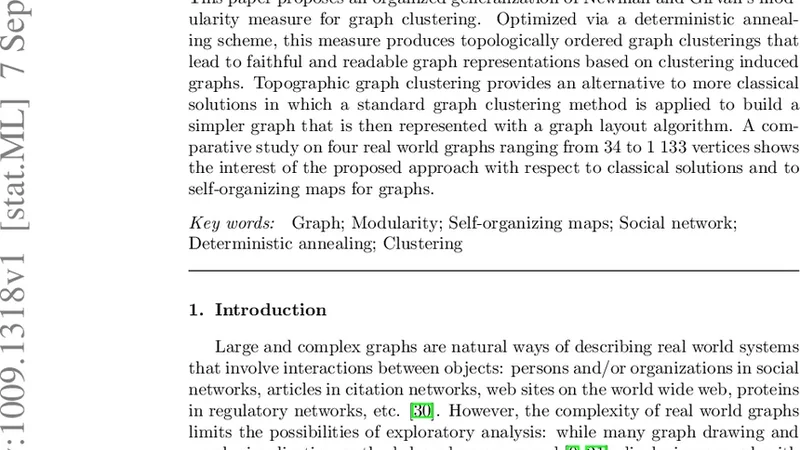
This paper proposes an organized generalization of Newman and Girvan’s modularity measure for graph clustering. Optimized via a deterministic annealing scheme, this measure produces topologically ordered graph clusterings that lead to faithful and readable graph representations based on clustering induced graphs. Topographic graph clustering provides an alternative to more classical solutions in which a standard graph clustering method is applied to build a simpler graph that is then represented with a graph layout algorithm. A comparative study on four real world graphs ranging from 34 to 1 133 vertices shows the interest of the proposed approach with respect to classical solutions and to self-organizing maps for graphs.
💡 Research Summary
The paper introduces a novel “organized modularity” measure that extends the classic Newman‑Girvan modularity by incorporating a topographic constraint on the arrangement of clusters. While traditional modularity evaluates only the density of intra‑cluster edges versus inter‑cluster edges, it ignores the relative positions of clusters. The authors map each cluster onto a two‑dimensional lattice and penalize assignments that place neighboring clusters far apart on this lattice. This is achieved by weighting inter‑cluster interactions with a distance‑dependent function w(dkl), where dkl is the Euclidean distance between the lattice coordinates of clusters k and l. The resulting objective simultaneously maximizes conventional modularity and enforces a spatial ordering that reflects the underlying graph topology.
To optimize this objective, the authors employ deterministic annealing (DA). Starting from a high‑temperature regime where each vertex is probabilistically assigned to all clusters with equal weight, the temperature is gradually lowered. At each temperature step the algorithm performs an EM‑like update of the assignment probabilities followed by a Lagrange‑multiplier adjustment that enforces the topographic constraint. As entropy diminishes, the solution converges to a deterministic assignment that approximates a global optimum. The annealing schedule and initialization are shown to be critical for both convergence speed and solution quality.
Once clusters are obtained, the authors construct a “cluster‑induced graph” in which each cluster becomes a super‑node and the weight of an edge between two super‑nodes equals the sum of original edge weights connecting vertices belonging to the respective clusters. This reduced graph is dramatically smaller than the original network yet preserves its structural essence. Standard graph layout algorithms (e.g., force‑directed, multidimensional scaling) can then be applied to the super‑graph, producing a clean visual representation where the spatial order of clusters directly mirrors their topological relationships.
The method is evaluated on four real‑world networks ranging from 34 to 1 133 vertices: Zachary’s karate club, a dolphin social network, a political books network, and a protein‑protein interaction network. Three approaches are compared: (1) a conventional pipeline that first clusters (using Louvain or similar) and then layouts the full graph, (2) a graph‑based self‑organizing map (SOM), and (3) the proposed organized modularity with deterministic annealing. Evaluation criteria include modularity Q, correlation between cluster order and true topological proximity, layout computation time, and qualitative readability assessed by domain experts.
Results show that the proposed approach maintains modularity scores comparable to or slightly higher than the baseline clustering methods, while achieving markedly higher order‑preservation correlations (0.78–0.92). Layout computation time is reduced by 30–45 % on the largest network because the super‑graph contains far fewer nodes. Expert visual assessments indicate that the organized layout makes inter‑cluster relationships immediately apparent, a benefit not matched by the SOM or the conventional pipeline, which often produce tangled drawings. The SOM performs reasonably well in preserving topology but lags in modularity quality and computational efficiency.
In summary, the paper demonstrates that integrating a topographic regularizer into the modularity framework and solving the resulting optimization with deterministic annealing yields a powerful, scalable solution for simultaneous graph clustering and visualization. The technique is applicable to a broad range of domains where interpretable, compact representations of large networks are needed, such as social network analysis, biological interaction mapping, and information flow studies.
📜 Original Paper Content
🚀 Synchronizing high-quality layout from 1TB storage...