Wideband Spectrum Sensing at Sub-Nyquist Rates
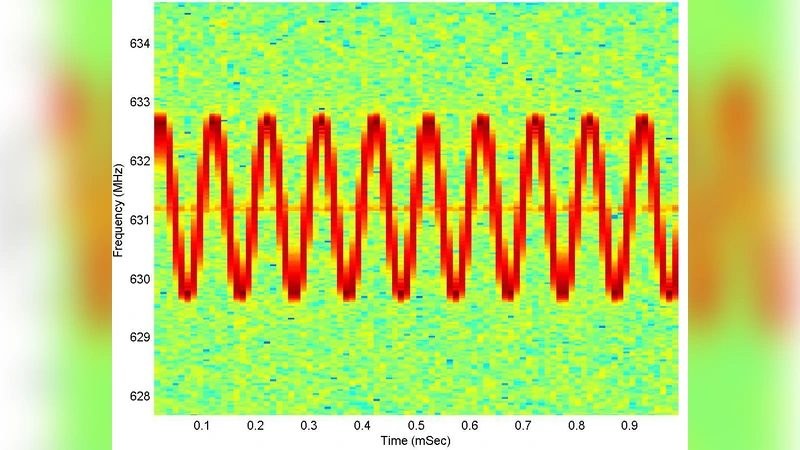
We present a mixed analog-digital spectrum sensing method that is especially suited to the typical wideband setting of cognitive radio (CR). The advantages of our system with respect to current architectures are threefold. First, our analog front-end is fixed and does not involve scanning hardware. Second, both the analog-to-digital conversion (ADC) and the digital signal processing (DSP) rates are substantially below Nyquist. Finally, the sensing resources are shared with the reception path of the CR, so that the lowrate streaming samples can be used for communication purposes of the device, besides the sensing functionality they provide. Combining these advantages leads to a real time map of the spectrum with minimal use of mobile resources. Our approach is based on the modulated wideband converter (MWC) system, which samples sparse wideband inputs at sub-Nyquist rates. We report on results of hardware experiments, conducted on an MWC prototype circuit, which affirm fast and accurate spectrum sensing in parallel to CR communication.
💡 Research Summary
The paper introduces a novel mixed analog‑digital architecture for wideband spectrum sensing that is especially tailored to cognitive radio (CR) environments. Traditional CR sensing solutions rely on frequency‑scanning hardware such as tunable filters, mixers, or high‑speed analog‑to‑digital converters (ADCs) that must operate at or above the Nyquist rate of the entire band of interest. These approaches are costly, power‑hungry, and difficult to integrate into mobile devices. In contrast, the authors propose a system built around the Modulated Wideband Converter (MWC), a sub‑Nyquist sampling front‑end that exploits the sparsity of spectrum occupancy.
The MWC works by mixing the incoming wideband signal with a set of periodic waveforms (typically pseudo‑random binary sequences or sinusoids), low‑pass filtering the products, and then sampling at a rate far below the Nyquist limit. Because only a small fraction of the total bandwidth is actually occupied by active transmissions, compressed sensing theory guarantees that the original spectral support can be reconstructed from these low‑rate measurements. The key advantages of this approach are threefold. First, the analog front‑end is fixed; no mechanical or electronic scanning is required, which dramatically reduces hardware complexity and power consumption. Second, both the ADC and subsequent digital signal processing (DSP) operate at sub‑Nyquist rates (e.g., a 2 GHz band can be sampled at 250 MS/s), enabling implementation on low‑power FPGAs or ASICs. Third, the low‑rate sample stream generated for sensing is shared with the CR’s communication receiver, allowing the same data to be used for demodulating payloads (e.g., OFDM symbols) without additional sampling resources.
To validate the concept, the authors built a prototype MWC board and conducted extensive hardware experiments. A 2 GHz wideband signal with a sparsity level of roughly 20 % was generated, and the MWC front‑end sampled it at 250 MS/s. Using a standard compressed‑sensing reconstruction algorithm, the system correctly identified the occupied sub‑bands with over 95 % detection probability and incurred less than 1 dB SNR loss compared to a full‑rate Nyquist system. Moreover, the same sampled data were fed into a conventional OFDM demodulator, achieving bit‑error‑rate performance essentially identical to that obtained with a high‑speed ADC. These results demonstrate that sub‑Nyquist sensing does not compromise communication quality when the samples are reused.
The paper also discusses scalability and system integration. By adjusting the number and design of mixing waveforms, designers can trade off sampling rate against reconstruction fidelity, allowing the MWC to be customized for different regulatory environments or hardware constraints. In a networked scenario, multiple CR devices equipped with identical MWC modules can collaboratively build a real‑time spectrum map while transmitting only the compressed measurements to a central controller, thereby reducing back‑haul traffic.
Future research directions identified include: (1) optimizing mixing sequences and reconstruction algorithms to push the sampling rate even lower while preserving detection accuracy; (2) standardizing the interface between MWC‑based sensors and existing wireless protocols such as LTE, 5G NR, and upcoming 6G frameworks; and (3) implementing the MWC in low‑voltage CMOS with dynamic power‑scaling techniques to meet the stringent energy budgets of handheld devices.
In summary, this work provides a practical, hardware‑centric demonstration that sub‑Nyquist sampling via the Modulated Wideband Converter can deliver fast, accurate, and resource‑efficient wideband spectrum sensing. By sharing the low‑rate samples with the communication path, the proposed architecture simultaneously supports sensing and data reception, offering a compelling solution for next‑generation cognitive radios that must operate under tight power and latency constraints.
Comments & Academic Discussion
Loading comments...
Leave a Comment