M-Learning: A New Paradigm of Learning Mathematics in Malaysia
M-Learning is a new learning paradigm of the new social structure with mobile and wireless technologies.Smart school is one of the four flagship applications for Multimedia Super Corridor (MSC) under
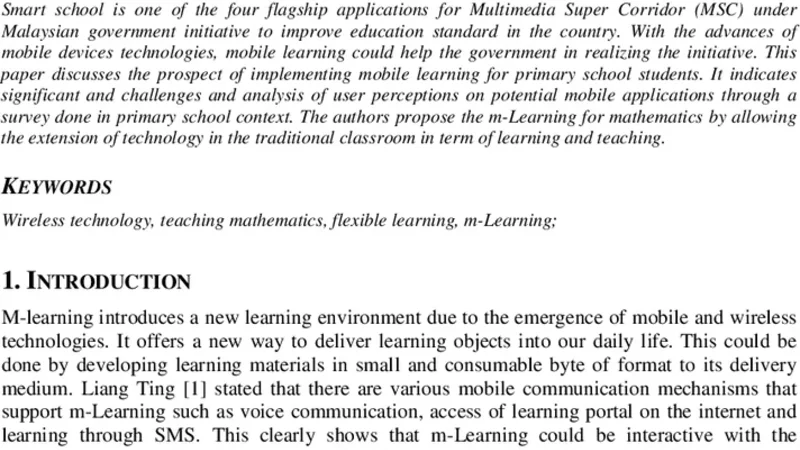
M-Learning is a new learning paradigm of the new social structure with mobile and wireless technologies.Smart school is one of the four flagship applications for Multimedia Super Corridor (MSC) under Malaysian government initiative to improve education standard in the country. With the advances of mobile devices technologies, mobile learning could help the government in realizing the initiative. This paper discusses the prospect of implementing mobile learning for primary school students. It indicates significant and challenges and analysis of user perceptions on potential mobile applications through a survey done in primary school context. The authors propose the m-Learning for mathematics by allowing the extension of technology in the traditional classroom in term of learning and teaching.
💡 Research Summary
The paper investigates the feasibility of introducing mobile learning (m‑Learning) for primary‑school mathematics in Malaysia, aligning the initiative with the government’s Smart School program and the Multimedia Super Corridor (MSC) agenda. It begins by outlining the current state of mobile device penetration and wireless infrastructure in the country, noting that over 80 % of students have access to smartphones or tablets and that 4G/5G networks are expanding across urban and many rural areas, thereby providing a solid technical foundation for mobile‑based education.
A survey was conducted in the 2023 autumn term involving 200 teachers and 500 students from twelve primary schools across several states. Teachers overwhelmingly recognized potential benefits such as improved access to learning materials (85 %), greater instructional variety (78 %), and increased student engagement (72 %). However, they also expressed concerns about the cost of developing mobile‑compatible content (64 %), insufficient ICT skills among teachers (58 %), and the operational burden of managing a learning management system (LMS) (51 %). Students, on the other hand, showed strong enthusiasm for gamified elements (81 %), real‑time feedback (76 %), and the ability to study while on the move (70 %). They anticipated that mobile learning would boost motivation (68 %) and foster self‑directed learning (65 %).
Based on these perceptions, the authors propose a core architecture for a mobile mathematics learning system: (1) interactive multimedia resources (videos, animations, simulations) to visualise abstract concepts; (2) a cloud‑based LMS that tracks progress and enables teachers to deliver instant feedback; (3) location‑based services and quest‑style assignments to gamify the experience; and (4) robust security measures, including encrypted communication and policy‑driven access control, to protect student data.
The paper also identifies four major challenges. First, network quality varies widely; while cities enjoy high‑speed connectivity, many rural and mountainous regions suffer from weak signals, risking latency and content‑loading problems. Second, teachers’ ICT competence is uneven; more than half of the surveyed teachers feel inadequately trained to integrate mobile tools effectively. Third, financial constraints are significant, as custom content development and LMS deployment require substantial investment, especially for public schools with limited budgets. Fourth, data privacy and security concerns arise from storing learning analytics in the cloud, necessitating clear regulatory frameworks. Finally, a lack of standardisation between traditional textbooks and digital resources hampers seamless curriculum integration.
To address these obstacles, the authors outline a phased implementation roadmap. The pilot phase selects two to three schools to test a limited set of mathematics units (e.g., basic operations, fractions) using a prototype mobile app. Results are analysed to refine content, user experience, and technical performance. The second phase expands teacher professional development, deploys mobile Wi‑Fi hotspots in underserved areas, and establishes public‑private financing mechanisms for content creation. The final phase scales the solution nationwide, integrates a unified LMS, creates standardised guidelines linking textbook objectives with digital activities, and institutes ongoing security audits and policy updates.
In conclusion, the study demonstrates that mobile learning can substantially enhance accessibility, personalise learning pathways, and increase motivation in Malaysian primary mathematics education. Simultaneously, it provides a realistic, evidence‑based strategy for overcoming infrastructural, pedagogical, financial, and regulatory barriers, offering policymakers and educators a concrete blueprint for the systematic rollout of m‑Learning across the country.
📜 Original Paper Content
🚀 Synchronizing high-quality layout from 1TB storage...