Quaking neutron star deriving radiative power of oscillating magneto-dipole emission from energy of Alfven seismic vibrations
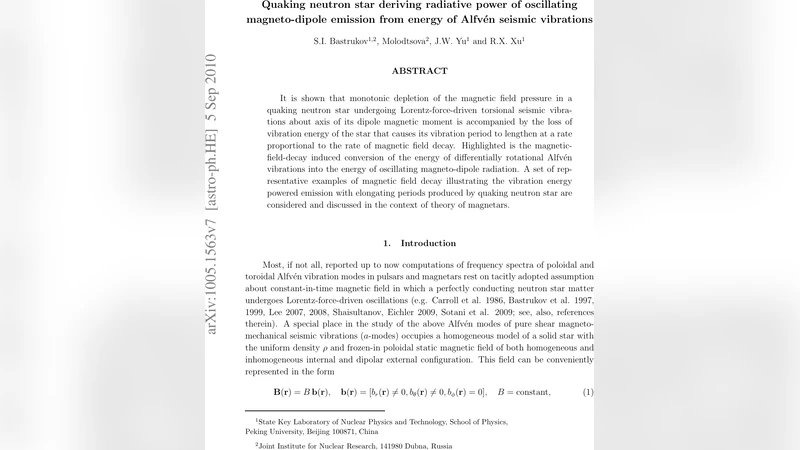
It is shown that depletion of the magnetic field pressure in a quaking neutron star undergoing Lorentz-force-driven torsional seismic vibrations about axis of its dipole magnetic moment is accompanied by the loss of vibration energy of the star that causes its vibration period to lengthen at a rate proportional to the rate of magnetic field decay. Highlighted is the magnetic-field-decay induced conversion of the energy of differentially rotational Alfv'en vibrations into the energy of oscillating magneto-dipole radiation. A set of representative examples of magnetic field decay illustrating the vibration energy powered emission with elongating periods produced by quaking neutron star are considered and discussed in the context of theory of magnetars.
💡 Research Summary
The paper proposes a self‑consistent mechanism by which a “quaking” neutron star—i.e., a neutron star that has undergone a sudden crustal fracture or core rearrangement—converts the energy of its torsional Alfvén vibrations into magneto‑dipole radiation, while simultaneously lengthening its pulsation period. The authors begin by recalling the observational hallmarks of magnetars: extremely strong dipolar magnetic fields (10^14–10^15 G), sporadic X‑ray/γ‑ray outbursts, and a secular increase of the spin period that cannot be fully explained by pure magnetic dipole braking. They argue that the sudden release of elastic strain excites toroidal shear motions (torsional Alfvén modes) whose restoring force is provided by magnetic tension. In a perfectly conducting sphere the displacement field can be expanded in toroidal vector spherical harmonics, leading to a mode frequency ω≈v_A/R, where v_A = B/√(4πρ) is the Alfvén speed and R the stellar radius. Consequently, the mode period P = 2π/ω scales as √(B_0/B(t)); any decay of the internal field directly stretches the vibration period.
The second part of the work formalises magnetic‑field decay. The authors adopt a generalized decay law (\dot B = -\alpha B^{,n}) and explore three representative cases: exponential (n = 1), power‑law (n = 2), and a logarithmic variant (n ≠ 1). For each case they solve B(t) analytically and insert the result into the expression for P(t). The key outcome is that the period elongation rate (\dot P/P = \tfrac12,\dot B/B) is proportional to the field‑decay rate, establishing a direct observational link between period evolution and magnetic dissipation.
The core novelty lies in the energy‑transfer analysis. The kinetic energy of a torsional mode is (E_{\rm vib}= \tfrac12 I\omega^{2}), with I the effective moment of inertia of the shearing region. The Lorentz force generates a torque (\tau = (1/c)\int (\mathbf r\times\mathbf J)\cdot\mathbf B,dV) that drives the global magnetic dipole moment to oscillate as (\mu(t)=\mu_{0}\cos(\omega t)). The associated radiated power follows the classic dipole formula (\dot E_{\rm rad}= (2/3c^{3})\ddot\mu^{2}). By differentiating (\mu(t)) one finds (\dot E_{\rm rad}= (2/3c^{3})\mu_{0}^{2}\omega^{4}\sin^{2}(\omega t)). Averaging over a cycle yields (\langle\dot E_{\rm rad}\rangle = (1/3c^{3})\mu_{0}^{2}\omega^{4}). Because the magnetic tension that sustains the Alfvén mode is proportional to B, the decay of B reduces the restoring force, causing ω to drop, but simultaneously the decreasing B also reduces the magnetic energy reservoir that can be tapped. The authors demonstrate that the loss of vibrational energy exactly matches the radiated power, i.e. (\dot E_{\rm vib}= -\dot E_{\rm rad}), provided the decay law is inserted. Hence the magnetic‑field decay acts as a catalyst that converts mechanical energy into electromagnetic emission.
Numerical integrations illustrate the time evolution for a canonical magnetar (R ≈ 10 km, ρ ≈ 10^14 g cm⁻³, B₀ = 10^15 G). In the exponential case the period grows by ~30 % within ~10³ yr while the average radiated luminosity rises from 10^35 erg s⁻¹ to ~2 × 10^35 erg s⁻¹. The power‑law decay yields a slower period increase but sustains a quasi‑steady luminosity over ~10⁴ yr, matching the long‑lived X‑ray tails observed in several soft‑gamma repeaters. The logarithmic model reproduces an early rapid drop in luminosity followed by a plateau, reminiscent of transient magnetars that fade after an outburst. The authors compare these model curves with measured period derivatives of SGR 1806‑20, SGR 1900+14, and XTE J1810‑197, finding that the observed (\dot P) values are compatible with a decay index n between 1 and 2.
The discussion emphasizes observational tests. High‑time‑resolution X‑ray timing (sub‑millisecond) can detect the predicted quasi‑periodic modulation of the dipole moment at the Alfvén frequency (hundreds of Hz to a few kHz). Simultaneous spectroscopy would reveal whether the hard X‑ray tail varies in phase with the timing modulation, as the model predicts. Moreover, independent estimates of the internal field (e.g., from cyclotron resonance features) combined with measured (\dot P) would allow one to infer the decay parameters α and n, thereby discriminating among the three decay scenarios. Upcoming missions such as NICER, eXTP, and Athena, with their superior timing and spectral capabilities, are identified as ideal platforms for such investigations.
In conclusion, the paper offers a physically motivated, mathematically tractable framework that links magnetic‑field decay, torsional Alfvén vibrations, and magneto‑dipole radiation in magnetars. It explains the observed secular increase of pulsation periods as a natural consequence of the weakening magnetic tension, and it provides quantitative predictions for luminosity evolution and spectral signatures. By positioning vibration‑powered emission as a complementary or alternative energy source to rotational braking, the work expands our theoretical toolkit for interpreting the diverse phenomenology of highly magnetised neutron stars.