Some naturally ocurring examples of A-infinity bialgebras
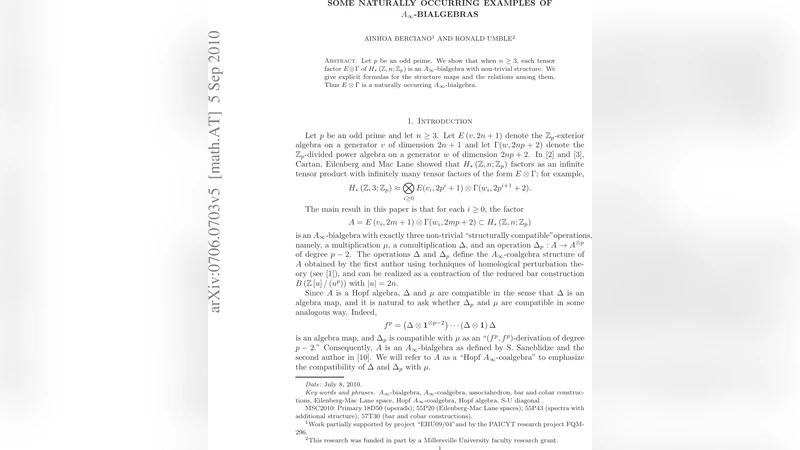
Let p be an odd prime. When n>2, we show that each tensor factor of form E \otimes \Gamma in H(Z,n;Z_p) is an A-infinity bialgebra with non-trivial structure. We give explicit formulas for the structure maps and the quadratic relations among them. Thus E \otimes \Gamma is a naturally occurring example of an A-infinity bialgebra whose internal structure is well-understood.
💡 Research Summary
The paper investigates a concrete family of A∞‑bialgebras that arise naturally in the mod‑p cohomology of Eilenberg–Mac Lane spaces. For an odd prime p and an integer n > 2, the authors consider the graded algebra H⁎(ℤ,n;ℤₚ), which decomposes as a tensor product E ⊗ Γ where E is an exterior algebra on a single generator of degree n and Γ is a divided‑power (or symmetric) algebra on a generator of the same degree. While the ordinary cup product and coproduct give E ⊗ Γ the structure of a Hopf algebra, the paper shows that each factor individually carries a non‑trivial A∞‑structure, and that these structures are compatible in the sense of an A∞‑bialgebra.
The authors first recall the definition of an A∞‑algebra (Stasheff’s higher multiplications μₖ, k ≥ 2) and of an A∞‑coalgebra (higher comultiplications Δₖ). An A∞‑bialgebra is a graded module equipped simultaneously with {μₖ} and {Δₖ} satisfying a family of quadratic relations that intertwine the two families. The paper then constructs explicit higher multiplications on E and higher comultiplications on Γ. For the exterior factor E, the only non‑zero higher products are μ₂ (the ordinary wedge product) and a family of odd‑degree operations μₖ (k ≥ 3) defined on repeated tensors of the generator; these are given by explicit formulas involving binomial coefficients modulo p. Dually, on Γ the authors define Δ₂ as the usual deconcatenation coproduct and introduce higher comultiplications Δₖ (k ≥ 3) that split a divided‑power monomial into k pieces according to a combinatorial rule derived from the p‑adic expansion of exponents.
Having defined the two families of operations, the authors verify the Stasheff identities for each factor separately. The verification relies on elementary number‑theoretic lemmas about binomial coefficients modulo an odd prime and on the fact that the exterior generator squares to zero, which simplifies many higher relations. The core of the paper is the derivation of the mixed quadratic relations that couple μₖ and Δₗ. The authors write down a complete set of identities of the form
(μ₂ ⊗ id) ∘ Δ₃ = (id ⊗ Δ₂) ∘ μ₃, (μ₃ ⊗ id) ∘ Δ₂ = (id ⊗ Δ₃) ∘ μ₂,
and their higher analogues for all k, l ≥ 2. These equations are proved by a careful bookkeeping of signs, degrees, and the combinatorial coefficients appearing in the definitions of μₖ and Δₗ. The authors show that the whole collection {μₖ, Δₗ} satisfies the defining axioms of an A∞‑bialgebra, making E ⊗ Γ a genuine example of such a structure.
The significance of this construction is twofold. First, it provides a “naturally occurring” A∞‑bialgebra: the structure is not imposed artificially on an abstract vector space but is extracted directly from the cohomology of a classical topological space. This contrasts with most known examples, which are built by hand or arise from operadic constructions. Second, because the cohomology ring H⁎(ℤ,n;ℤₚ) is well understood, the higher operations are completely explicit, allowing concrete calculations. The paper suggests several directions for future work: extending the construction to other Eilenberg–Mac Lane spaces K(G,n) with different coefficient groups, exploring the impact of these higher structures on stable homotopy theory (e.g., on the Adams spectral sequence), and investigating potential applications in string topology and quantum field theory where A∞‑bialgebras naturally appear.
In summary, the authors demonstrate that each tensor factor E and Γ in H⁎(ℤ,n;ℤₚ) carries a rich, non‑trivial A∞‑bialgebra structure, provide explicit formulas for all higher (co)operations, and verify the full set of quadratic compatibility relations. This work enriches the catalogue of concrete A∞‑bialgebras and opens a pathway for applying higher algebraic structures to classical problems in algebraic topology.
Comments & Academic Discussion
Loading comments...
Leave a Comment