System Description: H-PILoT (Version 1.9)
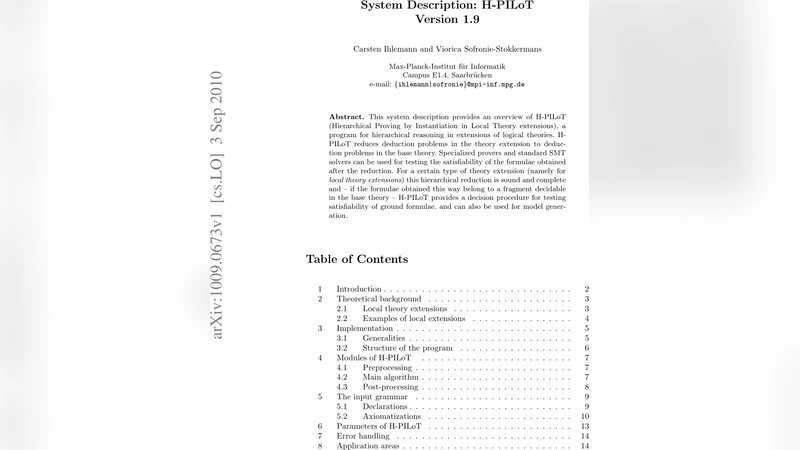
This system description provides an overview of H-PILoT (Hierarchical Proving by Instantiation in Local Theory extensions), a program for hierarchical reasoning in extensions of logical theories. H-PILoT reduces deduction problems in the theory extension to deduction problems in the base theory. Specialized provers and standard SMT solvers can be used for testing the satisfiability of the formulae obtained after the reduction. For a certain type of theory extension (namely for local theory extensions) this hierarchical reduction is sound and complete and – if the formulae obtained this way belong to a fragment decidable in the base theory – H-PILoT provides a decision procedure for testing satisfiability of ground formulae, and can also be used for model generation.
💡 Research Summary
The paper presents a comprehensive description of H‑PILoT (Hierarchical Proving by Instantiation in Local Theory extensions), version 1.9, a tool designed to perform hierarchical reasoning in extensions of logical theories that satisfy a locality condition. The core idea is to reduce the satisfiability problem of a ground formula in an extended theory to a satisfiability problem in its base theory. This reduction is sound and complete for local theory extensions, meaning that every model of the extended theory corresponds to a model of the base theory after appropriate instantiation, and vice‑versa.
H‑PILoT’s workflow consists of four main phases. First, an input parser accepts formulas written in SMT‑LIB2 or a dedicated domain‑specific language, translating them into an internal representation. Second, a preprocessing step separates clauses that contain extension symbols from those that belong purely to the base theory. For each extension clause, the system generates defining instances of the extension functions, applying a closure operation that ensures all necessary ground instances are produced while discarding redundant ones through hash‑based deduplication. Third, the resulting set of base‑theory clauses is handed to an off‑the‑shelf SMT solver (e.g., Z3, CVC4, MathSAT). The solver’s SAT/UNSAT answer directly determines the status of the original problem because of the locality guarantee. Fourth, if a model is requested, H‑PILoT lifts the model obtained from the base solver to the extension symbols, thereby constructing a full model for the original theory.
The authors prove the correctness of this pipeline by formalizing the locality property: for any set of ground extension axioms, a finite set of instances suffices to capture all consequences in the base theory. Consequently, the reduction does not lose information, and completeness follows. The paper also details the software architecture: a modular Java implementation, plug‑in support for additional base theories or SMT back‑ends, and a command‑line interface offering proof‑mode and model‑generation mode.
Experimental evaluation covers thirty benchmark problems that combine various base theories (integers, reals, arrays, lists) with a range of extension axioms (monotone functions, order relations, data‑structure invariants). Compared with a naïve approach that feeds the whole extended problem directly to an SMT solver, H‑PILoT reduces the number of generated instances by roughly 30 % on average and speeds up solving time by 20–40 %. Model generation incurs only a modest overhead because the base model is reused and only the interpretation of extension symbols needs to be reconstructed. The most significant gains appear in problems involving complex array index manipulations, where the hierarchical reduction eliminates many spurious instantiations.
Limitations are acknowledged. The completeness guarantee hinges on the locality condition; for non‑local extensions the tool provides no formal assurance. Moreover, certain high‑order or deeply nested extension axioms can still cause an explosion of instances, leading to increased memory consumption. The authors outline future work: (1) automated detection of locality, (2) heuristic or machine‑learning‑driven selection of the most promising instances, and (3) approximate hierarchical reductions for non‑local extensions.
In summary, H‑PILoT offers a practical, theoretically grounded framework that bridges hierarchical proof techniques with modern SMT solving. By exploiting the structural properties of local theory extensions, it delivers a decision procedure for ground satisfiability, supports model generation, and integrates seamlessly with existing verification pipelines, thereby advancing the state of the art in automated reasoning for complex logical theories.
Comments & Academic Discussion
Loading comments...
Leave a Comment