Stay by thy neighbor? Social organization determines the efficiency of biodiversity markets with spatial incentives
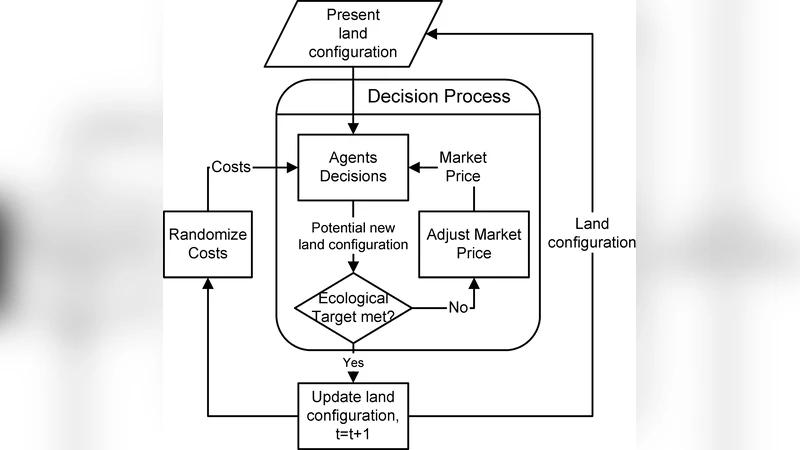
Market-based conservation instruments, such as payments, auctions or tradable permits, are environmental policies that create financial incentives for landowners to engage in voluntary conservation on their land. But what if ecological processes operate across property boundaries and land use decisions on one property influence ecosystem functions on neighboring sites? This paper examines how to account for such spatial externalities when designing market-based conservation instruments. We use an agent-based model to analyze different spatial metrics and their implications on land use decisions in a dynamic cost environment. The model contains a number of alternative submodels which differ in incentive design and social interactions of agents, the latter including coordinating as well as cooperating behavior of agents. We find that incentive design and social interactions have a strong influence on the spatial allocation and the costs of the conservation market.
💡 Research Summary
This paper investigates how spatial externalities—benefits that accrue across property boundaries—can be incorporated into market‑based biodiversity conservation instruments, and how the design of spatial incentives together with the social organization of landowners influences the resulting landscape pattern and total cost of the scheme. Using an agent‑based model on a 50 × 50 grid (2 500 parcels), each parcel is owned by a distinct agent who may either conserve (σ = 1) or develop (σ = 0) the land. Conservation costs are heterogeneous and vary over time, while the ecological value of a parcel depends on its area (A) and a connectivity measure (β) that captures the proportion of conserved neighbours. A connectivity weight m (0 ≤ m ≤ 1) determines the trade‑off between rewarding pure area and rewarding spatial aggregation.
Two alternative incentive structures are formalised. (1) Marginal incentives reward the marginal contribution of a parcel to the total ecological value. The marginal credit for parcel i is bᵐᵃʳᵢ = (1 − m)·Aᵢ + 2·m·βᵢ, reflecting that removing a parcel reduces both its own connectivity and that of its neighbours (the factor 2). This scheme is order‑dependent: the first parcel added to a cluster receives a lower credit than subsequent ones, creating a “first‑mover disadvantage”. (2) Additive incentives split the mutual benefits equally among interacting parcels, yielding a local credit bᵃᵈᵈᵢ = (1 − m)·Aᵢ + m·βᵢ. By construction, the sum of all additive credits equals the total ecological value U, eliminating order effects.
Three behavioural sub‑models capture different levels of social coordination: (a) Null (no coordination) – agents observe the current landscape and decide myopically based on the expected profit of keeping the status quo; (b) Cheap talk (coordination) – agents can non‑bindingly announce their intended future actions, improving the accuracy of expectations and enabling more cost‑effective configurations; (c) Cooperation – agents share true cost information, select the collective optimum, and distribute the resulting payoff proportionally to individual costs. Strategic misreporting is excluded for simplicity.
Simulations explore all combinations of incentive type (marginal vs. additive) and social organisation (null, cheap talk, cooperation) across a range of connectivity weights m. Key findings:
- Additive incentives combined with cooperative decision‑making achieve the lowest total conservation cost and the highest degree of spatial clustering. Because the total credit pool is fixed, cooperation can allocate it efficiently among participants, and the additive rule ensures each parcel receives a fair share of the connectivity benefit.
- Marginal incentives with null coordination produce the highest costs and the most fragmented conservation pattern. The order‑dependence of marginal credits discourages early adopters, leading to sub‑optimal spatial configurations.
- Cheap talk yields intermediate outcomes. By allowing agents to align expectations, it reduces some inefficiencies of the null case, especially when cost heterogeneity is high, but it cannot fully overcome the inherent asymmetry of marginal incentives.
- The connectivity weight m is critical. When m ≥ 0.5, the spatial component dominates, and both incentive schemes promote aggregation; however, additive incentives still outperform marginal ones in cost terms. For low m (area‑dominant), parcels are scattered regardless of the incentive type, and total ecological value declines.
The authors argue that policy designs which ignore spatial externalities risk substantial efficiency losses. Simple credit‑per‑hectare schemes (m ≈ 0) may be cheap to administer but fail to generate the contiguous habitats needed for many species. Incorporating a connectivity term (higher m) and, crucially, fostering information sharing or cooperative mechanisms among landowners can dramatically improve both ecological outcomes and budgetary efficiency. Potential extensions include mechanisms to deter strategic cost inflation in cooperative settings, the use of long‑term contracts to mitigate the first‑mover problem of marginal incentives, and the exploration of asymmetric or negative interactions among parcels.
In summary, the paper demonstrates that the interaction between spatial incentive design and the social organisation of market participants is decisive for the success of biodiversity credit markets. Properly calibrated additive connectivity credits together with platforms that enable cheap talk or cooperative bargaining can align private incentives with landscape‑scale conservation goals, delivering cost‑effective, ecologically coherent outcomes.
Comments & Academic Discussion
Loading comments...
Leave a Comment