Toroidal Carbon Nanotubes with Encapsulated Atomic Metal Loops
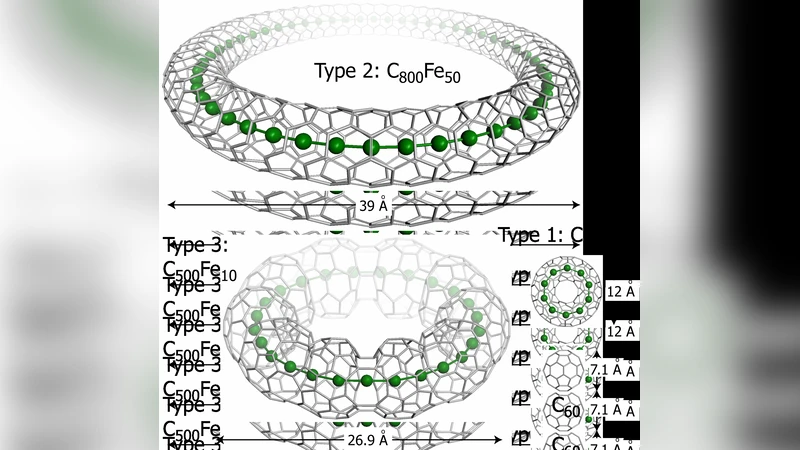
Toroidal carbon nanotubes can serve as hosts for encapsulated loops of atomic metal wires. Such composite structures have been analyzed using density functional theory for a semiconducting C$_{120}$ torus encapsulating chains of Fe, Au and Cu atoms. The sheathed metal necklaces form a zigzag structure and drops the HOMO/LUMO bandgap to less than 0.1 eV. The iron composite is ferromagnetic with a magnetic moment essentially the same as that of bcc iron. The azimuthal symmetry of these toroidal composites suggests that they may offer novel elecromagnetic properties not associated with straight, metal-encapsulated carbon nanotubes.
💡 Research Summary
This paper investigates a novel class of nanostructures in which a semiconducting carbon torus (C₁₂₀) serves as a host for atomic‑scale metal loops composed of Fe, Au, or Cu. Using density‑functional theory (DFT) with generalized gradient approximation and spin‑polarized calculations, the authors model the encapsulation of a single‑atom‑wide metal chain inside the toroidal cavity. The metal atoms adopt a zig‑zag configuration that follows the inner curvature of the torus, with inter‑atomic distances of roughly 2.5 Å—significantly shorter than in a free‑standing linear chain. This geometry is dictated by the torus’s curvature, which compresses metal‑metal bonds while simultaneously strengthening metal‑carbon interactions, as evidenced by charge‑density difference plots that show electron accumulation around each metal atom and depletion on adjacent carbon atoms.
Electronic structure analysis reveals that the pristine C₁₂₀ torus possesses a direct band gap of about 0.5 eV, characteristic of a semiconducting carbon network with reduced σ‑π hybridization due to curvature. Upon insertion of the metal loop, hybrid metal‑carbon states appear within the original gap, collapsing the HOMO‑LUMO separation to less than 0.1 eV. Consequently, the composite becomes quasi‑metallic, with a finite density of states at the Fermi level. The Fe‑encapsulated torus is especially noteworthy: spin‑polarized calculations predict a magnetic moment of ~2.2 μB per Fe atom, essentially identical to bulk bcc iron, indicating that the ferromagnetic ordering survives the extreme confinement and curvature. In contrast, Au and Cu loops remain non‑magnetic (or weakly paramagnetic) but still contribute metallic bands that enhance conductivity.
A key conceptual insight is the azimuthal symmetry of the toroidal composite. Because the metal loop wraps around the torus, the electronic wavefunctions acquire a well‑defined angular momentum quantum number, leading to quantized circumferential modes that have no analogue in straight, metal‑filled carbon nanotubes. This symmetry could give rise to unique electromagnetic responses: for example, the ferromagnetic Fe loop generates a persistent magnetic dipole aligned with the torus’s symmetry axis, effectively acting as a nanoscale current ring. Such a configuration may enable novel spin‑tronic functionalities, magnetic storage elements, or even metamaterial behavior at the nanoscale.
The authors also discuss potential applications. The reduced band gap suggests that these composites could serve as tunable interconnects or active channels in nano‑electronic circuits where a small bias can switch the system between insulating and conducting states. The preserved bulk‑like magnetism of the Fe loop opens the possibility of integrating magnetic functionality directly into carbon‑based nanodevices without the need for external magnetic layers. Moreover, the toroidal geometry may facilitate coupling to circularly polarized light or to external magnetic fields in ways that straight nanotubes cannot, hinting at applications in opto‑magnetic devices or quantum information platforms.
In summary, the study demonstrates that encapsulating atomic metal loops inside a carbon torus dramatically alters the host’s electronic and magnetic properties. The metal‑carbon hybridization collapses the band gap, while the Fe loop retains bulk ferromagnetism, and the overall azimuthal symmetry introduces new degrees of freedom for electromagnetic interaction. These findings broaden the design space for carbon‑based nanomaterials, suggesting that toroidal carbon‑metal composites could become a versatile platform for next‑generation nano‑electronics, spintronics, and photonic devices.
Comments & Academic Discussion
Loading comments...
Leave a Comment