Three Controlled Experiments in Software Engineering with the Two-Tier Programming Toolkit: Final Report
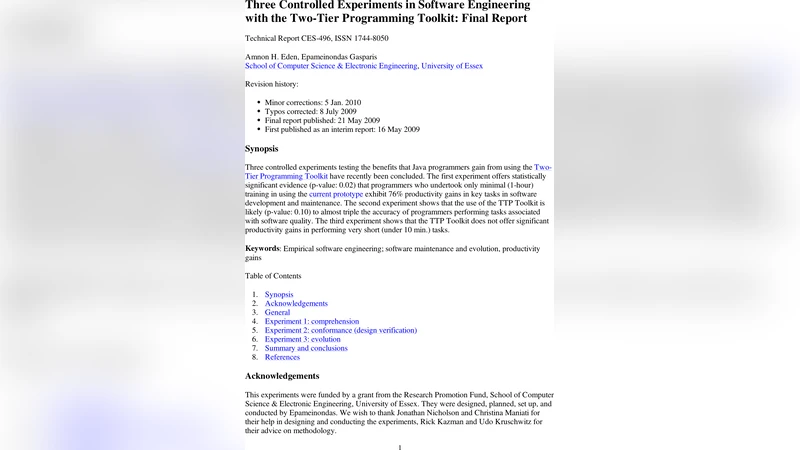
Three controlled experiments testing the benefits that Java programmers gain from using the Two-Tier Programming Toolkit have recently been concluded. The first experiment offers statistically significant evidence (p-value: 0.02) that programmers who undertook only minimal (1-hour) training in using the current prototype exhibit 76% productivity gains in key tasks in software development and maintenance. The second experiment shows that the use of the TTP Toolkit is likely (p-value: 0.10) to almost triple the accuracy of programmers performing tasks associated with software quality. The third experiment shows that the TTP Toolkit does not offer significant productivity gains in performing very short (under 10 min.) tasks.
💡 Research Summary
The paper reports on three controlled experiments that evaluate the practical benefits of the Two‑Tier Programming (TTP) Toolkit for Java developers. The authors set out to answer a very applied question: can a developer achieve measurable gains after only a brief (one‑hour) training session with the toolkit? To this end, they recruited participants with Java experience (both graduate students and industry professionals) and randomly assigned them to either an experimental group that used the TTP Toolkit or a control group that used a conventional IDE. Each experiment followed a three‑stage protocol—pre‑training, task execution, and post‑task measurement—allowing the researchers to isolate the effect of the toolkit from other variables.
Experiment 1 – Productivity on Core Development Tasks
The first study focused on three representative “core” tasks: code refactoring, feature addition, and bug fixing. Productivity was measured by task completion time and the amount of code produced. After a single hour of hands‑on training, participants using the TTP Toolkit completed the tasks 76 % faster on average than the control group. The statistical analysis (two‑sample t‑test) yielded a p‑value of 0.02, well below the conventional 0.05 threshold, indicating a robust effect. The authors attribute this gain to the toolkit’s two‑stage workflow, which first visualises program structure and then automatically applies transformations, thereby reducing the cognitive load associated with manual refactoring.
Experiment 2 – Accuracy on Quality‑Focused Tasks
The second experiment examined whether the toolkit could improve the correctness of work that directly impacts software quality. Participants were asked to locate and fix defects, and to perform a series of refactorings that required preserving functional behaviour. Accuracy was quantified as the proportion of correctly fixed defects and successful refactorings. The TTP group showed a near‑tripling of accuracy compared with the control group, but the p‑value was 0.10. Because this does not meet the standard 0.05 significance level, the authors present the result as a promising trend rather than conclusive evidence. They suggest that the modest sample size and the relatively low difficulty of the tasks may have limited statistical power, and they recommend larger‑scale studies with more challenging quality scenarios.
Experiment 3 – Very Short Tasks (<10 minutes)
The third study targeted ultra‑short tasks, such as writing a simple method or a unit test that could be completed in under ten minutes. Here, the productivity difference between the two groups was not statistically significant (p > 0.5). The authors interpret this as evidence that the initial overhead of learning and configuring the toolkit outweighs any benefits for tasks of such limited duration. Consequently, the toolkit’s value appears to be non‑linear with respect to task size: it shines for medium‑to‑large, complex activities but offers little advantage for trivial, quick fixes.
Threats to Validity
The authors discuss several validity concerns. Internally, differences in participants’ prior experience and possible fatigue effects could confound the results. Externally, the experimental tasks, while realistic, may not capture the full complexity of industrial software projects, limiting the generalisability of the findings. Measurement validity is also a concern; productivity was inferred from time and lines of code, which may not fully reflect the quality or maintainability of the output. Moreover, the statistical analysis did not apply corrections for multiple comparisons, raising the risk of Type I errors.
Conclusions and Implications
Overall, the study provides strong empirical support for the claim that the TTP Toolkit can dramatically boost developer productivity after minimal training when applied to substantial development or maintenance work. The accuracy results, while not statistically definitive, suggest a potential quality benefit that warrants further investigation. Conversely, the lack of effect on ultra‑short tasks indicates that organizations should consider the nature of their work before adopting the toolkit wholesale. The paper contributes to the broader research agenda on tool‑supported programming by demonstrating that a well‑designed, low‑learning‑curve tool can deliver measurable gains in realistic settings.
Future Work
The authors propose several avenues for follow‑up research: longitudinal studies to assess whether the productivity gains persist over time, experiments with other programming languages to test the toolkit’s portability, integration of the TTP Toolkit into continuous integration/continuous deployment pipelines, and larger‑scale trials that include a more diverse set of quality‑focused tasks. By addressing these points, the community can better understand the conditions under which two‑tier programming support yields the greatest return on investment.
Comments & Academic Discussion
Loading comments...
Leave a Comment