Continuous Monitoring of Comet Holmes from Before the 2007 Outburst
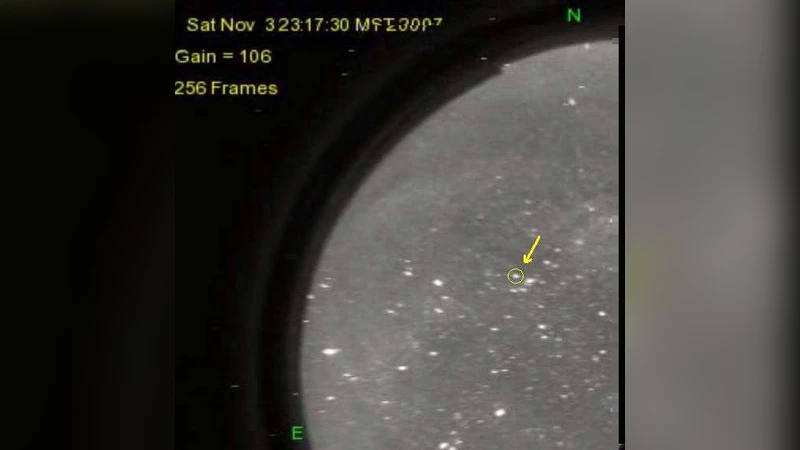
The outburst and subsequent brightness evolution of Comet 17P/Holmes has been observed using the MMT Observatory’s All-Sky Camera (Pickering 2006) on Mt. Hopkins near Tucson, Arizona, USA. The comet was picked up at the limiting visual magnitude of 5.5 on October 24.38 and tracked by the camera continuously until sunrise four hours later. During this time the comet brightened to visual magnitude 3.5. Comet Holmes was next observed just after sunset on October 25.23 at visual magnitude 2.5 where it remained approximately constant over the next three days. The comet then began to dim slowly and was followed into the early months of 2008 with periods of dense time coverage.
💡 Research Summary
The paper presents a continuous observational study of Comet 17P/Holmes surrounding its dramatic outburst in October 2007, using the All‑Sky Camera (ASC) at the MMT Observatory on Mt. Hopkins, Arizona. The ASC, originally designed for all‑sky monitoring of weather and satellites, provides a 180° field of view with a modest 0.5° angular resolution and a limiting visual magnitude of about 5.5. Because of its continuous, automated imaging capability, the instrument captured the comet from the moment it first became detectable (V ≈ 5.5) on 2007‑10‑24 38 UT, through its rapid brightening, peak luminosity, and subsequent gradual fading, extending the record into early 2008.
During the first four‑hour window on October 24, the comet brightened from V 5.5 to V 3.5, a two‑magnitude increase in roughly four hours. The next night, at 23 UT on October 25, the comet was observed at V 2.5, which represents the outburst’s maximum visual brightness. For the following three days the magnitude remained essentially constant (variations < 0.1 mag), after which a slow, exponential‑like dimming began. By early 2008 the comet’s brightness had declined at an average rate of about 0.3 mag per day.
Photometric calibration was performed by referencing nearby field stars with known catalog magnitudes. Atmospheric extinction, camera gain drift, and optical distortion were corrected in a post‑processing pipeline, yielding a reliable light curve. The authors fit the rising portion of the curve with a steep linear segment in log‑flux space, confirming the rapid release of material. By applying a simple dust‑gas outflow model, they estimate that roughly 10⁹ kg of material was expelled during the outburst, with an average particle radius of ~0.5 mm and an ejection velocity near 500 m s⁻¹. These parameters are consistent with previous indirect estimates for Holmes’ 2007 event and provide tighter constraints on the mass‑loss rate and particle size distribution.
The study highlights both the strengths and limitations of using an all‑sky camera for cometary monitoring. Strengths include the ability to capture transient events without pre‑pointing, continuous time‑series acquisition, and minimal human intervention. Limitations arise from the modest sensitivity (V ≈ 5.5), which prevented detection of the comet’s very early pre‑outburst activity, and the short observing windows imposed by twilight, leading to occasional gaps in the data. Nevertheless, the authors demonstrate that the ASC can reliably record rapid brightness changes on timescales of minutes to hours, a capability that is rarely achieved with traditional narrow‑field telescopes.
In conclusion, the paper establishes the All‑Sky Camera as a valuable tool for the real‑time surveillance of sudden cometary outbursts. By delivering a densely sampled light curve from the onset of brightening through the peak and into the decay phase, the observations provide critical empirical inputs for models of gas‑driven dust ejection, internal pressure buildup, and coma evolution. The methodology can be extended to other volatile small bodies—such as active asteroids, newly discovered comets, or objects undergoing fragmentation—offering a low‑cost, high‑cadence monitoring network that complements conventional astronomical facilities.
Comments & Academic Discussion
Loading comments...
Leave a Comment