Rate estimation in partially observed Markov jump processes with measurement errors
We present a simulation methodology for Bayesian estimation of rate parameters in Markov jump processes arising for example in stochastic kinetic models. To handle the problem of missing components an
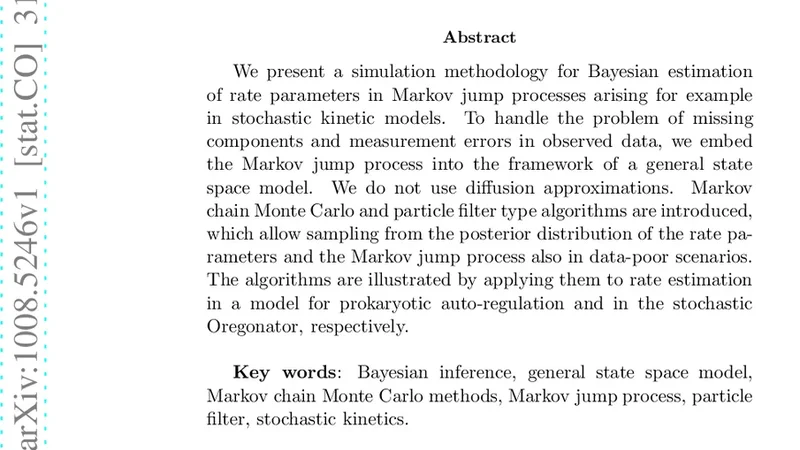
We present a simulation methodology for Bayesian estimation of rate parameters in Markov jump processes arising for example in stochastic kinetic models. To handle the problem of missing components and measurement errors in observed data, we embed the Markov jump process into the framework of a general state space model. We do not use diffusion approximations. Markov chain Monte Carlo and particle filter type algorithms are introduced, which allow sampling from the posterior distribution of the rate parameters and the Markov jump process also in data-poor scenarios. The algorithms are illustrated by applying them to rate estimation in a model for prokaryotic auto-regulation and in the stochastic Oregonator, respectively.
💡 Research Summary
The paper introduces a comprehensive Bayesian simulation framework for estimating reaction‑rate parameters in Markov jump processes (MJPs) when the observed data are incomplete and contaminated by measurement error. Unlike many existing approaches that rely on diffusion approximations (e.g., the chemical Langevin equation) to convert the discrete‑state jump dynamics into continuous stochastic differential equations, the authors retain the exact jump structure and embed the MJP as the latent state of a general state‑space model. In this formulation the observation equation may be nonlinear and explicitly includes an error term that can follow a Gaussian distribution or any other appropriate noise model, thereby faithfully representing realistic experimental uncertainties.
To sample from the posterior distribution of both the unknown rate parameters and the hidden jump trajectory, two complementary algorithms are developed. The first is a Gibbs‑type Markov chain Monte Carlo (MCMC) scheme that alternates between updating the parameters and updating the latent path. Path updates exploit the uniformization technique, which represents the MJP as a time‑changed Poisson process, allowing exact conditional simulation of the jump times and states given the current parameter values. The second algorithm is a particle‑filter‑based Particle MCMC (PMCMC) method. Here a sequential Monte Carlo (SMC) particle filter proposes candidate jump paths, computes importance weights that incorporate the measurement‑error likelihood, and performs resampling to focus computational effort on high‑probability regions. By embedding the particle filter within an MCMC outer loop, the method yields unbiased estimates of the marginal likelihood and thus enables efficient exploration of the high‑dimensional parameter space even when observations are sparse or irregularly spaced.
The authors validate the methodology on two benchmark systems. The first case study concerns a prokaryotic auto‑regulation network in which only a subset of molecular species are observed at discrete time points, while the remaining species are completely unobserved. Using synthetic data generated from known rate constants, the combined MCMC/PMCMC approach recovers posterior means that are close to the true values and produces credible intervals that correctly reflect the limited information content of the data. The second case study applies the framework to the stochastic Oregonator, a classic model of chemical oscillations. Here the observations are corrupted by relatively large Gaussian noise, mimicking realistic laboratory measurements. Despite the strong noise, the particle‑filter component successfully tracks the latent oscillatory trajectory, and the posterior distribution over the three reaction rates concentrates around the true parameters, demonstrating robustness to measurement error.
Key contributions of the work are: (1) a rigorous embedding of MJPs into a general state‑space representation that simultaneously handles missing components and measurement error without resorting to diffusion approximations; (2) an exact conditional path sampler based on uniformization, enabling efficient Gibbs updates of the latent trajectory; (3) a flexible PMCMC algorithm that leverages particle filtering to approximate the intractable likelihood while preserving exactness of the overall Bayesian inference; (4) empirical evidence that the combined approach remains accurate in data‑poor regimes, where traditional methods either fail to converge or produce biased estimates.
The paper also outlines several promising extensions. Scaling the particle filter to high‑dimensional biochemical networks may require parallel implementation and adaptive resampling strategies. Incorporating online data streams would lead to sequential Bayesian updating, useful for real‑time monitoring of biochemical reactors or epidemiological outbreaks. Finally, the framework could be expanded to perform model selection (e.g., choosing among alternative reaction network structures) by embedding reversible‑jump MCMC or Bayesian model evidence calculations within the same state‑space architecture. Overall, the study provides a powerful, exact, and computationally tractable toolbox for parameter inference in partially observed stochastic kinetic systems, with potential impact across systems biology, chemical engineering, and quantitative epidemiology.
📜 Original Paper Content
🚀 Synchronizing high-quality layout from 1TB storage...