The influence of the mass-ratio on the acceleration of particles by filamentation instabilities
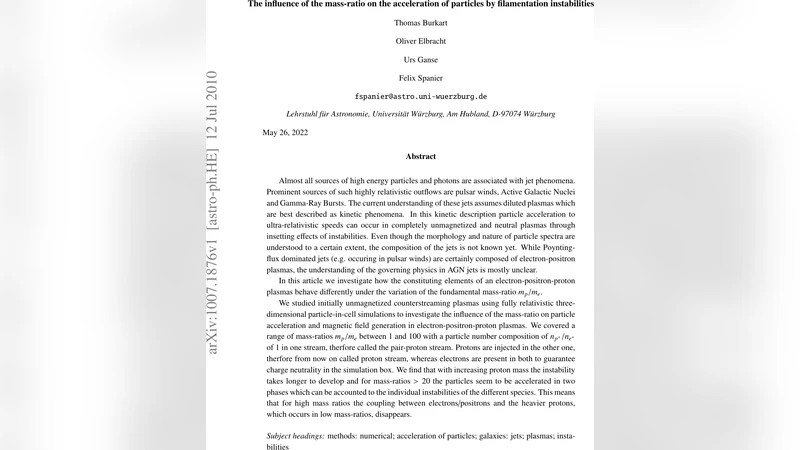
Almost all sources of high energy particles and photons are associated with jet phenomena. Prominent sources of such highly relativistic outflows are pulsar winds and Active Galactic Nuclei. The current understanding of these jets assumes diluted plasmas which are best described as kinetic phenomena. In this kinetic description particle acceleration to ultra-relativistic speeds can occur in completely unmagnetized and neutral plasmas through insetting effects of instabilities. Even though the morphology and nature of particle spectra are understood to a certain extent, the composition of the jets is not known yet. While Poynting-flux dominated jets are certainly composed of electron-positron plasmas, the understanding of the governing physics in AGN jets is mostly unclear. In this article we investigate how the constituting elements of an electron-positron-proton plasma behave differently under the variation of the fundamental mass-ratio m_p/m_e. We studied initially unmagnetized counterstreaming plasmas using fully relativistic three-dimensional particle-in-cell simulations to investigate the influence of the mass-ratio on particle acceleration and magnetic field generation in electron-positron-proton plasmas. We covered a range of mass-ratios m_p/m_e between 1 and 100 with a particle number composition of n_{p^+}/n_{e^+} of 1 in one stream, only protons are injected in the other, whereas electrons are present in both to guarantee charge neutrality in the simulation box. We find that with increasing proton mass the instability takes longer to develop and for mass-ratios > 20 the particles seem to be accelerated in two phases which can be accounted to the individual instabilities of the different species. This means that for high mass ratios the coupling between electrons/positrons and the heavier protons, which occurs in low mass-ratios, disappears.
💡 Research Summary
The paper investigates how the mass‑ratio between protons and electrons (mₚ/mₑ) influences particle acceleration and magnetic‑field generation in an unmagnetized, counter‑streaming electron‑positron‑proton plasma. Using fully relativistic three‑dimensional particle‑in‑cell (PIC) simulations, the authors explore seven values of the mass‑ratio (1, 2, 5, 10, 20, 50, 100). Each simulation consists of two opposite‑moving streams: one contains electrons and protons (with nₚ⁺/nₑ⁺ = 1), the other contains electrons and positrons, guaranteeing overall charge neutrality.
The results fall into two distinct regimes. For low mass‑ratios (≤ 10) the three species behave as a tightly coupled fluid. The filamentation (Weibel) instability grows rapidly, forming current sheets that involve electrons, positrons, and protons simultaneously. Consequently, the magnetic field reaches a high saturation level quickly, and all three species acquire comparable high‑energy tails in their spectra. The coupling is strong because the proton inertia is comparable to that of the leptons, allowing the protons to respond promptly to the electromagnetic fluctuations generated by the leptons.
When the mass‑ratio exceeds about 20, a two‑stage acceleration process emerges. In the first stage, the light leptons (electrons and positrons) dominate the instability, quickly generating strong magnetic filaments and accelerating to ultra‑relativistic energies. The heavy protons, owing to their larger inertia, lag behind and experience only the quasi‑static fields produced by the lepton filaments. As the simulation progresses, a secondary proton‑driven filamentation mode develops on a slower timescale. This second stage produces a distinct proton‑only current sheet and a separate high‑energy component in the proton spectrum, while the lepton spectrum remains largely unchanged from the first stage. The coupling between leptons and protons therefore weakens, and the overall magnetic field saturates at a level set primarily by the lepton dynamics, with only modest additional amplification from the proton‑driven mode.
The authors also examine the temporal evolution of the magnetic energy density. In low‑mass‑ratio runs the magnetic energy grows rapidly and reaches a plateau shortly after the instability saturates. In high‑mass‑ratio runs the growth curve shows an early steep rise (lepton‑driven) followed by a slower, secondary increase associated with the proton‑driven filamentation, before finally leveling off at a lower total magnetic energy than in the low‑ratio cases.
These findings have several astrophysical implications. First, they suggest that the composition of relativistic jets—whether they are dominated by electron‑positron pairs or contain a substantial proton component—directly affects the efficiency and timing of particle acceleration. Second, the emergence of two distinct acceleration phases for realistic mass‑ratios (mₚ/mₑ ≫ 20) implies that observed cosmic‑ray and photon spectra from jets could exhibit composite features rather than a single power‑law. Third, the reduced coupling at high mass‑ratios means that magnetic field generation in proton‑rich jets may be less efficient than in pair‑dominated jets, potentially influencing synchrotron emission and jet collimation.
Although the simulations stop at mₚ/mₑ = 100—far below the physical value of ≈ 1836—the trends observed (delayed instability growth, two‑stage acceleration, weakened lepton‑proton coupling) are expected to persist and become even more pronounced at realistic ratios. The paper therefore calls for future work extending the parameter space to higher mass‑ratios, varying the density ratios of the streams, and incorporating modest background magnetic fields to better mimic conditions in pulsar winds and AGN jets. Such studies will refine our understanding of how jet composition shapes the microphysics that ultimately powers the most energetic particles and photons in the universe.
Comments & Academic Discussion
Loading comments...
Leave a Comment