Quantum imaging: Scattered observations on "Copenhagen"
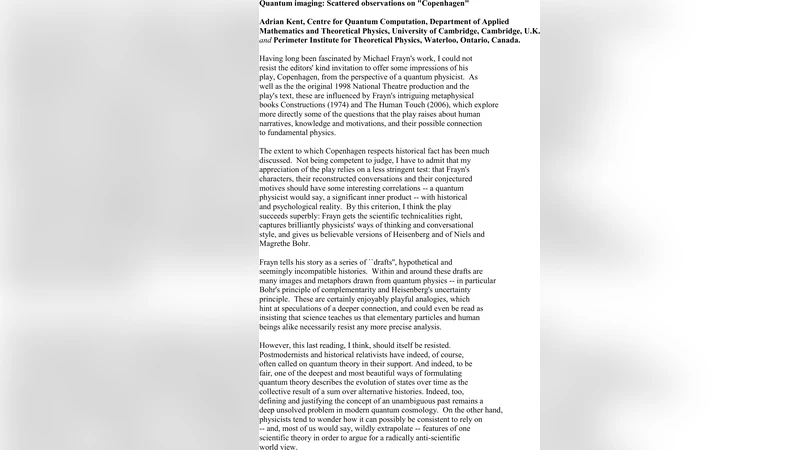
Remarks on Michael Frayn’s play “Copenhagen”.
💡 Research Summary
Adrian Kent offers a physicist’s commentary on Michael Frayn’s play Copenhagen, examining how the drama intertwines historical narrative with quantum‑mechanical ideas. He begins by stating that his own criterion for judging the play is not strict historical accuracy but the degree of “inner product” between the characters’ reconstructed conversations and the real mental habits of Niels Bohr, Werner Heisenberg and other Copenhagen‑era physicists. By this measure, Kent finds the play remarkably successful: the scientific jargon is correct, the conversational style of the physicists is captured, and the personalities of Heisenberg, Bohr and Magrethe Bohr feel authentic.
The play repeatedly uses the principles of complementarity and Heisenberg’s uncertainty as metaphors for the ambiguity of human motives and memory. Kent acknowledges that these analogies are “playful” and can be enjoyed, but he warns against taking them as literal scientific claims. He points out that the most elegant formalism of quantum theory—Feynman’s sum‑over‑histories—describes the evolution of a quantum state as a superposition of many possible histories, a notion that resonates with the play’s structure of multiple, sometimes incompatible drafts. Yet he stresses that the formalism remains a precise mathematical tool, not a justification for post‑modern relativism.
A central focus of the essay is Magrethe’s argument that the Copenhagen interpretation functions more like a political treaty than a logical deduction from experiment. Kent agrees that the interpretation was shaped by a community of physicists who, like any human group, are subject to social hierarchies, consensus‑building, and extra‑scientific influences. He recounts how, between the 1930s and the 1980s, questioning Bohr’s complementarity was almost heretical, illustrating how scientific ideas can become entrenched through sociological mechanisms rather than purely empirical ones. This observation serves as a caution against extrapolating a single scientific theory to support anti‑scientific world‑views.
Turning to the speculative link between quantum theory and consciousness, Kent adopts a sober stance. He identifies two “great problems” of contemporary physics: finding a mathematical description of reality that is fully compatible with quantum mechanics, and developing a physical theory of consciousness. He admits that the latter is still in its infancy—perhaps even more primitive than the early Greeks’ grasp of natural philosophy—and that any connection to quantum mechanics is at present speculative, lacking empirical grounding. Nonetheless, he leaves open the possibility that future, as‑yet‑unknown mathematical structures could bridge the two domains.
In a more whimsical turn, Kent draws a parallel between the play’s depiction of individuals as “miniature communities” with internal politics and the self‑similar scaling laws of statistical physics near phase transitions. He suggests that just as interaction strengths in a fractal system depend on the ratio of scales, one might imagine rescaling the “sub‑selves” within a person to inform decision‑making. He cites the square‑root law for representation (Penrose, 1952) as an example of a mathematically motivated, though rarely realized, political principle. While acknowledging that anthropologists and social scientists have already explored such analogies, he concedes that the idea offers limited new mileage.
Overall, Kent praises Frayn for capturing the spirit of quantum uncertainty and for embedding the play’s own ambiguities within the very metaphors it employs. He warns readers not to conflate artistic metaphor with scientific doctrine, emphasizing that quantum mechanics provides a rigorous, experimentally verified framework, whereas the philosophical extensions drawn in the play belong to a different, more speculative realm. The essay thus serves both as an appreciation of Copenhagen’s literary craft and as a reminder of the distinct epistemic standards that govern physics and the humanities.
Comments & Academic Discussion
Loading comments...
Leave a Comment