Topological obstructions to embedding of a matrix algebra bundle into a trivial one
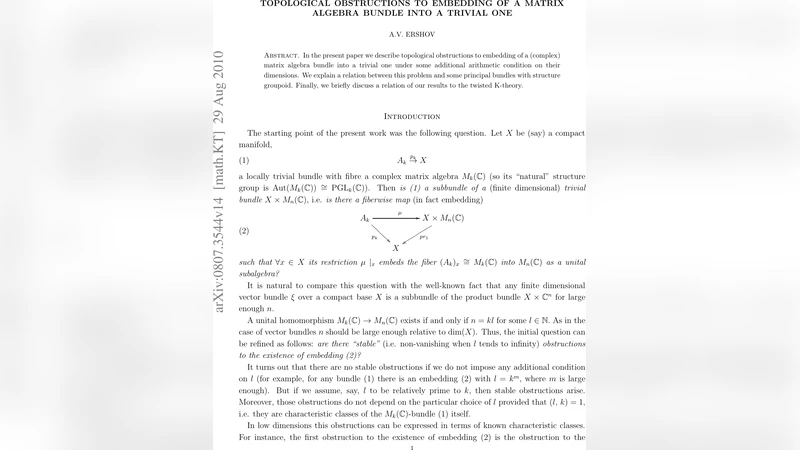
In the present paper we describe topological obstructions to embedding of a (complex) matrix algebra bundle into a trivial one under some additional arithmetic condition on their dimensions. We explain a relation between this problem and some principal bundles with structure groupoid. Finally, we briefly discuss a relation of our results to the twisted K-theory.
💡 Research Summary
The paper investigates the problem of embedding a complex matrix‑algebra bundle (A\to X) into a trivial matrix‑algebra bundle (\underline{\mathrm{M}}{m}(\mathbb C)=X\times\mathrm{M}{m}(\mathbb C)) under certain arithmetic constraints on the fibre dimensions. A matrix‑algebra bundle is locally isomorphic to the algebra (\mathrm{M}{n}(\mathbb C)); its transition functions take values in the projective linear group (\mathrm{PGL}{n}(\mathbb C)). An embedding is a fibrewise algebra monomorphism (\iota:A\hookrightarrow\underline{\mathrm{M}}{m}(\mathbb C)) such that each fibre (A{x}) is identified with a sub‑algebra of (\mathrm{M}_{m}(\mathbb C)).
The authors first impose an arithmetic condition on the ranks, for instance (\gcd(n,m)=1) or (n\mid m). This condition simplifies the obstruction theory because it guarantees that the natural inclusion (\mathrm{PGL}{n}\hookrightarrow\mathrm{PGL}{m}) is well‑behaved on the level of classifying spaces. The central object of study becomes the cohomology class (\alpha\in H^{2}(X,\mathbb Z/n)) determined by the original (\mathrm{PGL}{n})‑cocycle. To lift the structure group from (\mathrm{PGL}{n}) to (\mathrm{PGL}_{m}) one must kill this class; the paper shows that a necessary and sufficient condition is the vanishing of its Bockstein image (\beta(\alpha)\in H^{3}(X,\mathbb Z)). In other words, the obstruction to embedding lives in the third integral cohomology group, exactly as in the classical theory of the Brauer group.
A novel aspect of the work is the reinterpretation of the problem in terms of a principal bundle with a structure groupoid (\mathcal G). The groupoid is built from the inclusion (\mathrm{GL}{n}\hookrightarrow\mathrm{GL}{m}) and encodes both the original transition data and the desired lift. The obstruction class (\beta(\alpha)) then appears as a 2‑stack (or gerbe) class associated with (\mathcal G). This viewpoint generalises the usual Brauer‑group picture: while the Brauer group classifies central (\mathbb C^{\times})‑extensions of (\mathrm{PGL}_{n}), the groupoid approach captures extensions where the target group is larger, allowing a finer analysis of when a lift exists.
Finally, the paper connects these topological obstructions to twisted K‑theory. The class (\alpha) defines a twisting (a gerbe) for K‑theory, giving rise to the twisted K‑group (K^{0}_{\alpha}(X)). The authors prove that an embedding exists precisely when the twisted K‑group is torsion‑free; equivalently, the vanishing of (\beta(\alpha)) ensures that the associated twisted K‑theory spectrum is equivalent to an untwisted one. This establishes a direct bridge between the geometric problem of embedding matrix‑algebra bundles and the algebraic invariants of twisted K‑theory.
In summary, the paper provides a comprehensive obstruction theory for embedding matrix‑algebra bundles into trivial ones, identifies the key cohomological obstruction in (H^{3}(X,\mathbb Z)), reformulates the problem via principal groupoid bundles, and demonstrates how these obstructions manifest in twisted K‑theory. The results not only extend classical Brauer‑group considerations but also offer tools potentially useful in areas such as non‑commutative geometry, gauge theory, and the classification of bundles over complex manifolds.
Comments & Academic Discussion
Loading comments...
Leave a Comment