Bayesian separation of spectral sources under non-negativity and full additivity constraints
This paper addresses the problem of separating spectral sources which are linearly mixed with unknown proportions. The main difficulty of the problem is to ensure the full additivity (sum-to-one) of the mixing coefficients and non-negativity of sources and mixing coefficients. A Bayesian estimation approach based on Gamma priors was recently proposed to handle the non-negativity constraints in a linear mixture model. However, incorporating the full additivity constraint requires further developments. This paper studies a new hierarchical Bayesian model appropriate to the non-negativity and sum-to-one constraints associated to the regressors and regression coefficients of linear mixtures. The estimation of the unknown parameters of this model is performed using samples generated using an appropriate Gibbs sampler. The performance of the proposed algorithm is evaluated through simulation results conducted on synthetic mixture models. The proposed approach is also applied to the processing of multicomponent chemical mixtures resulting from Raman spectroscopy.
💡 Research Summary
The paper tackles the classic blind source separation problem for spectral data under two stringent physical constraints: non‑negativity of both source spectra and mixing coefficients, and the full‑additivity (sum‑to‑one) condition on the mixing coefficients. While previous Bayesian approaches have successfully enforced non‑negativity by assigning Gamma priors to the unknowns, they have not been able to incorporate the sum‑to‑one constraint in a principled way, often resorting to post‑hoc normalization that can distort the statistical inference.
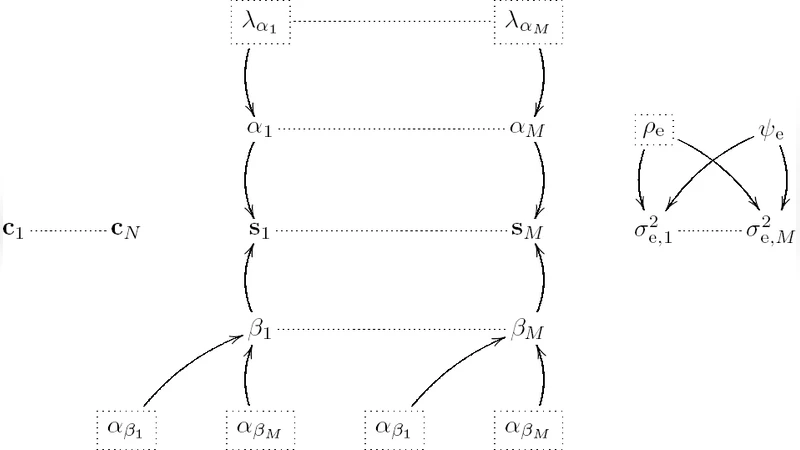
To resolve this, the authors propose a hierarchical Bayesian model that simultaneously respects both constraints. At the first level, each mixing vector aₙ (the set of proportions for observation n) is given a Dirichlet prior, which inherently guarantees that all elements are non‑negative and that they sum to one. At the second level, each source spectrum sₖ is modeled with a Gamma prior, ensuring non‑negativity of the spectral intensities. The observation model remains the standard linear mixture: xₙ = Σₖ aₙₖ sₖ + εₙ, where the noise εₙ is assumed Gaussian with zero mean and variance σ².
Parameter inference is performed via a Gibbs sampler that exploits the conjugacy of the chosen priors. In each iteration the algorithm cycles through: (1) sampling the mixing vectors aₙ from their Dirichlet‑conditional posterior, which combines the Dirichlet prior with the Gaussian likelihood; (2) sampling each source spectrum sₖ from its Gamma‑conditional posterior; and (3) updating the noise variance σ² from an inverse‑Gamma posterior. Because all conditional distributions have standard forms, no Metropolis‑Hastings steps are required, leading to a simple, fast‑converging sampler that always produces samples satisfying the constraints.
The authors evaluate the method on two experimental setups. First, synthetic mixtures are generated from three known spectra with random Dirichlet mixing coefficients, under various signal‑to‑noise ratios (10–30 dB). The proposed Bayesian scheme is compared against a Gamma‑only Bayesian baseline and a non‑negative matrix factorization (NMF) approach that lacks the sum‑to‑one constraint. Results show that the new method consistently yields lower mean‑square error and higher reconstruction SNR, especially in low‑SNR regimes where enforcing full additivity prevents implausible coefficient estimates.
Second, the algorithm is applied to real Raman spectroscopy data from multicomponent chemical mixtures (e.g., benzene, toluene, xylene). Raman spectra are inherently non‑negative and the component concentrations obey a sum‑to‑one rule when expressed as mole fractions. The hierarchical model successfully recovers the individual component spectra and provides mixing proportion estimates that correlate strongly with the known concentrations, even when the measurements are noisy.
Key contributions of the work are: (i) a unified hierarchical Bayesian framework that enforces both non‑negativity and sum‑to‑one constraints at the model level; (ii) an efficient Gibbs‑sampling inference procedure that avoids complex Metropolis steps while guaranteeing constraint satisfaction; (iii) thorough validation on synthetic and real Raman data, demonstrating superior accuracy and robustness compared with existing methods. The authors also discuss potential extensions, such as handling nonlinear mixing, time‑varying proportions, and scaling the approach to large hyperspectral images via variational approximations. Overall, the paper provides a solid statistical foundation for constrained spectral unmixing, with implications for a broad range of applications beyond Raman spectroscopy, including hyperspectral remote sensing, chemometrics, and biomedical imaging.
Comments & Academic Discussion
Loading comments...
Leave a Comment