Structural Solutions to Dynamic Scheduling for Multimedia Transmission in Unknown Wireless Environments
In this paper, we propose a systematic solution to the problem of scheduling delay-sensitive media data for transmission over time-varying wireless channels. We first formulate the dynamic scheduling problem as a Markov decision process (MDP) that explicitly considers the users’ heterogeneous multimedia data characteristics (e.g. delay deadlines, distortion impacts and dependencies etc.) and time-varying channel conditions, which are not simultaneously considered in state-of-the-art packet scheduling algorithms. This formulation allows us to perform foresighted decisions to schedule multiple data units for transmission at each time in order to optimize the long-term utilities of the multimedia applications. The heterogeneity of the media data enables us to express the transmission priorities between the different data units as a priority graph, which is a directed acyclic graph (DAG). This priority graph provides us with an elegant structure to decompose the multi-data unit foresighted decision at each time into multiple single-data unit foresighted decisions which can be performed sequentially, from the high priority data units to the low priority data units, thereby significantly reducing the computation complexity. When the statistical knowledge of the multimedia data characteristics and channel conditions is unknown a priori, we develop a low-complexity online learning algorithm to update the value functions which capture the impact of the current decision on the future utility. The simulation results show that the proposed solution significantly outperforms existing state-of-the-art scheduling solutions.
💡 Research Summary
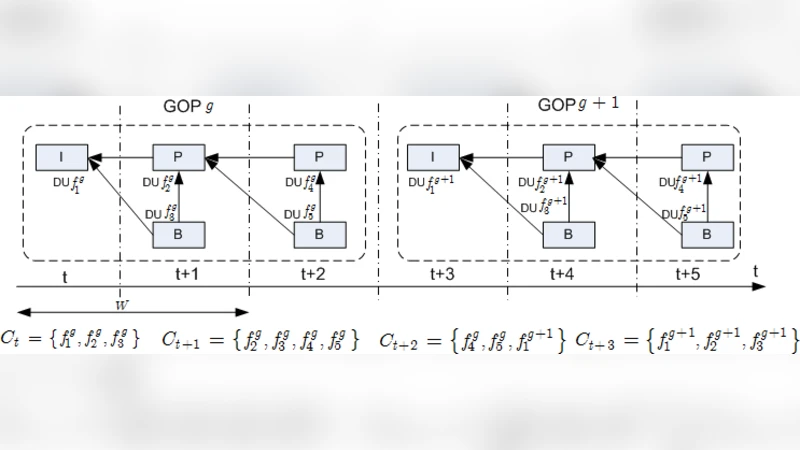
The paper tackles the problem of scheduling delay‑sensitive multimedia data over time‑varying wireless channels, a scenario where both the stochastic nature of the channel and the heterogeneous characteristics of multimedia packets (different sizes, deadlines, distortion impacts, and inter‑packet dependencies) must be jointly considered. The authors first model each Group‑of‑Pictures (GOP) as a collection of Data Units (DUs) and introduce a “context” that captures, for any time slot, the set of DUs whose deadlines fall within a scheduling window. This context encodes the types of DUs, their remaining buffer occupancy, and the directed‑acyclic‑graph (DAG) of decoding dependencies.
The dynamic scheduling problem is then formulated as a Markov Decision Process (MDP). The system state consists of three components: the current context, the buffer state (how many packets of each DU remain), and the wireless channel state, which is modeled as a finite‑state Markov chain. An action specifies how many packets to transmit from each DU in the current context. Immediate reward combines the reduction in video distortion (weighted by each DU’s distortion impact) and the transmission energy cost.
A major obstacle in traditional MDP solutions is the need for the transition probabilities of packet arrivals and channel changes, which are generally unknown in real wireless environments. To overcome this, the authors introduce a post‑decision state – a “middle” state that occurs after the transmission decision but before new arrivals and channel transitions. They define a post‑decision value function V̂(s′) that represents the optimal long‑term utility starting from this intermediate state. Because V̂(s′) abstracts away the expectation over unknown dynamics, the foresighted scheduling decision can be computed directly from the current state and V̂(s′) without knowing the underlying probabilities. The value function is then updated online using a temporal‑difference (TD) learning rule, enabling the algorithm to adapt to unknown and time‑varying environments.
To reduce the combinatorial explosion inherent in multi‑DU scheduling, the authors construct a transmission‑priority DAG. Each DU’s priority is derived from its distortion impact, deadline, and dependency relations; higher‑priority DUs must be transmitted before lower‑priority ones. By traversing this DAG from the root to leaves, the multi‑DU foresighted decision is decomposed into a sequence of single‑DU decisions that can be solved independently. This structural decomposition lowers the computational complexity from exponential in the number of DUs to linear, making real‑time implementation feasible.
The paper also distinguishes two cases: (i) independently decodable DUs (e.g., motion‑JPEG) and (ii) inter‑dependent DUs (e.g., H.264/HEVC). For the latter, the same DAG‑based priority framework is extended to respect decoding dependencies across DUs within a GOP.
Extensive simulations compare the proposed method against several state‑of‑the‑art baselines: RaDiO (which models dependencies but assumes a static channel), myopic cross‑layer optimizations (which only consider the current channel), and energy‑minimization schemes. Results show that the new algorithm achieves a 2–3 dB improvement in average PSNR, a 15 % or higher increase in deadline‑satisfaction ratio, and substantially lower computational overhead.
In summary, the contributions are threefold: (1) a unified MDP formulation that simultaneously captures channel dynamics and multimedia heterogeneity; (2) the introduction of a post‑decision state and online TD learning to handle unknown environment statistics; and (3) a DAG‑based priority structure that decomposes the multi‑packet scheduling problem into tractable single‑packet subproblems. These innovations enable long‑term, utility‑optimal scheduling in realistic, rapidly changing wireless networks and are directly applicable to emerging 5G/6G services such as live video streaming, augmented/virtual reality, and remote tele‑medicine, where both latency and visual quality are critical.
Comments & Academic Discussion
Loading comments...
Leave a Comment