Puzzles, positroid varieties, and equivariant K-theory of Grassmannians
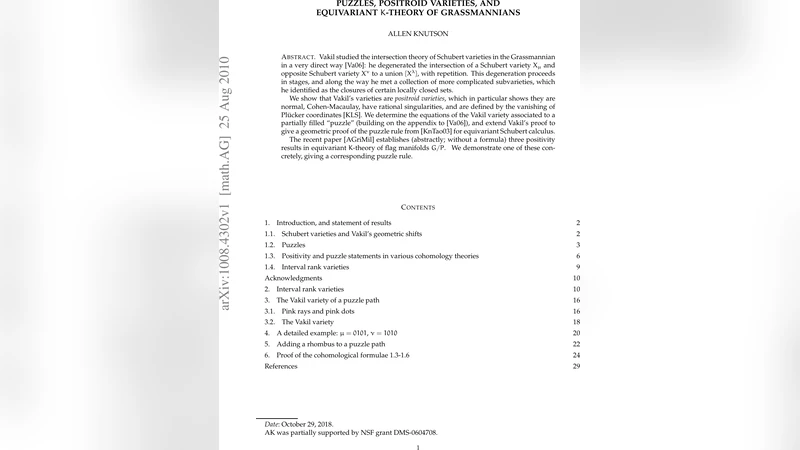
Vakil studied the intersection theory of Schubert varieties in the Grassmannian in a very direct way: he degenerated the intersection of a Schubert variety X_mu and opposite Schubert variety X^nu to a union {X^lambda}, with repetition. This degeneration proceeds in stages, and along the way he met a collection of more complicated subvarieties, which he identified as the closures of certain locally closed sets. We show that Vakil’s varieties are positroid varieties, which in particular shows they are normal, Cohen-Macaulay, have rational singularities, and are defined by the vanishing of Pl"ucker coordinates [Knutson-Lam-Speyer]. We determine the equations of the Vakil variety associated to a partially filled ``puzzle’’ (building on the appendix to [Vakil]), and extend Vakil’s proof to give a geometric proof of the puzzle rule from [Knutson-Tao ‘03] for equivariant Schubert calculus. The recent paper [Anderson-Griffeth-Miller] establishes (abstractly; without a formula) three positivity results in equivariant K-theory of flag manifolds G/P. We demonstrate one of these concretely, giving a corresponding puzzle rule.
💡 Research Summary
The paper revisits Ravi Vakil’s degeneration of the intersection of a Schubert variety (X_\mu) with an opposite Schubert variety (X^\nu) inside the Grassmannian (Gr(k,n)). Vakil’s construction proceeds through a sequence of flat degenerations, ending in a union of (possibly repeated) opposite Schubert varieties (X^\lambda). In the intermediate steps a collection of rather intricate subvarieties appears; these were originally described only as closures of certain locally closed loci and lacked a clean geometric description.
The authors identify each of these intermediate varieties as a positroid variety. Positroid varieties, introduced by Postnikov and later studied by Knutson, Lam, and Speyer, are known to be normal, Cohen‑Macaulay, and to have rational singularities; they are cut out by explicit vanishing of Plücker coordinates and admit Gröbner bases that make their equations transparent. By establishing the Vakil varieties as positroid varieties, the paper immediately inherits all of these desirable properties.
Building on Vakil’s appendix, the authors translate a partially filled “puzzle” (a combinatorial object introduced by Knutson and Tao) into a concrete set of Plücker equations. Each puzzle piece forces a specific Plücker coordinate to vanish; the collection of pieces therefore defines a positroid variety whose ideal is generated by those forced coordinates. This gives a precise algebraic description of the geometric object that the puzzle represents.
With this dictionary in hand, the authors give a geometric proof of the Knutson‑Tao puzzle rule for equivariant Schubert calculus. The original puzzle rule computes structure constants in the equivariant cohomology ring (H_T^*(Gr(k,n))) by counting weighted tilings. The new proof shows that each tiling corresponds to a component of the Vakil degeneration, and the equivariant weight attached to a tile matches the equivariant Chern class contribution of the corresponding Plücker coordinate. Consequently, the sum over all tilings reproduces the equivariant product of Schubert classes, providing a conceptual bridge between combinatorial tilings and the geometry of positroid varieties.
Finally, the paper addresses recent work of Anderson, Griffeth, and Miller, who proved three positivity statements in the equivariant (K)-theory of flag varieties (G/P) without giving explicit formulas. By exploiting the puzzle–positroid correspondence, the authors realize one of these positivity results concretely: they construct a puzzle rule for the equivariant (K)-theoretic structure constants of the Grassmannian. In this rule the weight of a puzzle is a monomial in the equivariant parameters, and the total contribution is a positive sum of such monomials, exactly matching the positivity predicted by Anderson‑Griffeth‑Miller.
In summary, the paper makes three major contributions: (1) it identifies Vakil’s intermediate varieties as positroid varieties, thereby proving normality, Cohen‑Macaulayness, and rational singularities; (2) it translates partially filled puzzles into explicit Plücker equations, giving a geometric proof of the equivariant puzzle rule; and (3) it provides a concrete, combinatorial manifestation of a recent abstract positivity theorem in equivariant (K)-theory. The work unifies degeneration techniques, positroid geometry, and puzzle combinatorics, offering a powerful new toolkit for calculations in the equivariant cohomology and (K)-theory of Grassmannians.
Comments & Academic Discussion
Loading comments...
Leave a Comment