Noise Corruption of Empirical Mode Decomposition and Its Effect on Instantaneous Frequency
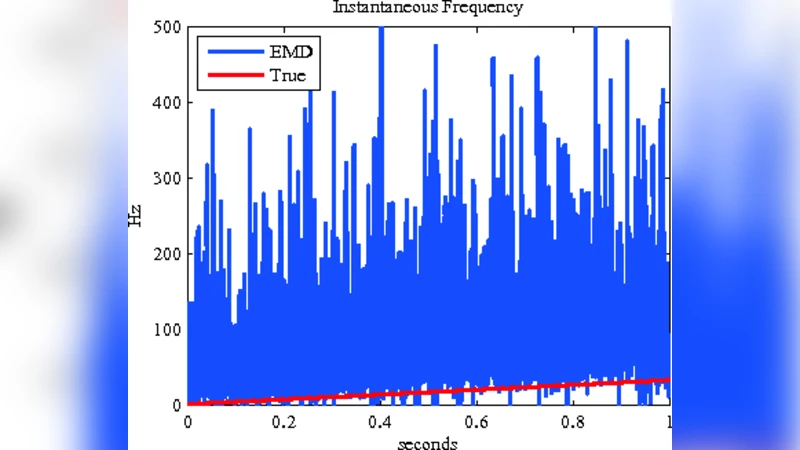
Huang’s Empirical Mode Decomposition (EMD) is an algorithm for analyzing nonstationary data that provides a localized time-frequency representation by decomposing the data into adaptively defined modes. EMD can be used to estimate a signal’s instantaneous frequency (IF) but suffers from poor performance in the presence of noise. To produce a meaningful IF, each mode of the decomposition must be nearly monochromatic, a condition that is not guaranteed by the algorithm and fails to be met when the signal is corrupted by noise. In this work, the extraction of modes containing both signal and noise is identified as the cause of poor IF estimation. The specific mechanism by which such “transition” modes are extracted is detailed and builds on the observation of Flandrin and Goncalves that EMD acts in a filter bank manner when analyzing pure noise. The mechanism is shown to be dependent on spectral leak between modes and the phase of the underlying signal. These ideas are developed through the use of simple signals and are tested on a synthetic seismic waveform.
💡 Research Summary
The paper investigates why Empirical Mode Decomposition (EMD), a widely used adaptive time‑frequency analysis tool, fails to deliver reliable instantaneous frequency (IF) estimates when the input signal is contaminated by noise. The authors begin by recalling that EMD decomposes a signal into a set of Intrinsic Mode Functions (IMFs) that are supposed to be locally narrow‑band; only under this condition does the Hilbert transform yield a physically meaningful IF. In practice, however, noise perturbs the decomposition process, producing IMFs that contain both signal and noise components. The authors label these mixed components “transition modes” and argue that they are the primary source of IF distortion.
Two complementary mechanisms are identified as the root cause of transition modes. First, spectral leakage: pure white noise possesses a flat spectrum, and when EMD processes such noise it behaves like a bank of band‑pass filters, each IMF occupying a finite frequency band. If a deterministic signal component falls within the same band, the corresponding IMF inevitably captures both the signal and the noise, violating the narrow‑band assumption. Second, signal phase: even when the frequency is fixed, the relative phase determines the locations of local extrema and zero‑crossings, which are the anchors for the sifting process. Certain phases make the extrema align unfavorably with the noise‑dominated band, increasing the likelihood that the sifting operation will produce a mixed IMF. Consequently, the same sinusoid can generate transition modes with different probabilities depending on its phase.
The authors validate these ideas through three experimental settings. (1) A single sinusoid plus additive white Gaussian noise. By varying the signal‑to‑noise ratio (SNR), they show that at high SNR the first IMF is almost pure and yields an accurate IF, whereas at lower SNR the second and third IMFs become transition modes, leading to large IF errors and spurious jumps. (2) A multi‑tone signal with noise. Here, adjacent frequency bands overlap, and the leakage between them creates more complex transition modes. The IF derived from the contaminated IMFs exhibits multiple abrupt excursions that have no counterpart in the original signal. (3) A synthetic seismic waveform constructed from a realistic earthquake signal plus added noise. Seismic data are intrinsically non‑stationary and already contain high‑frequency noise; the added white noise exacerbates the problem. Transition modes appear in several IMFs, and the resulting IF severely mis‑represents the true frequency evolution of the seismic event, which would mislead interpretations such as source mechanism or propagation velocity.
Having demonstrated the detrimental impact of transition modes, the paper proposes practical mitigation strategies. The simplest is to detect and discard IMFs that are likely to be mixed. This can be done by examining each IMF’s power spectral density, computing an IMF‑wise SNR, or measuring the deviation from a narrow‑band criterion (e.g., the ratio of instantaneous bandwidth to center frequency). IMFs that fall below a predefined threshold are excluded from the Hilbert analysis. A more proactive approach is to apply noise‑reduction preprocessing before EMD, such as band‑pass filtering, wavelet‑based denoising, or adaptive noise cancellation, thereby reducing the energy of the noise band that would otherwise leak into signal‑containing IMFs. Finally, the authors mention advanced variants of EMD—Ensemble EMD (EEMD), Complementary EEMD, and noise‑assisted methods—that statistically average out noise‑induced artifacts and have been shown to improve robustness against transition modes.
In summary, the paper makes three key contributions. First, it identifies and names the phenomenon of “transition modes” as the principal reason why noisy signals yield poor IF estimates after EMD. Second, it explains the underlying physics: spectral leakage between the filter‑bank‑like IMF bands and the phase‑dependent alignment of extrema. Third, it validates the theory with synthetic and semi‑realistic data, and it offers concrete guidelines for practitioners—detect‑and‑remove mixed IMFs, apply pre‑EMD denoising, or switch to ensemble‑based EMD variants. These insights are valuable for any field that relies on EMD for instantaneous frequency analysis, including seismology, biomedical signal processing, and mechanical vibration diagnostics, where noise is unavoidable and accurate IF extraction is critical for interpretation.
Comments & Academic Discussion
Loading comments...
Leave a Comment