Experimental demonstration of associative memory with memristive neural networks
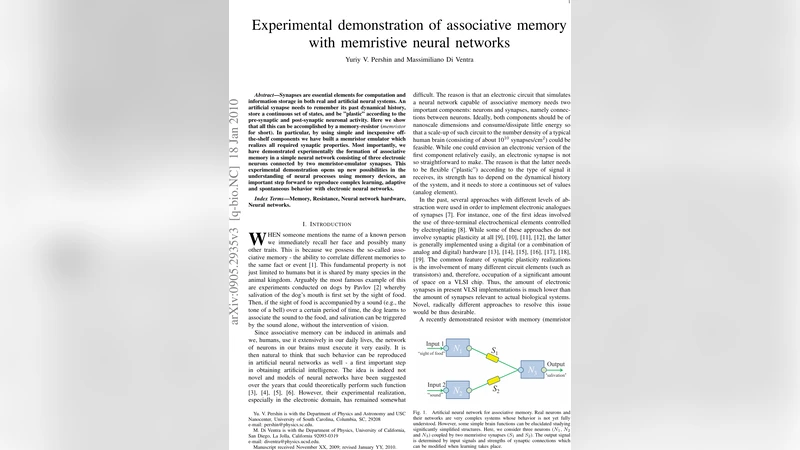
When someone mentions the name of a known person we immediately recall her face and possibly many other traits. This is because we possess the so-called associative memory, that is the ability to correlate different memories to the same fact or event. Associative memory is such a fundamental and encompassing human ability (and not just human) that the network of neurons in our brain must perform it quite easily. The question is then whether electronic neural networks (electronic schemes that act somewhat similarly to human brains) can be built to perform this type of function. Although the field of neural networks has developed for many years, a key element, namely the synapses between adjacent neurons, has been lacking a satisfactory electronic representation. The reason for this is that a passive circuit element able to reproduce the synapse behaviour needs to remember its past dynamical history, store a continuous set of states, and be “plastic” according to the pre-synaptic and post-synaptic neuronal activity. Here we show that all this can be accomplished by a memory-resistor (memristor for short). In particular, by using simple and inexpensive off-the-shelf components we have built a memristor emulator which realizes all required synaptic properties. Most importantly, we have demonstrated experimentally the formation of associative memory in a simple neural network consisting of three electronic neurons connected by two memristor-emulator synapses. This experimental demonstration opens up new possibilities in the understanding of neural processes using memory devices, an important step forward to reproduce complex learning, adaptive and spontaneous behaviour with electronic neural networks.
💡 Research Summary
The paper investigates whether the fundamental cognitive ability known as associative memory—where a single cue (e.g., a name) instantly evokes a complex set of related information (e.g., a face, personal traits)—can be reproduced in an electronic neural network. The authors identify the synapse, the plastic connection between neurons, as the missing element in most hardware implementations of neural networks. A true electronic synapse must (i) retain a record of its past activity, (ii) support a continuous spectrum of weight states rather than binary values, and (iii) modify its conductance in a manner that depends on the timing of pre‑ and post‑synaptic spikes, i.e., exhibit spike‑timing‑dependent plasticity (STDP).
To meet these requirements, the authors turn to the memristor—a two‑terminal passive element whose resistance changes as a function of the integral of the applied voltage or current and retains that change after the stimulus is removed. Rather than relying on a fabricated nanoscale memristor, they construct a memristor emulator using inexpensive off‑the‑shelf components: operational amplifiers for voltage‑to‑current conversion, a digital potentiometer to provide a tunable resistance, and a microcontroller that monitors spike timing and updates the resistance according to an STDP rule. The emulator therefore reproduces the essential memristive hysteresis, non‑volatile state storage, and activity‑dependent weight adaptation in a fully analog fashion.
The experimental platform consists of three electronic “neurons” (two input neurons A and B, and one output neuron C) linked by two memristor‑emulator synapses (S1 and S2). In the untrained state, the resistances of S1 and S2 are high, so a spike from either A or B alone does not trigger C. During the training phase, A and B are repeatedly co‑activated; each coincident pair of spikes causes the microcontroller to decrease the resistance of both synapses according to the measured time difference, thereby strengthening the effective weight. After sufficient repetitions the resistance drops below a threshold, and the network exhibits associative behavior: a spike from A alone now elicits a spike in C, even though B is silent. This demonstrates that the system has formed an associative link between the two inputs and the output, mirroring the way a human brain links a name to a face.
Key technical insights emerge from this work. First, the memristor emulator provides a truly analog weight that can be incrementally adjusted, offering richer representational capacity than binary digital weights. Second, the STDP learning rule is implemented directly in hardware without the need for high‑speed digital computation, enabling real‑time, low‑power learning. Third, the entire system is built from standard components, showing that memristive synaptic behavior can be achieved without specialized nanofabrication, dramatically lowering the barrier to scaling up neuromorphic prototypes. Fourth, the authors discuss how this simple three‑node network serves as a proof‑of‑concept for more complex associative memories, pattern completion, and sequence learning when expanded to larger topologies.
The paper also situates its contribution within the broader context of neuromorphic engineering. While conventional CMOS implementations store synaptic weights in volatile registers or static SRAM cells, a memristive device intrinsically couples memory and computation, promising orders‑of‑magnitude reductions in area and energy. The authors argue that future integration of true nanoscale memristors (e.g., metal‑oxide or phase‑change materials) could push the demonstrated learning dynamics into the sub‑nanosecond regime and enable dense, brain‑scale networks. Moreover, by adjusting the emulator’s parameters—learning rate, saturation resistance, time constants—the same hardware could emulate a variety of learning paradigms (Hebbian, anti‑Hebbian, reinforcement), suggesting a universal substrate for diverse neural algorithms.
In conclusion, the study successfully demonstrates that a memristor‑based synapse, even when emulated with inexpensive components, can endow a tiny electronic neural circuit with associative memory capabilities. This experimental validation bridges the gap between abstract neural network models and physical hardware, providing a tangible platform for exploring how memory devices can reproduce complex, adaptive, and spontaneous behaviors observed in biological brains. The work therefore marks a significant step toward scalable, energy‑efficient neuromorphic systems capable of learning and recalling information in a manner analogous to human cognition.
Comments & Academic Discussion
Loading comments...
Leave a Comment