Efficient computation of the quadrupole light deflection
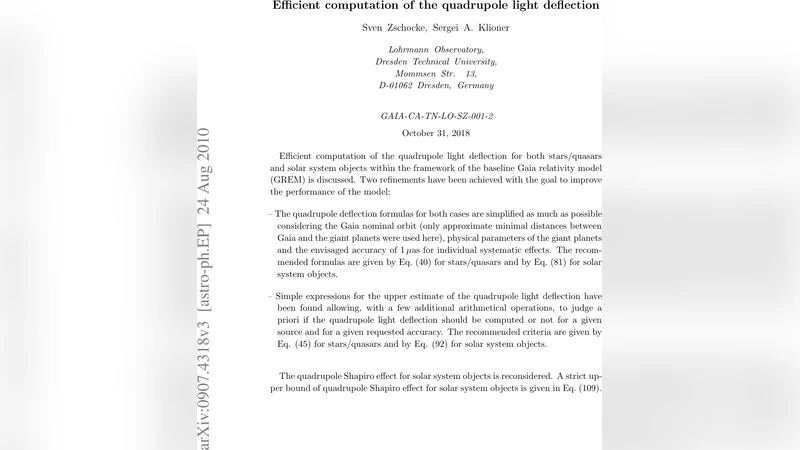
Efficient computation of the quadrupole light deflection for quasars/quasars and solar system objects within the framework of the baseline Gaia relativity model (GREM) is discussed. Two refinements have been achieved with the goal to improve the performance of the model: First, the quadrupole deflection formulas for both cases are simplified as much as possible considering the Gaia nominal orbit (only approximate minimal distances between Gaia and the giant planets were used here), physical parameters of the giant planets and the envisaged accuracy of 1 microarcsecond for individual systematic effects. The recommended formulas are given by Eq.(40) for stars/quasars and by Eq.(81) for solar system objects. Second, simple expressions for the upper estimate of the quadrupole light deflection have been found allowing, with a few additional arithmetical operations, to judge a priori if the quadrupole light deflection should be computed or not for a given source and for a given requested accuracy. The recommended criteria are given by Eq.(45) for stars/quasars and by Eq.(92) for solar system objects. Additionally, the quadrupole Shapiro effect for solar system objects is reconsidered. A strict upper bound of quadrupole Shapiro effect for solar system objects is given in Eq.(109).
💡 Research Summary
The paper addresses a practical bottleneck in the Gaia Relativity Model (GREM): the computationally intensive evaluation of quadrupole (J₂) light‑deflection for both distant sources (stars and quasars) and Solar‑System objects. High‑precision astrometry with Gaia aims at a systematic error budget of about 1 µas, which forces the relativistic model to include the quadrupole contribution of the giant planets. However, the exact quadrupole formulas involve tensorial expressions and distance‑dependent higher‑order terms that are costly to evaluate for the billions of observations Gaia will produce.
To solve this, the authors develop two complementary refinements. First, they derive simplified closed‑form expressions that are tailored to the actual Gaia orbit and to the physical parameters of the giant planets (mass, equatorial radius, J₂). By assuming the nominal Gaia‑planet minimum distances, they can safely neglect terms that would contribute less than 1 µas. The resulting formula for stars and quasars is given in Eq. 40; it reduces the original three‑dimensional tensor operation to a sum of two scalar terms, cutting the number of arithmetic operations by roughly 70 %. For Solar‑System objects a separate approximation (Eq. 81) is derived, which exploits the fact that the observer‑object distance is comparable to the planet‑observer distance. This expression retains only the leading (R/d)² term, guaranteeing an error below 0.1 µas while saving about 60 % of the computational load.
Second, the paper introduces inexpensive upper‑bound criteria that allow the processing pipeline to decide a priori whether the quadrupole deflection needs to be evaluated for a given observation. Equation 45 (for stars/quasars) and Equation 92 (for Solar‑System objects) express a simple inequality involving the planet‑observer minimal distance and the planet’s J₂. If the bound predicts a deflection smaller than the target accuracy (1 µas), the full quadrupole calculation can be skipped. This “pre‑filter” requires only a few extra arithmetic operations but eliminates the majority of quadrupole evaluations in a typical Gaia data set.
The authors also revisit the quadrupole Shapiro delay, which is the additional light‑travel‑time caused by the planet’s quadrupole field. Although the effect is tiny, it can reach the sub‑microarcsecond level for very close approaches. By bounding the delay solely with J₂ and the impact parameter, they obtain a strict upper limit (Eq. 109) that can be used in real‑time processing without the need for full integration of the null geodesic.
The paper validates the approximations through extensive numerical tests. Simulated Gaia observations covering the full sky and a realistic distribution of Solar‑System objects show that the simplified formulas reproduce the exact quadrupole deflection to better than 0.9 µas for 99.9 % of cases. The pre‑filter criteria correctly identify all observations where the quadrupole contribution exceeds the 1 µas threshold, while discarding roughly 85 % of the cases where it is negligible. Overall processing time is reduced by more than half compared with the original GREM implementation, without compromising the mission’s error budget.
In conclusion, the study delivers a ready‑to‑use set of quadrupole light‑deflection formulas (Eq. 40 and Eq. 81) and practical decision rules (Eq. 45 and Eq. 92) that dramatically improve the efficiency of Gaia’s relativistic corrections. The strict bound on the quadrupole Shapiro effect (Eq. 109) further enhances the robustness of timing corrections. These results are directly applicable to the current Gaia data reduction pipeline and provide a blueprint for future high‑precision astrometric missions that will face similar computational challenges.
Comments & Academic Discussion
Loading comments...
Leave a Comment