Congestion in planar graphs with demands on faces
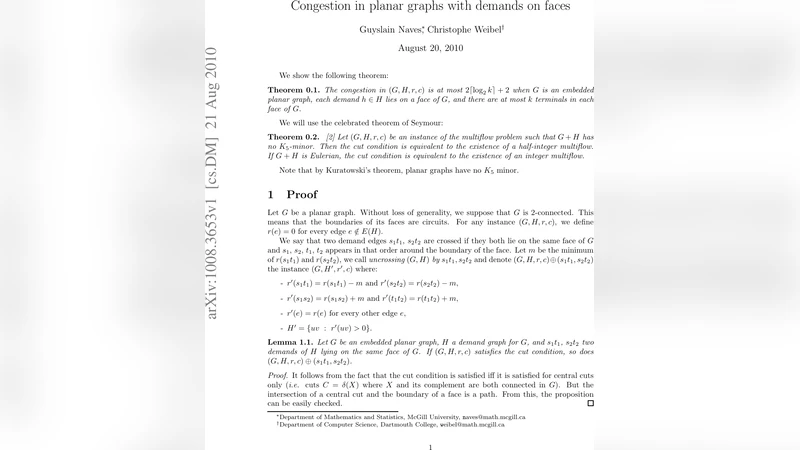
We give an algorithm to route a multicommodity flow in a planar graph $G$ with congestion $O(\log k)$, where $k$ is the maximum number of terminals on the boundary of a face, when each demand edge lie on a face of $G$. We also show that our specific method cannot achieve a substantially better congestion.
💡 Research Summary
The paper studies the multicommodity flow problem in a planar graph G where every demand edge lies entirely on a single face of G. Let k be the maximum number of terminals that appear on the boundary of any face. The authors present an algorithm that routes all demands with congestion at most 2⌈log₂ k⌉ + 2, i.e., O(log k).
The core tool is Seymour’s theorem: in a K₅‑minor‑free graph (hence any planar graph), the cut condition is equivalent to the existence of a half‑integral flow, and if the graph is Eulerian, to an integral flow. Starting from an instance that satisfies the cut condition, the algorithm processes each face independently. For a face F with terminals u₁,…,u_m ordered around the boundary, the set is split into a left part L and a right part R (roughly half each). Demands whose endpoints lie in opposite parts are called bilateral. The algorithm repeatedly selects a pair of crossing bilateral demands, reduces both by their minimum capacity m, and replaces them with two non‑crossing demands (uncrossing). This operation preserves the cut condition (Lemma 1.1). After all crossings are eliminated, every remaining demand on F has both endpoints in the same side, so the face can be “split” by adding a zero‑capacity edge between the two middle terminals. This creates two new faces, each containing at most half the original number of terminals.
Applying Seymour’s theorem to the modified instance (which now has a planar graph G + H_F with doubled capacities) yields an integer flow with congestion 2. Because each uncrossing step incurs a factor 2 in the graph size, after ⌈log₂ k⌉ iterations the number of terminals per face drops to 1, and the total congestion accumulated is 2⌈log₂ k⌉ + 2, establishing Theorem 0.1.
The second part of the paper proves that this approach cannot be substantially improved by merely invoking Seymour’s theorem repeatedly. Assuming we apply the theorem c times to a face with n terminals, each application can produce at most C_n (non‑crossing) planar demand graphs, where C_n is the nth Catalan number. Counting the total number of possible demand graphs (≈ (2n)!/(n! 2ⁿ)) and comparing it with the number of graphs obtainable after c applications (bounded by m^{2nc}·C_n^c, with m≈(2c)!/(c! 2^c)), the authors show that to cover all possible demand instances one needs c = Ω(log n log log n). Consequently, the logarithmic congestion bound is essentially tight for methods based solely on Seymour’s theorem.
In summary, the paper delivers a constructive O(log k) congestion algorithm for planar multicommodity flow with face‑restricted demands and demonstrates, via combinatorial counting arguments, that the technique’s reliance on Seymour’s theorem imposes a near‑optimal lower bound on achievable congestion.
Comments & Academic Discussion
Loading comments...
Leave a Comment