On disjoint paths in acyclic planar graphs
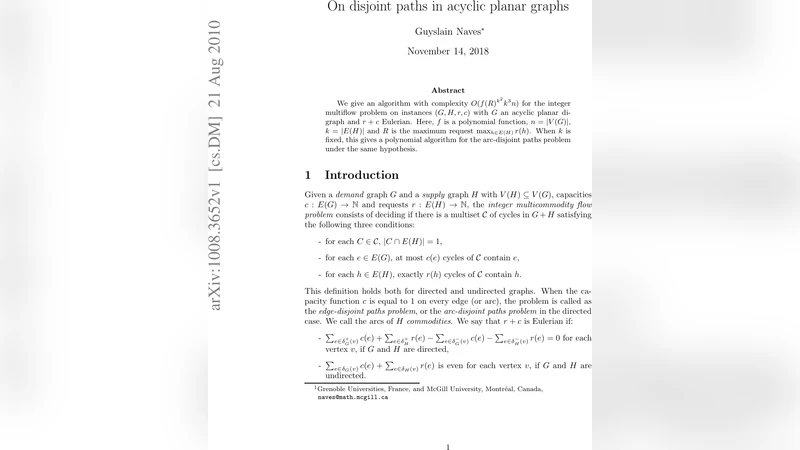
We give an algorithm with complexity $O(f(R)^{k^2} k^3 n)$ for the integer multiflow problem on instances $(G,H,r,c)$ with $G$ an acyclic planar digraph and $r+c$ Eulerian. Here, $f$ is a polynomial function, $n = |V(G)|$, $k = |E(H)|$ and $R$ is the maximum request $\max_{h \in E(H)} r(h)$. When $k$ is fixed, this gives a polynomial algorithm for the arc-disjoint paths problem under the same hypothesis.
💡 Research Summary
The paper addresses the integer multiflow problem on a very specific class of directed graphs: planar acyclic digraphs whose demand and capacity functions together satisfy an Eulerian condition (the total inflow equals total outflow at every vertex). Formally, an instance consists of a planar acyclic digraph G, a demand graph H with k arcs, a non‑negative integer demand function r on the arcs of H, and a capacity function c on the arcs of G. The goal is to route r(h) pairwise arc‑disjoint paths for each demand arc h∈E(H) such that the number of paths using any arc a∈E(G) does not exceed c(a).
The authors first exploit the planar embedding of G to construct its dual graph. Because G is acyclic, every feasible flow can be interpreted as a circulation in the dual: each unit of demand corresponds to a unit of flow that traverses a sequence of faces from the source face to the sink face. The Eulerian hypothesis guarantees that the total demand can be expressed as a sum of such circulations without violating flow conservation.
The central technical contribution is a homotopy‑based enumeration of possible routes. In a planar setting, a path’s “type” can be captured by the sequence of faces it crosses; two paths are homotopic if they separate the same set of faces. Acyclicity forces all paths to be monotone with respect to a topological ordering, which dramatically limits the number of distinct homotopy classes. For each demand arc h, the algorithm enumerates all homotopy classes that could carry up to R = max_{h} r(h) units of flow. The number of classes is bounded by a function f(R)^{k²}, where f is a polynomial in R.
Having enumerated the classes, the algorithm proceeds with a dynamic programming (DP) scheme that processes the arcs of G in a topological order. The DP state records, for each arc, how many units of flow have already been assigned to each homotopy class. Transition steps check whether adding another unit from a given class respects the capacity c(a). Because each transition involves at most k³ operations (the cube stems from handling interactions among up to k demands), the overall running time becomes O(f(R)^{k²} k³ n), where n = |V(G)|.
When k (the number of demand arcs) is treated as a fixed constant, the factor f(R)^{k²} collapses to a polynomial in R, yielding a polynomial‑time algorithm in the size of the input graph. Consequently, the same algorithm solves the special case where every demand equals 1, i.e., the arc‑disjoint paths problem, under the identical structural assumptions.
The paper proves two main theorems. The first establishes correctness: any feasible integer multiflow respecting the Eulerian condition can be transformed into a collection of homotopy‑class assignments that the DP will accept, guaranteeing that the algorithm never discards a valid solution. The second theorem provides the complexity bound and shows that for constant k the algorithm runs in polynomial time.
In the discussion, the authors outline several avenues for future work. One direction is to relax the acyclicity requirement and investigate whether a similar homotopy‑DP framework can handle general planar digraphs, possibly by decomposing cycles or using more sophisticated dual‑graph techniques. Another is to consider non‑integral capacities or to drop the Eulerian condition, which would require new ways to enforce flow conservation without the convenient circulation interpretation. Finally, they note that the exponential dependence on k² in the current bound may be improvable; reducing this exponent could make the method practical for moderate values of k and larger demand magnitudes.
Overall, the paper contributes a novel algorithmic paradigm that combines planar duality, homotopy classification, and dynamic programming to solve integer multiflow and arc‑disjoint paths problems on a non‑trivial class of graphs. The result bridges a gap between fixed‑parameter tractability results known for general planar graphs and polynomial‑time algorithms for highly restricted settings, opening the door to new applications in network routing, VLSI design, and planar logistics where the underlying graph is naturally acyclic and Eulerian.
Comments & Academic Discussion
Loading comments...
Leave a Comment